Steel Fabrication Workshop License Saudi Arabia 2026
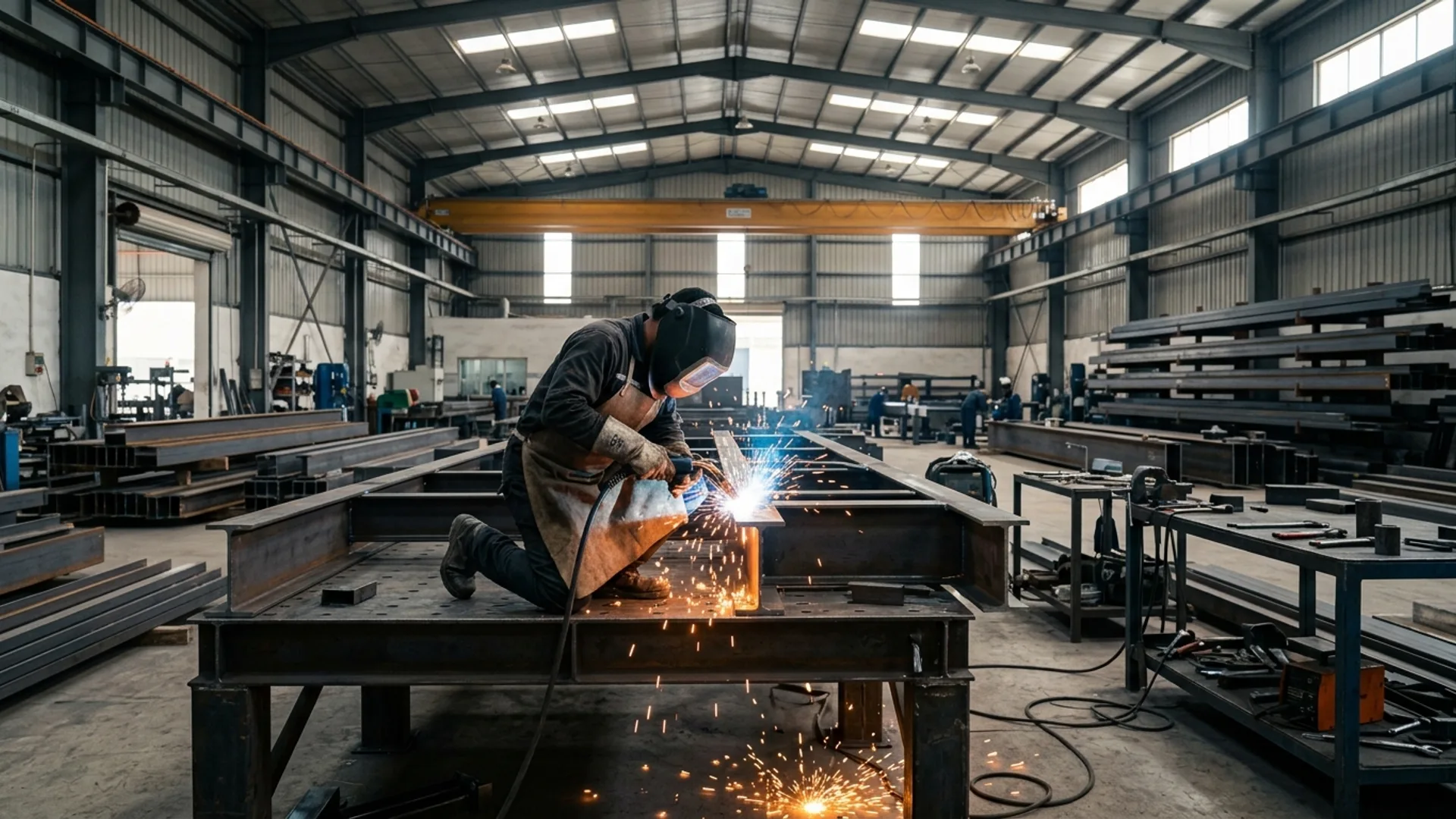
A steel fabrication or metal workshop in Saudi Arabia needs a commercial registration that names the activity, Civil Defense approval and then a Balady municipal licence; under the Ministry of Municipalities and Housing rules, ironwork and aluminium workshops are medium-risk, must sit in an industrial or workshop zone and need at least 100 m2 per activity. If you plan to manufacture at factory scale, the Ministry of Industry and Mineral Resources industrial licence applies instead: it is valid for 1 year and does not allow production until the later stages are approved.
This guide is written for founders and foreign investors who want to open a steel fabrication, ironwork or aluminium workshop in the Kingdom in 2026. It explains the decision that shapes everything else (workshop licence or industrial licence), the approvals in the order you will meet them, the location and area rules that catch most applicants, and the costs that are fixed by the government versus the ones you must confirm on the portal on the day you apply.
Workshop or factory: the decision that sets your licensing route
Metal businesses in Saudi Arabia follow one of two regulatory routes, and the choice is driven by what you actually do on the floor, not by the name you put on the sign.
- The professional workshop route. Cutting, welding, bending and assembling steel or aluminium for doors, gates, railings, shades, frames, window systems and similar custom work, usually made to order for individual clients and contractors. This is licensed by the municipality through the Balady platform under the Ministry of Municipalities and Housing (MOMAH) requirements for professional workshops.
- The industrial route. Series production of structural steel, pre-engineered buildings, steel products or aluminium profiles at factory scale, with production lines, raw material imports and output that is sold as a manufactured product. This is licensed by the Ministry of Industry and Mineral Resources (MIM) through its industrial licence, usually inside an industrial city or a licensed industrial plot.
| Point of comparison | Professional metal workshop | Steel fabrication factory |
|---|---|---|
| Main licensing authority | MOMAH, through Balady and the local amanah or municipality | Ministry of Industry and Mineral Resources (industrial licence) |
| Risk class in MOMAH rules | Industrial professional workshop, medium risk (F1) | Outside the workshop rules; industrial licensing applies |
| Where it can operate | Industrial areas and designated workshop and support-services areas | Industrial cities or plots approved for industrial use |
| Minimum area | 100 m2 per activity in industrial areas | Set by the industrial project and the plot allocation |
| Key safety step | Civil Defense approval before the municipal licence is issued | Civil Defense plus the industrial stages (establishment, construction, production) |
| First licence validity | Municipal licence valid 1 to 5 years, chosen on Balady | Initial industrial licence valid 1 year, no production allowed |
| Expat levy position | Standard expat levy rules apply | Industrial-licensed establishments pay no expat levy since 17 December 2025 |
Many founders start with a workshop and move to an industrial licence once volumes justify a production line. That is a legitimate path, but the two routes have different premises requirements, so pick the site with the next three years in mind rather than the next three months.
Who can own a steel fabrication business in Saudi Arabia
Saudi and GCC nationals can register the activity directly with the Ministry of Commerce. Foreign investors can hold 100% of a company in most activities, except those on the prohibited or restricted list published by the Ministry of Investment (MISA). Metal fabrication and the manufacture of metal products are not trading activities, so the separate capital rules that apply to 100% foreign-owned trading companies do not apply to a fabrication business that makes what it sells.
Under the Investment Law in force since February 2025, foreign investors now register with MISA (investment registration, formerly called the MISA licence). MISA notifies registration within 10 working days of a complete file, and an annual update replaces the old renewal. The registration and update fees are determined by the ministry upon approval, so treat any figure you see quoted elsewhere with caution. There is no general minimum capital for an LLC, but the capital you declare should match the equipment, premises and payroll you plan, because banks, landlords and MIM will read it as a signal of how real the project is.
For the full structure decision (LLC, branch of a foreign company or joint stock company), see our guide to company formation in Saudi Arabia, and for the investor registration file in detail, our MISA registration guide.
Approvals in order: the sequence for a metal workshop
The order matters because each authority checks the output of the one before it. Applying out of order is the main reason files bounce between portals.
- MISA investment registration (foreign investors). File the investor documents and receive registration, normally within 10 working days of a complete file.
- Trade name and commercial registration with the Ministry of Commerce. Reserve the trade name (SAR 200 for an Arabic name, SAR 500 for an English name) and register the company. For an LLC the CR fee is SAR 1,200 plus SAR 500 publication plus 15% VAT. The CR must include the metal fabrication or workshop activity you will license.
- Premises in a permitted zone. Lease or buy a unit inside an industrial area or a designated workshop zone, register the lease on Ejar and obtain the national address for the site.
- Civil Defense safety licence. Apply through the Salamah portal (accessed via Absher Business). MOMAH rules state plainly that Civil Defense approval must be obtained before the municipal licence is issued.
- Balady municipal licence. Apply on the Balady platform with the valid CR, the Civil Defense approval and any approval required by the authority that supervises the activity. Choose a licence term of 1 to 5 years.
- Chamber of Commerce, ZATCA, Qiwa and GOSI. Register the establishment on Qiwa and GOSI before hiring, complete the ZATCA tax registration, and note that Chamber membership has no subscription for the first 3 years after CR registration.
The factory route adds MIM steps after the CR: the initial industrial licence, then the upgrade to the establishment and construction stage, then the upgrade to production once the plant is built and inspected. We cover those stages below.
MOMAH workshop requirements for ironwork and aluminium
The municipal requirements for professional workshops, published by MOMAH and available on the ministry website (PDF, Arabic) and on Balady, apply to low and medium-risk professional workshops that the ministry supervises. MOMAH announced an update to these workshop requirements in October 2025, covering site, construction, fire protection, health and technical operating requirements. Three parts of the document matter most for a metal business.
Classification
The rules split professional workshops into two groups. Light professional workshops are low risk (F2) and cover installation, repair and light maintenance, such as jewellery, watch, phone and appliance repair. Industrial professional workshops are medium risk (F1) and cover manufacturing, assembly and installation that may cause a medium hazard or limited pollution. The rules list carpentry, ironwork (حدادة) and aluminium workshops by name in the industrial group. A steel fabrication workshop is therefore an F1 industrial professional workshop.
Location and area
- Inside the urban boundary, industrial professional workshops may operate in industrial areas and in designated workshop and support-services areas. Commercial streets are open to light workshops, not to ironwork or aluminium.
- Outside the urban boundary, the approved building system for that area applies.
- The minimum workshop area for an industrial professional workshop is 100 m2 per activity in industrial areas. Running ironwork and aluminium as two activities in one unit means planning for both.
- For a standalone workshop in a workshop or industrial area, the minimum front setback is 6 m, and parking, building ratio and landscaping follow the building system of the area.
Additional activities on the same site
You can add ministry-approved additional activities after approval by the supervising authority, provided the total area of the added activities does not exceed 50% of the licensed area, the main activity keeps its minimum area, and each added activity has at least 6 m2. This is useful if you want a small showroom or a powder-coating corner, but it has to be planned into the layout before you apply, not squeezed in afterwards.
The same document requires compliance with the Saudi Fire Protection Code, waste control and site cleanliness, and the ministry’s signage rules. Our broader guide to the Balady municipal licence explains the platform itself.
Civil Defense: the safety licence comes before the municipal licence
Welding, cutting, grinding, gas cylinders and paint or coating materials all raise the fire risk profile of a metal workshop, which is why the Civil Defense step is not a formality. The General Directorate of Civil Defense issues the safety licence electronically through its Salamah portal, which is open to establishments with a valid commercial registration and is reached through Absher Business. Renewal is also handled online.
In practice, the Civil Defense file for a metal workshop depends on the floor area, the number of workers, the storage of gas and flammable materials, and the fire detection and suppression systems installed. Plan the following before you sign the fit-out contract:
- Fire extinguishers matched to the hazard (metal, electrical and general), placed and tagged as the code requires.
- Safe storage for oxygen, acetylene or other welding gas cylinders, secured upright and away from ignition sources.
- Clear emergency exits, signage and lighting, and no blocked escape routes from stored stock.
- Ventilation and fume extraction for welding and cutting areas.
- Electrical installation suited to heavy machinery, with proper earthing.
Civil Defense fees and inspection requirements vary by activity and area, so confirm them on the official portal when you apply.
The factory route: MIM industrial licence for steel fabrication
If your plan is a production plant (structural steel, pre-engineered buildings, steel products or aluminium profiles at scale), the core licence is issued by the Ministry of Industry and Mineral Resources. According to the MIM service page for issuing an industrial licence:
- The industrial licence is a document that lets the industrial investor start completing the requirements to establish the industrial project.
- It is valid for one year and does not entitle the holder to start production.
- The condition is a valid commercial registration that includes the industrial activity, and the required document is that valid CR.
- The applicant acknowledges the GCC Unified Industrial Regulation (1427H).
- MIM’s service card lists 30 to 90 days to process the application, through the web channel.
After the initial licence, the project moves through the establishment and construction stage and then the upgrade to production once the plant, machinery and approvals are in place. Industrial plots are usually allocated by MODON (the Saudi Authority for Industrial Cities and Technology Zones) or by the relevant special zone, and the plot allocation, building permit and Civil Defense approvals run alongside the MIM stages. For the stage-by-stage detail, see our industrial licence guide and, for later years, the industrial licence renewal guide.
The commercial difference between the routes is significant. Since 17 December 2025, establishments holding an industrial licence pay no expat levy, while a workshop licensed through Balady follows the standard levy rules. For a fabrication business with a large welding and fitting team, that alone can decide which route makes sense once the order book is stable.
Costs and timelines in 2026
Government fees below are taken from the official sources named in this guide. Items marked “confirm on the portal” are calculated by the system at the time of application and change with area, activity and term, so we do not print a figure for them.
| Item | Authority | Government fee (2026) | Typical timing |
|---|---|---|---|
| Trade name reservation | Ministry of Commerce | SAR 200 (Arabic) or SAR 500 (English) | Electronic, through the Saudi Business Center |
| CR for an LLC | Ministry of Commerce | SAR 1,200 + SAR 500 publication + 15% VAT | Issued electronically once the file is complete |
| Investment registration (foreign investors) | MISA | Determined by the ministry upon approval | Within 10 working days of a complete file |
| Civil Defense safety licence | General Directorate of Civil Defense (Salamah) | Confirm on the portal | Depends on inspection and site readiness |
| Balady municipal licence | MOMAH / amanah | Calculated on Balady under the Municipal Services Fees Regulation | Term of 1 to 5 years |
| Initial industrial licence (factory route) | MIM | Confirm on the portal | 30 to 90 days per the MIM service card; valid 1 year |
| Chamber of Commerce | Chamber | No subscription for the first 3 years, then SAR 200 to 5,000 a year by class | Annual after year 3 |
| Annual CR confirmation | Ministry of Commerce | SAR 1,200 for an LLC | Every 12 months |
Two points on the commercial registration that founders often miss. First, under the Commercial Register Law in force since 3 April 2025, the CR has no expiry date but must be confirmed every 12 months; a CR that is not confirmed within 90 days of the due date is suspended. Second, the CR number is now the unified national number starting with 7, which every other portal (Balady, Salamah, Qiwa, GOSI, ZATCA) reads. You can read the ministry announcement on mc.gov.sa.
Beyond government fees, the real budget for a metal workshop is the premises (rent in industrial and workshop zones varies widely by city and plot), the fit-out for fire safety and ventilation, machinery, and the payroll for welders, fitters and a supervisor. Build a 12-month cash plan that covers those before the first invoice is paid, because municipal and Civil Defense approvals are tied to a site that is ready to inspect.
Hiring welders and fitters: Qiwa, GOSI and Nitaqat
A fabrication workshop is labour-intensive, so the employment set-up needs the same care as the licence. Once the CR is issued, register the establishment on Qiwa (the Ministry of Human Resources and Social Development platform) and on GOSI, then request work visas and contracts through Qiwa as you hire. Employment contracts are documented on Qiwa and wages are protected through the Wage Protection System.
Nitaqat, the Saudization programme, places each establishment in one of five ranges: Red, Low Green, Medium Green, High Green and Platinum, based on the share of Saudi employees for its activity and size. Your range affects services such as new visas and transfers, so plan Saudi hiring for supervisory, administrative, sales and quality roles from the start rather than waiting for a visa request to be declined. Workshop staff also need the safety training and personal protective equipment that Civil Defense and the occupational safety rules expect.
Installing steel on client sites: when contracting rules apply
Many workshops fabricate in their own unit and also install on site: erecting steel structures, cladding, railings or aluminium facades for contractors and building owners. Installation work on a construction project is contracting activity, and government and many large private projects ask for a contractor classification certificate. If site installation is a core part of your revenue, include the right contracting activities in the CR from the outset and read our guide to the contractor classification certificate, which explains the grades and the file. Keeping fabrication and installation activities aligned in the CR avoids an amendment later, when a tender deadline is already running.
Common mistakes to avoid
- Signing a lease on a commercial street. Ironwork and aluminium are industrial professional workshops and belong in industrial or designated workshop areas. A cheap unit on a retail street cannot be licensed for this activity.
- Taking a unit below 100 m2 per activity. If you plan ironwork and aluminium in one unit, check the area against both activities before you pay a deposit.
- Applying to Balady before Civil Defense. The municipal licence is issued after Civil Defense approval, so start the safety file in parallel with the fit-out.
- A CR without the right activity. Balady, Salamah and MIM all read the activities on the commercial registration. A generic activity leads to rejection and a paid amendment.
- Choosing the workshop route for a factory-scale plan. If you intend series production, an industrial licence and an industrial plot are the right base, and the expat levy position since 17 December 2025 can change the economics.
- Treating the initial industrial licence as permission to produce. MIM states that the first licence is valid for one year and does not entitle the holder to start production.
- Forgetting the annual CR confirmation. The CR no longer expires, but missing the 12-month confirmation leads to suspension after 90 days, which blocks every other portal.
- Relying on quoted fee ranges. Balady and Civil Defense amounts are calculated by the system for your site and term. Budget with the portal figure, not a number from a forum.
How Noble Core helps you open a metal workshop in Saudi Arabia
Noble Core works with founders and foreign investors on the full set-up: MISA investment registration, the trade name and commercial registration with the right fabrication and installation activities, the Civil Defense and Balady files, and the Qiwa, GOSI and ZATCA registrations that follow. For factory-scale projects, we prepare the industrial licence application and coordinate the stages with your engineering consultant. We complete the procedures on your behalf, so you can focus on equipment, people and orders.
Share your plan (workshop or factory, the city you are considering and the activities you need) and our team will map the route and the document list for you. Talk to a Noble Core consultant on WhatsApp.
Need help setting up in Saudi Arabia? Noble Core handles your MISA licence, commercial registration, and visas end-to-end, done right the first time.
Frequently Asked Questions
Do I need a license to open a steel fabrication workshop in Saudi Arabia?
Yes. You need a commercial registration that includes the metal workshop activity, a Civil Defense safety licence and a Balady municipal licence. Under MOMAH rules, ironwork and aluminium workshops are medium-risk industrial professional workshops, so they must operate in an industrial area or a designated workshop zone with at least 100 m2 per activity.
Can a foreigner own 100% of a metal fabrication business in Saudi Arabia?
In most cases, yes. Foreign investors can hold 100% of a company in most activities except those on MISA’s prohibited or restricted list. The investor registers with MISA, which notifies registration within 10 working days of a complete file, and then registers the company with the Ministry of Commerce before applying for the safety and municipal licences.
What is the minimum area for an ironwork or aluminium workshop?
The MOMAH professional workshop requirements set a minimum of 100 m2 per activity for industrial professional workshops in industrial areas. If you run ironwork and aluminium as two activities in the same unit, plan the area for both. Additional activities may not exceed 50% of the licensed area, and each needs at least 6 m2.
Can I open a steel workshop on a commercial street?
No. The MOMAH rules allow light workshops, such as phone or appliance repair, on commercial streets, but industrial professional workshops, including ironwork and aluminium, must sit in industrial areas or designated workshop and support-services areas inside the urban boundary. Check the zoning of the plot before you sign a lease or pay a deposit.
Is Civil Defense approval required before the Balady licence?
Yes. The MOMAH workshop requirements state that Civil Defense approval must be obtained before the municipal licence is issued. The safety licence is issued through the Salamah portal, reached via Absher Business, for establishments with a valid commercial registration. Start the safety file during fit-out so the inspection is not the step that delays opening.
When do I need an MIM industrial license instead of a workshop license?
When you plan factory-scale production, such as structural steel, pre-engineered buildings or aluminium profiles sold as manufactured products. MIM’s initial industrial licence requires a valid CR that includes the industrial activity, is valid for one year and does not allow production until the project is upgraded through the establishment and production stages.
How long does it take to get a steel fabrication license in Saudi Arabia?
It depends on the route and on site readiness. MISA registration is notified within 10 working days of a complete file, and the Ministry of Commerce issues the CR electronically. Civil Defense and Balady timing follows inspection of a ready site. For the factory route, the MIM service card lists 30 to 90 days for the initial industrial licence.
Do steel fabrication companies pay the expat levy in Saudi Arabia?
A workshop licensed through Balady follows the standard expat levy rules. Since 17 December 2025, establishments holding an industrial licence from the Ministry of Industry and Mineral Resources pay no expat levy. For a fabrication business with a large welding team, this can be a deciding factor when choosing between the workshop and factory routes.