Saudi Arabia vs UAE Business Setup 2026: Comparison
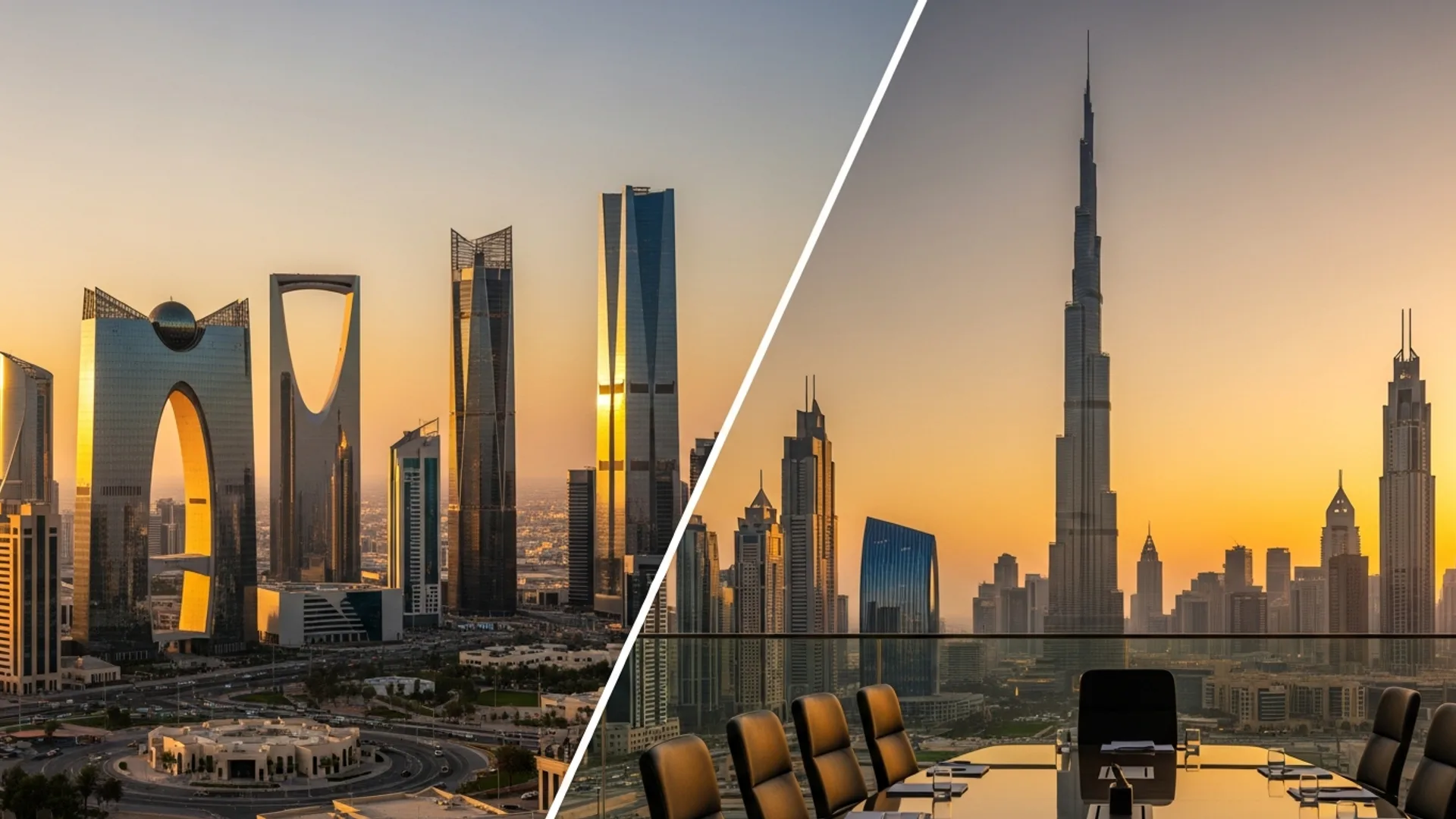
Both Saudi Arabia and the UAE now allow 100% foreign ownership in most activities, and both license fast — so the choice is about strategy, not access. Saudi Arabia offers the Gulf’s largest economy and a fast-growing domestic market of roughly 37 million people, while the UAE offers a 9% headline corporate tax, a 5% VAT, and a re-export hub. Many founders ultimately choose both. This 2026 guide compares them side by side so you can decide where — and whether — to build.
We look at market size, ownership, tax, setup cost and speed, talent and localization, the sectors each rewards, when to pick each, and how to run a presence in both Kingdoms-and-Emirates at once.
Saudi Arabia vs UAE at a glance (2026)
Each market has genuine, distinct strengths. Saudi Arabia is the demand engine of the Gulf — the biggest population and the largest Vision 2030 spending programme. The UAE is the region’s connector — a low-tax base that re-exports to the wider Middle East, Africa, and South Asia. The table below summarises the headline differences; the sections after it explain each in depth.
| Factor | Saudi Arabia (KSA) | United Arab Emirates (UAE) |
|---|---|---|
| Population / market size | ~37 million — largest Gulf market and economy | ~10 million — affluent, highly international |
| Foreign ownership | 100% in most activities (MISA investment licence) | 100% in most mainland activities + free zones |
| Corporate income tax | 20% on the foreign-owned share of profits | 9% above AED 375,000 profit (0% below) |
| Zakat | 2.5% on the Zakat base for Saudi/GCC-owned share | Not applicable |
| VAT | 15% | 5% |
| Localization programme | Saudization (Nitaqat) — continuous, band-based | Emiratisation — point-in-time MoHRE checks |
| Licensing speed | MISA licence typically 3–10 business days | Mainland/free-zone often 1–5 business days |
| Best for | Serving the large domestic Saudi market; megaprojects | Regional HQ, holding, trading and re-export hub |
Tax and fee figures are indicative for 2026 — always confirm current rates on the official ZATCA, MISA, and UAE Federal Tax Authority portals before you decide.
Market size and growth: the two engines of the Gulf
Saudi Arabia is the largest economy and the largest consumer market in the Gulf, with a population of roughly 37 million and a young, fast-urbanising demographic. Under Vision 2030, the Kingdom is channelling enormous investment into non-oil sectors — tourism, entertainment, logistics, manufacturing, healthcare, technology and giga-projects such as NEOM, the Red Sea, Diriyah and Qiddiya. For a company that wants to serve customers at scale, Saudi Arabia is unmatched in the region for sheer domestic demand.
The UAE, with a population near 10 million, is smaller but exceptionally affluent, open and international. Its strength is connectivity: world-class ports and airports, a deep professional-services ecosystem, and decades of experience as a re-export and regional-headquarters hub. Where Saudi Arabia is the destination market, the UAE is often the launchpad and control tower for the wider Middle East, Africa and South Asia. Neither is “better” — they answer different questions.
Ownership: both now allow 100% foreign ownership
One of the biggest myths is that you still need a local partner in the Gulf. In 2026, both markets allow full foreign ownership in most activities.
- Saudi Arabia: a foreign investor can own 100% of a Saudi company through a MISA investment licence from the Ministry of Investment — no Saudi sponsor required in most sectors. A short negative list (some trading, security-related and resource activities) carries conditions, so confirm your specific activity with MISA.
- UAE: since the 2021 reforms, most mainland commercial and industrial activities allow 100% foreign ownership, and the UAE’s many free zones have always offered full ownership. A limited list of “strategic impact” activities is the exception.
Bottom line: ownership is no longer a deciding factor — both are open. The decision now turns on tax, market access, talent and cost.
Tax: the clearest difference between the two
Tax is where the two markets diverge most, and it is the factor most founders weigh first. Here both systems are simply different by design — Saudi Arabia funds a large domestic economy and public-investment programme, while the UAE keeps a lean, internationally competitive base.
| Tax | Saudi Arabia (KSA) | UAE |
|---|---|---|
| Corporate income tax | 20% on the non-Saudi (foreign) share of profits | 9% on taxable profit above AED 375,000; 0% below |
| Zakat | 2.5% on the Zakat base attributable to the Saudi/GCC-owned share | Not applicable |
| VAT | 15% standard rate | 5% standard rate |
| Withholding tax | Applies to certain payments to non-residents (e.g. 5%–20% by type) | 0% in most cases |
| Free-zone tax relief | Special Economic Zones with incentives (e.g. reduced/holiday CIT) | 0% on qualifying free-zone income (Qualifying Free Zone Person) |
In Saudi Arabia, the mix of corporate income tax and Zakat depends on ownership: the foreign-owned share of profit is generally subject to 20% corporate income tax, while the Saudi/GCC-owned share falls into the Zakat base at 2.5%. Both are administered by ZATCA (the Zakat, Tax and Customs Authority). The UAE’s federal corporate tax, introduced in 2023, applies a 9% rate above AED 375,000 of taxable profit, with a 0% band below that and special relief for qualifying free-zone income, administered by the Federal Tax Authority. You can read the Saudi rules on the ZATCA portal.
The practical takeaway: a UAE base can be more tax-efficient for holding, IP and regional-trading structures, while a Saudi entity is the right home for revenue earned inside the Saudi market — and Saudi Special Economic Zones now offer competitive incentives of their own.
It is worth stressing that the headline rates do not tell the whole story. In Saudi Arabia, the 20% corporate income tax applies to the portion of profit attributable to non-Saudi shareholders, so a partly Saudi-owned company is taxed on a blended basis — part corporate tax, part Zakat. ZATCA also operates a mature e-invoicing system (Fatoora), so accurate, real-time invoicing is part of day-to-day compliance from your first sale. In the UAE, the 9% corporate tax is recent (effective 2023), and the Qualifying Free Zone Person regime can preserve a 0% rate on qualifying income provided you meet substance and de-minimis conditions — these conditions matter, so the 0% is not automatic. Both systems reward clean bookkeeping and early registration; neither rewards leaving tax planning until after you have signed contracts.
A worked example
Imagine a consultancy earning SAR 1 million of profit. A wholly foreign-owned Saudi entity would face roughly 20% corporate income tax on that profit, plus 15% VAT collected on its invoices and remitted to ZATCA. The same consultancy run through a UAE entity would face 9% only on profit above AED 375,000, with 5% VAT — materially lighter on the corporate-tax line. But if that consultancy’s clients are Saudi ministries or Saudi corporates that require a local vendor and local content, the UAE entity simply cannot win the work. That is the trade-off in one picture: lower tax in the UAE versus direct market access in Saudi Arabia.
Setup cost and speed
Both markets have invested heavily in fast, digital licensing. Neither is slow by global standards.
In Saudi Arabia, the MISA investment licence is typically issued in 3 to 10 business days with complete, attested documents, followed by the Commercial Registration (CR) through the Saudi Business Center and post-licence registrations. A notable 2026 facility: MISA licence issuance and renewal fees have been suspended (previously SAR 12,000 first year / SAR 62,000 renewal), and the new Commercial Register Law (effective 3 April 2026) introduced a unified national CR with no expiry. Document attestation in your home country is usually the longest variable.
In the UAE, a mainland or free-zone licence is often issued in 1 to 5 business days, with free zones offering bundled packages (licence + visas + flexi-desk). Headline government setup costs in the UAE are frequently lower for a small entity, while Saudi setup is weighted toward serving a larger market and meeting heavier post-licence compliance.
| Cost / speed item | Saudi Arabia (SAR) | UAE (AED) |
|---|---|---|
| Investment / trade licence | MISA fee suspended in 2026 | ~12,000–30,000+ depending on zone/activity |
| Commercial Registration | ~1,200–2,000 (one-time) | Bundled within licence |
| Chamber of Commerce | ~2,000–3,000 / year | ~1,000–2,000 / year |
| Typical licence issuance | 3–10 business days | 1–5 business days |
| Noble Core setup package | from SAR 36,999 | varies — ask for a live quote |
Figures are indicative for 2026 and vary by activity, structure and visa count — confirm current figures on the official portals or request a live quote.
One nuance worth understanding: the cheapest licence is rarely the cheapest market overall. In Saudi Arabia, the suspended MISA fee and the no-expiry unified Commercial Register reduce headline and ongoing costs, but you should budget for document attestation, certified Arabic translation, a national (Wasel) address, and the post-licence registrations that let you hire and invoice. In the UAE, a free-zone package can look inexpensive up front, yet costs rise with each additional visa, with office or flexi-desk upgrades, and with mainland conversions if you later need to trade directly inside the local market. The honest comparison is total cost of ownership over two to three years for your actual activity and headcount — not the sticker price of the licence alone.
Talent and localization: Saudization vs Emiratisation
Both countries run national-employment programmes that are central — and positive — parts of their development strategies, and any serious employer should plan for them from day one. They are structured differently, so the rules of one do not transfer to the other.
- Saudization (Nitaqat) — administered by the Ministry of Human Resources and Social Development (MHRSD) and tracked continuously through the Qiwa platform. Companies are placed in colour bands (Platinum, Green tiers, Red) based on their Saudi-national ratio, which is recalculated on an ongoing basis. In 2026, MHRSD raised quotas across several professions and, from 15 April 2026, only Saudi employees with contracts documented on Qiwa count toward your ratio.
- Emiratisation — administered by MoHRE in the UAE and assessed as a point-in-time headcount at scheduled checks, with targets focused on private-sector companies above certain sizes.
Importantly, the two do not cross-count: a Saudi national in your UAE office does not help your Emiratisation position, and an Emirati in your Saudi office does not help Saudization. If you operate in both, budget for two separate localization plans. You can review Saudi labour services on the MHRSD portal and the Qiwa platform.
Far from being an obstacle, localization is a genuine opportunity. Saudi Arabia’s young, increasingly skilled workforce is one of the Kingdom’s strongest assets, and building a Saudi team early often opens doors to government tenders, local-content credit and long-term market trust. The practical advice is to plan your Saudization band from day one: map which roles will be filled by Saudi nationals, document every contract through Qiwa, and track your colour band continuously rather than scrambling before a check. The same forward planning applies to Emiratisation in the UAE — treat both as core HR strategy, not a last-minute compliance task. Beyond nationals, both markets give employers access to a deep, multinational talent pool, with streamlined work-visa and residency systems (Iqama in Saudi Arabia, the UAE residence visa and Golden Visa in the Emirates).
Which sectors suit each market
The smartest choice often follows your sector, because each market is actively building world-class capacity in specific areas.
Where Saudi Arabia leads
- Giga-projects and construction — NEOM, the Red Sea, Diriyah, Qiddiya and Riyadh’s expansion.
- Tourism, entertainment and sport — fast-scaling under Vision 2030.
- Manufacturing, industry and localization of supply chains — backed by the National Industrial Strategy and local-content rules.
- Healthcare, education and consumer brands serving a large, young population.
- Regional Headquarters (RHQ) — strong incentives for groups basing MENA leadership in the Kingdom.
Where the UAE leads
- Trading, logistics and re-export — leveraging Jebel Ali and global connectivity.
- Financial services and fintech — DIFC and ADGM common-law hubs.
- Holding companies, IP and asset structuring — low-tax, treaty-rich base.
- Tech, media and professional services with an international talent pool.
When to choose each — and how to do both
There is no universal winner; there is the right fit for your plan. As a practical rule:
- Choose Saudi Arabia when your customers, contracts or projects are inside the Kingdom — selling to Saudi consumers or government, bidding on Vision 2030 projects, or needing local content and an RHQ.
- Choose the UAE when you want a low-tax regional base, a holding or trading hub, financial-services licensing, or a control tower to coordinate the wider region.
- Choose both when you want the best of each: a UAE base for tax-efficient holding, IP and regional coordination, plus a Saudi operating entity to win and deliver work in the Kingdom. This is the path many founders take.
Can you run both at once? Yes — and it is increasingly common. A typical cross-border structure is a UAE holding or regional HQ that owns a Saudi MISA-licensed operating company. Each entity is licensed, taxed and staffed under its own country’s rules, but they share leadership, IP and capital. Noble Core operates in both markets and can set up and coordinate a UAE–KSA structure as a single project. Start with our company formation in Saudi Arabia guide, and pair it with our MISA licence guide to map the Saudi side before you build the bridge.
How a UAE–KSA structure works in practice
A common sequence looks like this. First, establish the UAE entity — often a free-zone or mainland holding company that will own the group’s shares, intellectual property and regional brand. Second, use that entity (or the ultimate parent) as the foreign shareholder applying for the Saudi MISA investment licence, then complete the Saudi Commercial Registration and post-licence registrations with ZATCA, GOSI, Qiwa and the Chamber of Commerce. Third, set transfer-pricing and intercompany agreements so that management fees, royalties and service charges between the two entities are documented and defensible — both ZATCA and the UAE Federal Tax Authority expect arm’s-length pricing. Done well, this gives you a tax-efficient regional holding layer in the UAE and a fully compliant operating company that can win and deliver work inside Saudi Arabia.
The cross-border advantage
The cross-border model is not just about tax. It lets you bank, invoice and contract locally on both sides of the border, hire and localize in each market separately, and present a credible local presence to Saudi clients while keeping group functions lean in the UAE. For founders selling across the Gulf, this dual footprint is often the fastest route to scale — and because Noble Core runs teams in both countries, the two setups can be sequenced together rather than treated as two unrelated projects months apart.
Common mistakes to avoid
- Treating it as either/or. Many businesses gain the most by using both markets for their distinct strengths rather than forcing one to do everything.
- Applying one country’s localization logic to the other. Nitaqat and Emiratisation have different formulas, platforms and penalties — never assume they transfer.
- Underestimating Saudi tax layering. Plan for the corporate-tax / Zakat split and 15% VAT, and register with ZATCA correctly from the start.
- Forgetting the UAE corporate tax. The UAE is no longer zero-tax — model the 9% above AED 375,000 and the free-zone qualifying conditions.
- Leaving document attestation late. In Saudi Arabia, home-country notarisation and Saudi-embassy legalisation are often the longest part of the timeline.
- Skipping the negative list. Confirm your exact activity is open to 100% foreign ownership in each market before committing.
- Ignoring Qiwa contract documentation. From April 2026, only Qiwa-documented Saudi contracts count toward Saudization.
The verdict: different strengths, often both
Saudi Arabia gives you the Gulf’s largest market and the deepest Vision 2030 opportunity pipeline; the UAE gives you a low-tax, highly connected regional base. Both allow 100% foreign ownership and license quickly, so the real question is where your customers and capital sit. For a growing number of founders, the answer is both — a UAE base for efficiency and reach, and a Saudi entity to serve the region’s biggest economy from the inside.
Need help setting up in Saudi Arabia? Noble Core handles your MISA licence, commercial registration, and visas end-to-end — done right the first time.
Frequently Asked Questions
Is Saudi Arabia or the UAE better for business setup in 2026?
Neither is universally better — they have different strengths. Saudi Arabia offers the Gulf’s largest market (~37 million people) and the deepest Vision 2030 opportunity, while the UAE offers a 9% corporate tax, 5% VAT and a re-export hub. Choose by where your customers and capital sit; many founders set up in both.
Can a foreigner own 100% of a company in both Saudi Arabia and the UAE?
Yes. In 2026 both markets allow 100% foreign ownership in most activities — in Saudi Arabia through a MISA investment licence, and in the UAE across most mainland activities and all free zones. A short negative list of restricted activities applies in each, so confirm your specific activity before committing.
How does tax compare between Saudi Arabia and the UAE?
Saudi Arabia applies 20% corporate income tax on the foreign-owned share of profit, 2.5% Zakat on the Saudi/GCC share, and 15% VAT, all via ZATCA. The UAE applies 9% corporate tax above AED 375,000 (0% below) and 5% VAT, with relief for qualifying free-zone income. The UAE base is leaner; Saudi suits in-market revenue.
Which is cheaper and faster to set up in?
UAE government setup costs are often lower for a small entity and licences can issue in 1–5 business days. Saudi Arabia’s MISA licence typically issues in 3–10 business days, and in 2026 MISA issuance and renewal fees are suspended. Speed is comparable; cost depends on activity, visas and structure.
What is the difference between Saudization and Emiratisation?
Both are national-employment programmes but structured differently. Saudization (Nitaqat), run by MHRSD via Qiwa, is band-based and tracked continuously. Emiratisation, run by MoHRE, is a point-in-time headcount at scheduled checks. They do not cross-count — a Saudi national doesn’t help UAE targets, and vice versa.
Can I run a business in both Saudi Arabia and the UAE at the same time?
Yes, and it’s increasingly common. A typical structure is a UAE holding company or regional HQ that owns a Saudi MISA-licensed operating company. Each entity follows its own country’s licensing, tax and localization rules while sharing leadership and capital. Noble Core sets up and coordinates UAE–KSA structures as one project.
When should I choose Saudi Arabia over the UAE?
Choose Saudi Arabia when your customers, contracts or projects are inside the Kingdom — selling to Saudi consumers or government, bidding on Vision 2030 giga-projects, meeting local-content rules, or basing a Regional Headquarters. Its ~37 million-person market and investment pipeline are unmatched in the Gulf for domestic demand.
When should I choose the UAE over Saudi Arabia?
Choose the UAE when you want a low-tax regional base, a holding or trading hub, financial-services licensing (DIFC/ADGM), or a control tower to coordinate the wider Middle East, Africa and South Asia. Its 9% corporate tax, 5% VAT and global connectivity make it efficient for cross-border and re-export structures.