Opening a Coffee Shop in Saudi Arabia (2026): Licences & Cost
Opening a coffee shop in Saudi Arabia in 2026 takes roughly 4-8 weeks and a budget from around SAR 150,000-400,000 for a small café once you add fit-out, deposits, and stock. Foreign investors first secure a MISA investment licence (issued in about 3-10 business days), then a Commercial Register from the Ministry of Commerce, a municipal (Baladiya) shop licence, a Saudi Food & Drug Authority (SFDA) food permit, and ZATCA registration for 15% VAT. Saudi-owned cafés skip MISA and register directly via the Saudi Business Center at mc.gov.sa.
What “opening a coffee shop in Saudi Arabia” actually involves
A coffee shop in Saudi Arabia is a regulated food-and-beverage (F&B) establishment, which means it sits at the intersection of several authorities rather than a single licence. You are running a commercial business (Ministry of Commerce), occupying a commercial premises (the local municipality, or Baladiya), preparing food and drink for the public (the Saudi Food & Drug Authority), employing staff (MHRSD, Qiwa, GOSI), and collecting tax (ZATCA). Each layer has its own portal, fee, and inspection.
The good news is that the Kingdom’s coffee culture is enormous and growing fast. Specialty cafés, drive-thru kiosks, and roastery concepts have become a defining feature of Saudi city life, and Vision 2030 has actively encouraged hospitality, tourism, and small-business investment. For a well-located, well-run café, the regulatory path is clear and predictable once you understand the sequence. The mistake most first-timers make is treating it as one application; in reality it is a chain of approvals where each step unlocks the next.
This guide walks through the full path in the order you actually complete it, with indicative SAR figures, the exact portals and screens you will use, the documents to prepare, and the errors that cost applicants weeks. If you want the whole chain handled end-to-end, our company formation in Saudi Arabia team manages it as a single project.
Who needs which licence: foreign vs Saudi/GCC owners
The first fork in the road is ownership, because it decides whether you need a MISA investment licence at all.
Foreign (non-Saudi, non-GCC) investors
If any shareholder is a non-Saudi and non-GCC individual or company, you must obtain an investment licence from the Ministry of Investment of Saudi Arabia (MISA) before you can register commercially. The encouraging news is that 100% foreign ownership is permitted for most food-and-beverage activities, so you can own and run a café without a mandatory Saudi partner. MISA licence issue and renewal fees were suspended in 2026 (previously SAR 12,000 to issue and around SAR 62,000 for the multi-year package), which has materially lowered the entry cost.
Saudi and GCC owners
Wholly Saudi or GCC-owned cafés do not need a MISA licence. They register directly through the Saudi Business Center at mc.gov.sa, which streamlines the Commercial Register and several linked steps in one flow. The rest of the chain (municipality, SFDA, ZATCA, GOSI) is identical to the foreign-owned path.
Restaurant licence vs simple café
Your activity classification matters. A pure beverage-and-pastry café, a café with a full kitchen, and a roastery that sells beans have different SFDA requirements and municipal conditions. Choosing the right activity codes up front avoids a re-classification later, which is one of the most common and avoidable delays.
Step-by-step: how to open a coffee shop in Saudi Arabia
Follow this sequence. Steps 1-3 establish the legal entity; steps 4-7 turn it into a licensed, operating café.
- Reserve your trade name and choose activities. On the Saudi Business Center portal (mc.gov.sa), reserve your company name. Under the new Commercial Register Law (effective 3 April 2026), English trade names are now allowed alongside Arabic. Select the correct F&B activity codes (café, restaurant, beverage preparation, retail of roasted coffee, as applicable).
- Obtain the MISA investment licence (foreign owners only). Apply on the MISA investor portal with your attested corporate documents. Issuance typically takes around 3-10 business days. Skip this step if you are Saudi/GCC-owned.
- Issue the Commercial Register (CR). Through the Saudi Business Center, issue your unified national CR. Under the 2026 law the CR number begins with “7”, has no expiry date, and is confirmed annually instead of renewed. Indicative CR cost is around SAR 1,200-2,000.
- Join the Chamber of Commerce. Membership is required to activate the CR for many transactions; budget roughly SAR 2,000-3,000 per year depending on your category.
- Secure the premises and municipal (Baladiya) shop licence. Sign a commercial lease for a unit zoned for F&B, then apply to your city municipality (via the Balady platform, balady.gov.sa) for the shop/activity licence. The municipality reviews your floor plan, signage, civil-defence safety, and accessibility, and conducts an inspection.
- Get the SFDA food permit and pass health inspection. A coffee shop preparing food and drink needs Saudi Food & Drug Authority compliance: approved kitchen layout, food-safety controls, and certified food handlers. The municipal health inspection and SFDA requirements run alongside your fit-out.
- Register with ZATCA, GOSI, Qiwa and Muqeem. Register the entity with the Zakat, Tax and Customs Authority (ZATCA) at zatca.gov.sa for 15% VAT and Fatoora e-invoicing, open a GOSI file at gosi.gov.sa for social insurance, set up your employer account on Qiwa at qiwa.sa, and use Muqeem (muqeem.sa) and Absher (absher.sa) for resident-employee and Iqama services.
Each step issues a credential the next one needs (CR before municipal licence, municipal licence before final operating approval), which is why doing them out of order is the single biggest cause of delay.
The portals you will actually use
Saudi Arabia has digitised almost every step, so you will move between a handful of government platforms. Knowing what each one does saves hours.
- Saudi Business Center (mc.gov.sa): Trade-name reservation, Commercial Register issuance, and many linked approvals under the Ministry of Commerce.
- MISA investor portal: The foreign-investment licence application and management for non-Saudi/GCC owners.
- Balady (balady.gov.sa): Municipal shop licence, signage approval, and health/safety inspections.
- ZATCA (zatca.gov.sa): VAT registration, returns, and Fatoora e-invoicing onboarding.
- Qiwa (qiwa.sa) and GOSI (gosi.gov.sa): Employer registration, labour contracts, Saudization (Nitaqat), and social insurance.
- Muqeem (muqeem.sa) and Absher (absher.sa): Iqama issuance/renewal, exit-re-entry, and resident-employee services.
- My.gov / Unified National Platform (my.gov.sa): A single front door that links out to the services above.
Documents and IDs you need to prepare
Gathering the paperwork before you start is the easiest way to compress the timeline. Foreign-owned cafés need more, because corporate documents must be attested and translated.
For the MISA investment licence (foreign owners)
- Certificate of incorporation and commercial register extract of the parent company, attested.
- The parent company’s Articles of Association.
- A board resolution authorising the Saudi investment and appointing a manager.
- Audited financial statements (where required for your activity).
- Passports of shareholders and the proposed general manager.
- A power of attorney for the person filing on your behalf.
- Certified Arabic translations and legalisation/attestation of all foreign documents.
For the café itself
- Commercial lease for an F&B-zoned premises.
- Floor plan / interior layout for municipal and SFDA review.
- Civil-defence safety compliance (fire exits, extinguishers, ventilation).
- Food-handler health certificates for staff and a food-safety plan.
- National Address registration for the business.
- Iqamas and contracts for foreign staff (via Qiwa, Muqeem, Absher).
Fees and timeline: what a Saudi coffee shop costs in 2026
The table below gives indicative SAR ranges. Government fees can change and vary by city and activity, so treat these as planning figures and confirm current amounts on the official portal before you budget firmly.
| Item | Indicative cost (SAR) | Typical timeline |
|---|---|---|
| MISA investment licence (foreign owners) | Issue/renew fees suspended in 2026 | 3-10 business days |
| Commercial Register (CR) | 1,200-2,000 | 1-3 business days |
| Chamber of Commerce membership | 2,000-3,000 / year | 1-2 days |
| Municipal (Baladiya) shop licence | 3,000-8,000 (varies by city/size) | 1-3 weeks incl. inspection |
| SFDA food permit + health inspection | 1,000-5,000 (indicative) | Runs with fit-out |
| Iqama (per foreign employee) | ~650 / year govt fee + levies | Days, after CR active |
| GOSI contributions (Saudi staff) | ~21.5% of wage (employer + employee) | Monthly |
| VAT (ZATCA) | 15% on sales | Ongoing |
| Fit-out, equipment, deposits, stock | 120,000-350,000+ (concept-dependent) | 4-8 weeks |
| Noble Core setup package | From 36,999 | End-to-end |
For most small-to-mid specialty cafés, founders should plan a realistic all-in launch budget of roughly SAR 150,000-400,000 once premises fit-out, espresso equipment, furniture, deposits, and opening stock are included. The government licensing portion is a relatively small slice of that; the capital goes into the space and the machines.
Choosing a city and location for your café
Where you open shapes both your cost base and your licensing experience, because municipal fees, rents, and zoning rules vary between cities. Riyadh, Jeddah, the Eastern Province (Dammam, Khobar), and emerging destinations under Vision 2030 each have a distinct café market and customer profile. Saudi Arabia’s coffee consumption is among the highest in the region, and the specialty segment in particular has expanded rapidly, so the demand side is strong across every major city. The deciding factors are usually rent, footfall, and how well your concept matches the neighbourhood.
Riyadh
As the capital and largest market, Riyadh has the deepest pool of office workers, families, and specialty-coffee enthusiasts, plus a strong drive-thru and delivery culture. Prime retail rents are higher, but footfall and ticket sizes can support premium concepts. Municipal processing through the Riyadh municipality on Balady is well-established and digital.
Jeddah and the Western Region
Jeddah’s café scene leans social and design-led, with strong demand for sit-in experiences along the coast and in lifestyle districts. The Western Region also serves visitors, which can lengthen trading hours and seasons for the right location.
Eastern Province
Khobar and Dammam combine high disposable income with a mature café habit, making the Eastern Province attractive for both grab-and-go kiosks and destination roasteries. Whichever city you choose, confirm that your specific unit is zoned and approved for food-and-beverage use before signing, because a unit’s permitted activity is set at the municipal level and cannot be assumed from the building type alone.
Fit-out, equipment and concept budgeting
Most of your capital goes into the physical café, not the paperwork, so it is worth budgeting this carefully. The biggest line items typically are:
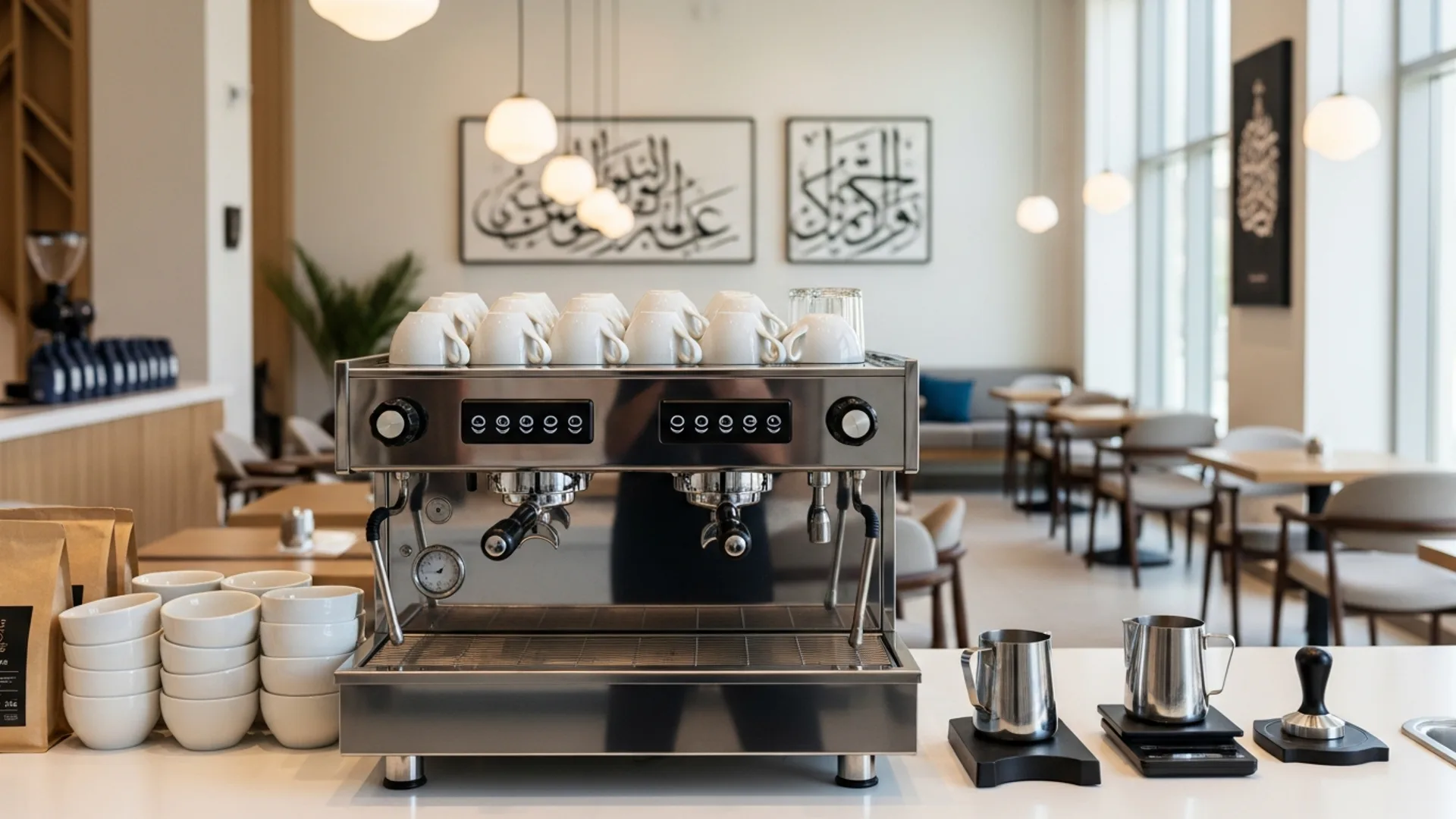
- Espresso and brewing equipment: a commercial espresso machine, grinders, water filtration, and brewing gear. Quality here directly affects your product, so it is usually the wrong place to cut corners.
- Interior fit-out: flooring, counters, joinery, seating, lighting, and branding. Civil-defence-compliant fire safety, ventilation, and an SFDA-acceptable kitchen layout must be designed in, not added later.
- Refrigeration and kitchen: fridges, display chillers, prep stations, and dishwashing, scaled to whether you serve food or only beverages and pastries.
- POS and back-office: a Fatoora-ready point-of-sale, inventory software, and payment terminals.
- Deposits and opening stock: rent deposits, utility connections, initial coffee beans, milk, packaging, and consumables.
A compact grab-and-go kiosk can launch toward the lower end of the SAR 150,000-400,000 range, while a full sit-in specialty café with a kitchen sits at the higher end or beyond. Build a contingency of 10-15% into the budget, and make sure you fund several months of working capital so rent, salaries, GOSI, and stock are covered while the café builds its customer base.
Tax, VAT and e-invoicing for cafés
Once registered with the Zakat, Tax and Customs Authority (ZATCA), your café charges 15% VAT on most sales. Coffee, food, and beverages sold to customers are standard-rated, so your point-of-sale system must calculate VAT correctly and your receipts must be compliant.
ZATCA also operates the Fatoora e-invoicing system, which is being rolled out in waves to different taxpayer groups. In practice this means your POS and invoicing software must be able to generate and (when your wave applies) integrate compliant electronic invoices with ZATCA. Choosing a POS that is already Fatoora-ready from day one is far easier than retrofitting later. Confirm which Fatoora wave and integration deadline applies to you directly on zatca.gov.sa.
Keep clean records from your first day of trading. VAT returns are filed periodically, and a café handles a high volume of small transactions, so a well-configured POS that captures every sale, tracks input VAT on purchases (beans, milk, packaging, equipment), and exports tidy reports will save you significant time at filing. Many new owners underestimate the bookkeeping side of a busy café; setting up sound accounting and an e-invoicing-ready till before you open is far cheaper than fixing it after a quarter of messy receipts.
Hiring staff: Saudization, Qiwa and GOSI
A café is a people business, so employer compliance matters from your first hire. You will:
- Open an employer file and manage contracts through Qiwa at qiwa.sa.
- Register staff for social insurance with GOSI at gosi.gov.sa; total contributions for Saudi employees are around 21.5% of wages, split between employer and employee.
- Meet your Saudization (Nitaqat) ratio, since retail and F&B have national-employment targets. Maintaining a healthy Nitaqat band keeps your visa and government services flowing smoothly.
- Manage Iqamas, exit-re-entry, and renewals for foreign staff through Muqeem (muqeem.sa) and Absher (absher.sa). Indicative Iqama government fees are around SAR 650 per year plus applicable levies.
Cafés rely on baristas, kitchen staff, and shift supervisors, so plan your headcount, Saudization mix, and GOSI budget into your monthly running costs from the outset rather than as an afterthought.
Common errors that delay café approvals
Most café launches that slip do so for predictable, fixable reasons. Watch for these:
- Wrong activity codes. Registering as a generic “restaurant” when you are a beverage-led café (or vice-versa) triggers re-classification and a fresh municipal review.
- Premises not zoned for F&B. Signing a lease before confirming the unit can be licensed for food service is the costliest mistake; always verify zoning first.
- Documents not attested or translated. Foreign corporate papers need legalisation and certified Arabic translation; missing attestation stalls the MISA application.
- Skipping the order of steps. Applying for the municipal licence before the CR is active, or for staff visas before GOSI/Qiwa, creates loops.
- Ignoring civil-defence and SFDA conditions. Fire safety, ventilation, and food-handler certificates are inspected, not optional; build them into the fit-out plan.
- POS not Fatoora-ready. Choosing an e-invoicing-incompatible till means costly rework once your ZATCA wave applies.
- Under-budgeting working capital. Many founders fund the licence and fit-out but run thin on the first months of rent, salaries, and stock.
How the new 2026 Commercial Register Law helps café owners
The Commercial Register Law that took effect on 3 April 2026 makes life simpler for multi-branch and growing café brands. The register is now a unified national one: CR numbers start with “7”, there is no expiry date, and an annual confirmation replaces the old renewal cycle. There is a five-year grace period to transition existing registers, and English trade names are permitted. For a café operator planning a second or third location, this means you can expand under one national register instead of juggling city-by-city CRs, which lowers administrative overhead as you scale.
How Noble Core helps you open your café
Noble Core Ventures runs the entire chain as one managed project so you can focus on the concept, the coffee, and the customer experience. We:
- Confirm the right activity codes and ownership structure before you commit to a lease.
- Prepare, attest, and translate every document for the MISA and CR applications.
- File the MISA investment licence, Commercial Register, and Chamber membership.
- Coordinate the municipal (Baladiya) shop licence, SFDA food permit, and inspections.
- Register you with ZATCA for VAT and Fatoora, and set up GOSI, Qiwa, Muqeem, and Absher.
- Advise on Saudization, Iqamas, and ongoing compliance so nothing lapses.
If you are a foreign investor, start with our MISA licence in Saudi Arabia service, which is the gateway to everything else. Noble Core end-to-end setup packages start from SAR 36,999, and we give you a fixed, transparent scope so there are no surprises between trade-name reservation and opening day.
Need help setting up in Saudi Arabia? Noble Core handles your MISA licence, commercial registration, and visas end-to-end — done right the first time.
Frequently Asked Questions
How do I open a coffee shop in Saudi Arabia?
To open a coffee shop in Saudi Arabia, foreign owners first obtain a MISA investment licence (about 3-10 business days), then a Commercial Register from the Ministry of Commerce, a municipal shop licence via Balady, an SFDA food permit, and ZATCA registration for 15% VAT. Saudi or GCC owners skip MISA and register directly through the Saudi Business Center at mc.gov.sa.
How much does it cost to open a coffee shop in Saudi Arabia?
A realistic all-in budget for a small specialty café is roughly SAR 150,000-400,000, mostly fit-out, equipment, deposits, and stock. Government items are indicative: Commercial Register around SAR 1,200-2,000, Chamber membership SAR 2,000-3,000 per year, and a municipal licence of a few thousand riyals. MISA licence fees are suspended in 2026. Confirm current figures on the official portal.
Can a foreigner own 100% of a coffee shop in Saudi Arabia?
Yes. Most food-and-beverage activities, including cafés, are open to 100% foreign ownership through a MISA investment licence, so you do not need a mandatory Saudi partner. A few activities remain restricted, so confirm your exact café and food-service activity codes with the Ministry of Investment of Saudi Arabia (MISA) before filing your application.
How long does it take to open a coffee shop in Saudi Arabia?
Most coffee shops in Saudi Arabia become fully operational in about 4-8 weeks. The MISA investment licence is usually issued in 3-10 business days and the Commercial Register in 1-3 days, while the municipal licence, SFDA food permit, and fit-out run in parallel. Timelines depend on document attestation, premises readiness, and inspection scheduling.
What licences do I need for a coffee shop in Saudi Arabia?
A Saudi coffee shop needs a Commercial Register from the Ministry of Commerce, a MISA investment licence if any owner is non-Saudi/GCC, a municipal (Baladiya) shop licence via Balady, an SFDA food permit with health inspection, and ZATCA registration for VAT and Fatoora e-invoicing. You also register staff with GOSI, Qiwa, and Muqeem for employment and Iqama services.
Do I need an SFDA permit for a coffee shop in Saudi Arabia?
Yes. Because a coffee shop prepares food and drink for the public, it must meet Saudi Food and Drug Authority (SFDA) requirements, including an approved kitchen layout, food-safety controls, and certified food handlers. The local municipality also conducts a health inspection. Build SFDA and civil-defence safety conditions into your fit-out plan to avoid delays at the final approval stage.
Does a coffee shop in Saudi Arabia charge VAT?
Yes. Coffee, food, and beverages are standard-rated, so your café charges 15% VAT on most sales once registered with the Zakat, Tax and Customs Authority (ZATCA) at zatca.gov.sa. You must also onboard to the Fatoora e-invoicing system, which ZATCA rolls out in waves, and use a compliant point-of-sale. Confirm your specific obligations directly on the ZATCA portal.
What changed for café registration under the 2026 Commercial Register Law?
Effective 3 April 2026, Saudi Arabia introduced a unified national Commercial Register: CR numbers begin with 7, the register has no expiry, and an annual confirmation replaces renewal. There is a five-year grace period and English trade names are allowed. For café brands, this means you can expand to new branches under one national register instead of separate city-specific CRs.