Opening a Beauty Salon or Spa in Saudi Arabia (2026)
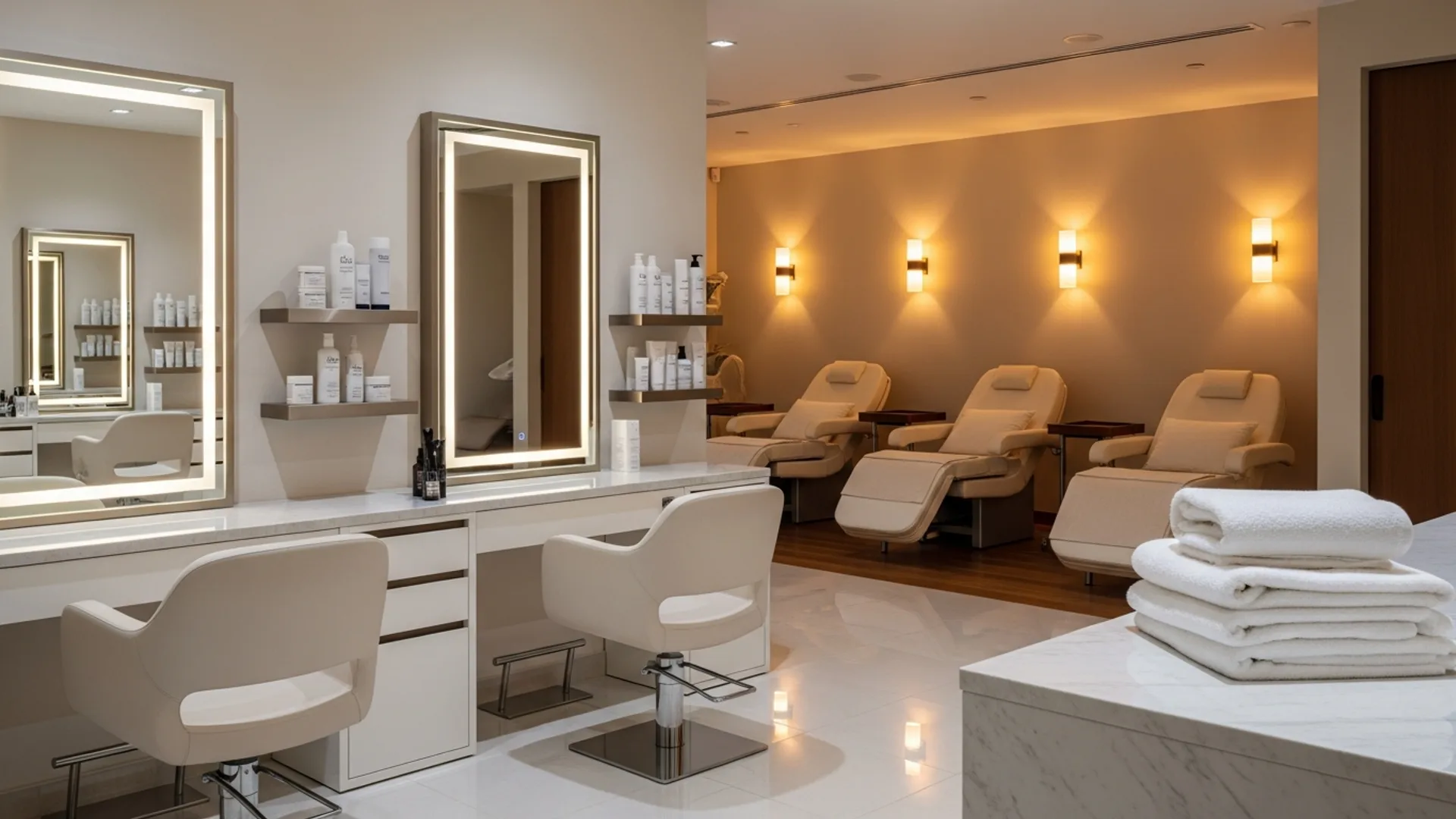
Opening a beauty salon or spa in Saudi Arabia in 2026 typically takes about 4 to 8 weeks and combines a Ministry of Commerce Commercial Register (CR), a municipal (Baladiya) beauty-centre licence, Civil Defence safety approval, and — for foreign owners — a MISA investment licence (issued in roughly 3 to 10 business days). Budget from around SAR 36,999 for a foreign-owned setup, plus annual chamber fees of about SAR 2,000 to 3,000. This guide walks through every portal screen, document, and fee so you can plan with confidence.
What counts as a beauty salon or spa in Saudi Arabia
Under the Saudi classification system, a “beauty salon,” “ladies’ salon,” “barbershop,” “spa,” or “beauty centre” is a personal-care service activity regulated primarily at the municipal level by the relevant Amana (municipality/Baladiya), with company registration handled by the Ministry of Commerce through the Saudi Business Center. The activity code you choose on your Commercial Register determines exactly which approvals you need.
Common categories include:
- Women’s beauty salon / ladies’ salon — hair, nails, facials, makeup, and threading services for female clients.
- Men’s barbershop / grooming salon — haircuts, shaving, and men’s grooming.
- Spa, wellness, and massage centre — body treatments, sauna, and relaxation services (some treatment types carry extra health approvals).
- Beauty centre / cosmetic studio — combining several of the above under one premises.
In line with regulations, salons in Saudi Arabia operate as gender-specific premises: a ladies’ salon serves female clients with female staff, and a men’s salon serves male clients. Mixed-service brands usually run two separate, clearly partitioned premises or two licences. Confirm the exact activity wording on the Saudi Business Center (mc.gov.sa) before you register, because changing it later means amending your CR.
The activity code matters more than many first-time owners expect. A ladies’ beauty salon, a high-end day spa, and a quick-service nail bar can sit in slightly different sub-categories, each with its own municipal inspection checklist, Saudization expectations, and (where treatments touch on health services) additional approvals. Spend time matching your real service menu to the closest activity classification on mc.gov.sa, and add secondary activities — for example, retailing cosmetic products alongside services — rather than discovering mid-launch that your CR does not cover what you actually sell.
Choosing your salon or spa format and location
Before you touch any portal, decide what you are actually building, because the format drives your premises, headcount, and capital needs.
- Neighbourhood ladies’ salon — the most common model, focused on hair, nails, threading, and makeup. Lower fit-out cost, but a competitive market, so location and service quality decide success.
- Premium day spa or wellness centre — treatment rooms, sauna, and body therapies. Higher fit-out and plumbing requirements, stricter hygiene and Civil Defence scrutiny, and a higher average ticket.
- Men’s grooming / barbershop — separate licence and premises, typically faster turnover and lower per-treatment pricing.
- Multi-brand beauty centre — combining several of the above, often the route for franchises and groups, which usually means multiple CRs or branch registrations.
Location choice in cities such as Riyadh, Jeddah, and the Dammam metropolitan area affects both your rent and your municipal zoning approval. Mall units, standalone shop-fronts, and residential-district ground floors each have different licensing nuances, footfall, and parking expectations. The municipality (Amana) will only licence personal-care services in zones approved for them, so confirm the zoning of any unit with the local Baladiya before signing a lease — this single check prevents one of the most expensive early mistakes.
Who needs which licence: foreign vs Saudi owners
Your ownership structure decides your first step.
Saudi or GCC nationals
A Saudi or GCC owner can usually go straight to the Ministry of Commerce to issue a Commercial Register, then move on to the municipal beauty-centre licence. No MISA investment licence is required, which shortens the timeline and removes one approval layer. Many local owners still choose to use a setup consultant to handle the municipal and Civil Defence steps, which are where most first-time delays occur.
Foreign investors
A non-GCC foreign investor must first obtain an investment licence from the Ministry of Investment of Saudi Arabia (MISA). Saudi Arabia now permits 100% foreign ownership in most service activities, including many personal-care and wellness businesses, so you generally do not need a Saudi partner. Importantly, MISA investment-licence issuance and renewal fees were suspended in 2026 (these were previously SAR 12,000 to issue and around SAR 62,000 over the standard renewal cycle), which materially lowers the cost of entry. Always confirm current figures on the official portal, as fee policies are reviewed periodically.
If you are weighing the foreign-ownership route, our overview of how to get a MISA licence in Saudi Arabia explains the documents, eligibility, and timeline in detail.
Why the 2026 reforms help salon and spa owners
Two recent changes make 2026 a strong time to enter the market. First, the suspension of MISA licence issuance and renewal fees removes a sizeable upfront and recurring cost that previously deterred smaller service investors. Second, the new Commercial Register Law, effective 3 April 2026, replaced the old per-city, expiry-based CR with a single unified national Commercial Register: the number starts with “7,” carries no expiry date, allows English trade names, and is maintained through a simple annual confirmation rather than a renewal cycle. For a beauty brand planning multiple branches across Saudi cities, a unified national CR meaningfully simplifies expansion. These reforms sit within Saudi Arabia’s Vision 2030 drive to grow the private sector and the wellness economy, which is positive context for new salon and spa operators.
Step-by-step: how to open a beauty salon or spa in Saudi Arabia
Here is the practical sequence most owners follow in 2026. Foreign investors complete step 1; Saudi and GCC owners start at step 2. The steps are largely sequential because each approval often depends on the document issued in the step before it — your municipal licence application, for example, needs both your Commercial Register and a registered Ejar lease in hand.
- Obtain a MISA investment licence (foreign owners). Apply through the MISA investor portal. Upload your commercial registration from your home country (attested), passport copies of shareholders, and a financial statement. Issuance typically takes 3 to 10 business days.
- Reserve a trade name and issue the Commercial Register (CR). Log in to the Saudi Business Center (mc.gov.sa), open the “Establish a business” / “Issue Commercial Register” service, reserve your trade name (English trade names are now permitted), select the beauty-salon or spa activity code, and pay the CR fee. Under the new Commercial Register Law effective 3 April 2026, you receive a unified national CR whose number begins with “7” and which carries no expiry date — instead you submit an annual confirmation.
- Register with the Chamber of Commerce. Membership is issued through the same flow and renewed annually (roughly SAR 2,000 to 3,000 per year, indicative — confirm on the official portal).
- Secure premises and a municipal lease (Ejar). Lease a shop unit that meets municipal zoning for personal-care services and register the contract on the Ejar platform. Salon premises must meet partitioning, ventilation, and privacy standards.
- Apply for the municipal beauty-centre licence. Through your local Amana / the Baladi platform, submit the premises licence application for a salon or spa. The municipality reviews your floor plan, sanitation arrangements, and signage.
- Obtain Civil Defence safety approval. Your premises must pass fire-safety and emergency-exit checks. Civil Defence approval (Salama) is usually a condition of the final municipal licence.
- Register for tax and labour platforms. Register with ZATCA for VAT and e-invoicing, enrol the company on Qiwa (labour file), and register with GOSI for social insurance before hiring.
- Open a corporate bank account and issue staff visas/Iqamas. With your CR and licences, open a business account, then use Qiwa, the MOFA visa platform (Enjaz / visa.mofa.gov.sa), Muqeem, and Absher to bring in and document your stylists, therapists, and managers.
For a full company-formation walkthrough that ties these steps together, see our guide to company formation in Saudi Arabia.
Required documents and IDs
Prepare these before you start so the portals do not stall mid-application:
- Passport copies of all shareholders and the general manager.
- For foreign owners: home-country commercial registration / certificate of incorporation, attested and (where required) translated into Arabic.
- MISA investment licence (foreign owners).
- Reserved trade name confirmation from the Saudi Business Center.
- Articles of Association (drafted and notarised through mc.gov.sa).
- Ejar lease contract for the salon or spa premises.
- Premises floor plan showing treatment areas, sanitation, and (for salons) gender-appropriate partitioning.
- National Address registration for the business.
- Manager’s Iqama (for resident managers) and Absher / Muqeem records for staff.
Fees and timeline table (2026, indicative)
The figures below are indicative planning numbers. Government fees can change, so always confirm the current amount on the official portal at the moment you apply.
| Item | Authority / portal | Indicative fee (SAR) | Typical time |
|---|---|---|---|
| MISA investment licence (foreign owners) | MISA | Issuance/renewal fees suspended in 2026 (confirm) | 3–10 business days |
| Commercial Register (CR) | Ministry of Commerce / mc.gov.sa | ~1,200–2,000 | 1–3 business days |
| Chamber of Commerce membership | Chamber | ~2,000–3,000 / year | Same day |
| Municipal beauty-centre / spa licence | Amana / Baladi | ~2,000–6,000 (varies by city & size) | 1–3 weeks |
| Civil Defence (Salama) safety approval | Civil Defence | Varies by premises | 1–2 weeks |
| GOSI registration & contributions | GOSI / gosi.gov.sa | ~21.5% total (employer + employee, Saudi staff) | Same day to register |
| Iqama issuance / renewal (per expat employee) | Absher / Muqeem | ~650 / year govt fee + levies | Days |
| VAT | ZATCA / zatca.gov.sa | 15% on taxable supplies | Register before trading |
| Noble Core setup package | Noble Core | From 36,999 | 4–8 weeks end-to-end |
Hiring staff: Saudization, Qiwa, GOSI, and visas
Personal-care businesses are labour-intensive, so plan your workforce early.
Qiwa and Saudization (Nitaqat)
The Ministry of Human Resources and Social Development (MHRSD) sets Saudization targets through the Nitaqat programme, administered on Qiwa (qiwa.sa). Salons and beauty centres have specific localisation requirements — notably, ladies’ beauty salons are an area where Saudi female employment is actively encouraged. Check your activity’s current Nitaqat band on Qiwa, because it affects how many work visas you can request.
GOSI social insurance
Register the company and every employee with the General Organisation for Social Insurance (GOSI) at gosi.gov.sa. For Saudi employees, total contributions run at roughly 21.5% of wages split between employer and employee (indicative — confirm current rates on the portal); rates for non-Saudis differ and mainly cover occupational hazards.
Work visas and Iqamas
Once your Qiwa work-visa quota is approved, recruit stylists, therapists, and beauticians, issue entry visas through the MOFA Enjaz platform (visa.mofa.gov.sa), and complete Iqama issuance and renewals via Muqeem and Absher. The Iqama government fee is around SAR 650 per year plus applicable levies (indicative — confirm on the official portal).
Products, hygiene, and SFDA cosmetic rules
If your salon or spa sells or uses cosmetic products — hair colour, skincare, nail products, or retail beauty items — those products must comply with Saudi Food and Drug Authority (SFDA) cosmetic regulations. Imported cosmetics generally need to be notified through the SFDA’s cosmetic notification system, and retail products must carry compliant Arabic labelling.
On the premises side, the municipality enforces strict hygiene and sterilisation standards: single-use items where required, sterilised tools, clean water supply, proper waste disposal, and staff health cards. Building these standards in from day one avoids re-inspections that delay your opening.
Practical hygiene checklist for inspection day
- An autoclave or approved steriliser for reusable metal tools, with a documented sterilisation log.
- Single-use consumables — disposable razors, files, and applicators where reuse is not permitted.
- Clearly separated clean and used-tool storage.
- Valid health cards for all client-facing staff.
- Proper hot and cold water supply at each station and treatment room.
- Compliant waste disposal, including separate handling for chemical and biological waste.
- First-aid kit and clearly displayed emergency information.
Day spas adding treatments that border on health services — for example certain skin or body procedures — may need extra approvals beyond the standard beauty-centre licence. If your menu includes anything that could be classed as a medical or semi-medical procedure, confirm the specific requirement with the relevant authority before you advertise it, because offering an unapproved treatment is a common reason for penalties.
Planning your budget and break-even
Beyond the official fees in the table above, build a realistic capital plan. Typical cost drivers for a Saudi salon or spa include:
- Fit-out and equipment — styling stations, mirrors, treatment beds, wash basins, sterilisation equipment, and reception. A premium spa fit-out costs several times more than a simple ladies’ salon.
- Rent and Ejar deposit — usually a year paid in one to four instalments, plus a deposit, registered on Ejar.
- Staff costs — salaries plus GOSI contributions (around 21.5% total for Saudi staff), recruitment, and visa or Iqama fees of roughly SAR 650 per year per expat employee plus levies.
- Opening stock — retail cosmetics and consumables, which may require SFDA-compliant labelling.
- Working capital — three to six months of operating costs to cover the ramp-up before the client base matures.
A disciplined plan separates one-off setup spend (licences, fit-out, deposits) from recurring monthly costs (rent, salaries, utilities, VAT remittance). Many owners find that staff and rent, not government fees, dominate the budget — so location and headcount decisions matter far more to break-even than the licensing line items. All government figures here are indicative; verify the exact amounts on the relevant official portal at the time you apply.
Tax, e-invoicing, and ongoing compliance
After launch, your salon or spa has recurring obligations:
- VAT (15%) on taxable services and retail product sales, filed with ZATCA (zatca.gov.sa) once you cross the registration threshold.
- E-invoicing (Fatoora) — ZATCA is rolling out e-invoicing integration in waves; once your business is in scope, your billing system must integrate with the Fatoora platform.
- Annual CR confirmation — under the 2026 Commercial Register Law, the CR no longer expires, but you must submit an annual confirmation to keep it active (a five-year grace structure applies for lapses).
- Municipal licence renewal, chamber membership renewal, GOSI filings, and Qiwa labour-file upkeep.
You can manage most government interactions through your unified account on my.gov.sa, which links the national platforms.
Common mistakes to avoid
- Choosing the wrong activity code — registering a generic “trading” CR instead of the correct salon/spa personal-care activity, which the municipality will reject.
- Signing a lease before zoning check — committing to premises that the Amana will not licence for personal-care use. Verify zoning first.
- Ignoring gender-specific premises rules — planning a single mixed space instead of compliant, separate ladies’ and men’s areas or licences.
- Underestimating Civil Defence (Salama) requirements — fire-safety fit-out is a frequent cause of final-licence delays.
- Skipping SFDA cosmetic notification for imported products you sell or use, leading to customs and inspection problems.
- Hiring before checking Nitaqat — requesting more work visas than your Saudization band allows on Qiwa.
- Forgetting the annual CR confirmation under the new 2026 law and assuming “no expiry” means “no action.”
- Treating indicative fees as final — always confirm current figures on the official portal before budgeting.
How Noble Core helps you open faster
Noble Core is a Saudi-focused business-setup consultancy. We manage the entire beauty-salon or spa launch end-to-end so you avoid the back-and-forth that stretches timelines: selecting the correct municipal activity code, securing your MISA investment licence for 100% foreign ownership, issuing your Commercial Register and chamber membership on mc.gov.sa, coordinating the Amana beauty-centre licence and Civil Defence approval, registering you with ZATCA, Qiwa, and GOSI, and handling staff visas through Enjaz, Muqeem, and Absher.
Our setup packages start from SAR 36,999, and we map your Saudization (Nitaqat) position, SFDA product obligations, and e-invoicing readiness before you sign a single lease. To begin, explore our full guide to company formation in Saudi Arabia or the dedicated MISA licence guide, then reach out for a tailored quote and timeline for your salon or spa.
Need help setting up in Saudi Arabia? Noble Core handles your MISA licence, commercial registration, and visas end-to-end — done right the first time.
Frequently Asked Questions
Can foreigners open a beauty salon or spa in Saudi Arabia?
Yes. Foreign investors can own 100% of a beauty salon or spa in most personal-care activities in Saudi Arabia. You first obtain a MISA investment licence (issued in about 3 to 10 business days), then register the company on the Saudi Business Center (mc.gov.sa) and complete the municipal beauty-centre licence and Civil Defence approval before opening.
How much does it cost to open a beauty salon spa in Saudi Arabia in 2026?
Plan from around SAR 36,999 for a full foreign-owned setup with Noble Core. Core official costs include the Commercial Register (about SAR 1,200 to 2,000), chamber membership (about SAR 2,000 to 3,000 per year), and the municipal salon licence (roughly SAR 2,000 to 6,000 depending on city and size). All figures are indicative; confirm current amounts on the official portal.
How long does it take to license a salon or spa in Saudi Arabia?
End to end, opening a beauty salon or spa in Saudi Arabia usually takes about 4 to 8 weeks. The MISA investment licence is issued in roughly 3 to 10 business days, the Commercial Register in 1 to 3 days, and the municipal beauty-centre licence and Civil Defence approval each take 1 to 3 weeks, depending on your premises and city.
Do I need a MISA licence to open a beauty salon in Saudi Arabia?
If you are a non-GCC foreign investor, yes. You need a MISA investment licence before registering the company, which allows up to 100% foreign ownership in most service activities. MISA issuance and renewal fees were suspended in 2026. Saudi and GCC nationals do not need a MISA licence and can go straight to the Ministry of Commerce.
What documents are needed to open a beauty salon spa in Saudi Arabia?
You need shareholder and manager passports, the MISA investment licence (for foreign owners), a reserved trade name and Commercial Register from mc.gov.sa, notarised Articles of Association, an Ejar lease contract, a premises floor plan, National Address registration, and staff Iqama and Absher or Muqeem records. Foreign owners also provide attested home-country incorporation documents.
Which authorities regulate beauty salons and spas in Saudi Arabia?
Several authorities are involved. The Ministry of Commerce issues the Commercial Register, the local municipality (Amana) grants the beauty-centre licence, Civil Defence handles safety approval, MISA licenses foreign investors, ZATCA manages VAT and e-invoicing, MHRSD and Qiwa handle Saudization and labour, GOSI covers social insurance, and the SFDA regulates cosmetic products used or sold.
Are there hiring or Saudization rules for beauty salons in Saudi Arabia?
Yes. MHRSD sets Saudization targets through Nitaqat, administered on Qiwa (qiwa.sa). Ladies’ beauty salons are an area where Saudi female employment is actively encouraged, so check your activity’s current Nitaqat band before requesting work visas. You must also register staff with GOSI, where total contributions for Saudi employees run at about 21.5%.
Do salon products in Saudi Arabia need SFDA approval?
Cosmetic products that you sell or use, such as hair colour, skincare, and nail products, must comply with Saudi Food and Drug Authority (SFDA) cosmetic regulations. Imported cosmetics generally need notification through the SFDA cosmetic notification system, and retail products require compliant Arabic labelling. Confirm current requirements on the official SFDA portal before importing or stocking products.