Starting a Catering Company in Saudi Arabia (2026)
Starting a catering company in Saudi Arabia means securing a MISA investment licence (issued in roughly 3–10 business days), registering a Commercial Register with the Ministry of Commerce (CR fee ~SAR 1,200–2,000), then layering food-safety and municipal permits on top. With 100% foreign ownership allowed in most activities, MISA licence issue/renew fees suspended in 2026, and a Noble Core launch package from SAR 36,999, a compliant catering setup is faster and cheaper to start than most founders expect — provided each food-handling and labour step is sequenced correctly.
What a catering company in Saudi Arabia actually is
A catering company prepares, packages and delivers food for events, corporate clients, schools, hospitals, airlines and institutions across the Kingdom. Unlike a sit-down restaurant, the licence emphasises a central production kitchen, cold-chain logistics and bulk food handling rather than a public dining space. That distinction matters because it changes which municipal and food-safety permits you need.
In regulatory terms, a catering business sits at the intersection of three frameworks: the investment licence from the Ministry of Investment of Saudi Arabia (MISA) for foreign investors, the Commercial Register from the Ministry of Commerce, and the food establishment permits issued by the relevant municipality and aligned with Saudi Food and Drug Authority (SFDA) standards. Get the order right and the rest follows smoothly.
Vision 2030 has expanded events, tourism and hospitality demand dramatically — from entertainment seasons to corporate hospitality and large institutional contracts — so the catering segment is one of the more attractive food-sector entry points for new investors.
Catering vs restaurant vs cloud kitchen
Founders often confuse these three models, and the difference changes your licensing path. A restaurant serves food on a dining premises open to the public and carries higher footfall-related municipal requirements. A cloud (or central) kitchen cooks purely for delivery with no dine-in area. A catering company produces in bulk and supplies third-party events or institutions, frequently off-site. All three need municipal food permits, but the activity code you select at the MISA and Commercial Register stage must match the model you actually run — picking “restaurant” when you mean “catering” can block the correct food-premises permit later.
Who needs a catering licence (and who doesn’t)
You need a dedicated catering licence and the associated food permits if you intend to prepare food commercially and supply it to third parties. The following operators all fall inside the catering or food-services net:
- Event and wedding caterers supplying buffets, plated meals and hospitality stations.
- Corporate and institutional caterers serving offices, factories, hospitals, schools and labour accommodation.
- Central/cloud kitchens producing for delivery brands or multiple outlets.
- Airline and transport caterers handling in-flight or in-transit meals.
- Specialty providers — bakeries-at-scale, meal-prep subscriptions, frozen ready-meals.
Foreign investors who want full control will route through MISA for the investment licence, since most catering and food-service activities now permit 100% foreign ownership. Saudi and GCC nationals can register directly with the Ministry of Commerce without a MISA licence. Either way, the food-safety and municipal permits are mandatory before you cook for a paying client.
Choosing your legal structure
Most foreign-owned catering companies are set up as a limited liability company (LLC), which suits a single investor or a small group of shareholders and limits liability to the capital contributed. Larger groups planning multiple kitchens or a national rollout sometimes choose a closed joint-stock company. A branch of a foreign company is possible for established international caterers, but it cannot carry out certain local activities as freely as a locally incorporated LLC. The right structure affects your tax treatment (Zakat versus corporate income tax), your capital requirements and how easily you can add shareholders later — so decide this before you reserve a trade name.
The exact step-by-step setup process (2026)
Below is the practical, portal-by-portal sequence. Each step names the authority and the screen you will work in. Foreign investors complete all steps; Saudi nationals skip Step 1.
- Apply for the MISA investment licence. Go to the MISA investor portal (misa.gov.sa), create an investor account, and complete the “New Investment Licence” application. Upload your parent-company documents and select the catering/food-services activity. MISA typically issues service-activity licences in around 3–10 business days. Note the 2026 change: MISA licence issue and renewal fees (previously SAR 12,000 / SAR 62,000) are suspended — confirm the current position on the official portal.
- Reserve your trade name and issue the Commercial Register (CR). Through the Saudi Business Center (my.gov.sa / business.sa) and the Ministry of Commerce (mc.gov.sa), reserve a trade name and issue the CR. Under the new Commercial Register Law effective 3 April 2026, the CR is a unified national register: the ID now starts with “7”, there is no expiry (you file an annual confirmation instead), there is a 5-year grace mechanism, and English trade names are permitted. Indicative CR fee is ~SAR 1,200–2,000.
- Register with the Chamber of Commerce. Membership is issued in parallel with the CR; budget an indicative ~SAR 2,000–3,000 per year depending on your capital and category.
- Draft and notarise the Articles of Association (MoA). For an LLC, the MoA is authenticated through the Ministry of Commerce e-services. This sets out shareholders, capital and management.
- Open a corporate bank account and deposit capital. Saudi banks require the CR, MoA, MISA licence and a national/Iqama-based authorised signatory.
- Register for tax with ZATCA. Enrol on the Zakat, Tax and Customs Authority portal (zatca.gov.sa) for Zakat/corporate tax and VAT (standard rate 15%). You will join the ZATCA e-invoicing (Fatoora) programme in the applicable integration wave.
- Register the establishment for labour and social insurance. Set up your file on Qiwa (qiwa.sa) for the labour establishment and on GOSI (gosi.gov.sa) for social insurance. Total GOSI contribution for a Saudi employee is around 21.5% (employer plus employee).
- Obtain the municipal food-establishment permit. Apply through your municipality’s “Baladi” e-services for the food-premises (production kitchen) licence, with inspection against SFDA food-safety requirements. This is the permit that legally lets you prepare food for sale.
- Issue visas and Iqamas for staff. Once Qiwa allocates your work-visa quota, process visas via the MOFA Enjaz/visa platform (visa.mofa.gov.sa) and complete entry and Iqama issuance through Absher (absher.sa) and Muqeem (muqeem.sa). Indicative Iqama issuance/renewal government fee is ~SAR 650/year plus applicable levies.
For a deeper walkthrough of the corporate-formation layer, see our guide to company formation in Saudi Arabia, which covers entity choice, capital and notarisation in detail.
Required documents and IDs
Have these ready before you start — missing paperwork is the single biggest cause of delay. Requirements vary slightly by activity and municipality, so confirm specifics on the relevant portal.
- Parent-company commercial registration and Articles of Association, legalised/attested (for a corporate foreign shareholder).
- Audited financial statements of the parent company (often requested by MISA).
- Passport copies of shareholders, directors and the authorised signatory.
- Board resolution authorising the Saudi investment and appointing the manager.
- Proposed trade name(s) and the selected ISIC/MISA activity codes.
- A lease or title for the production-kitchen premises (needed for the municipal food permit).
- Kitchen layout and equipment list for the SFDA-aligned inspection.
- Iqama or national ID details for any in-Kingdom resident signatory.
Foreign investors should also note that company-level documents typically require attestation in the country of origin and through the Saudi mission abroad (the MOFA channel) before they are accepted locally.
Fees and timeline at a glance
The table below gives indicative 2026 figures. Government fees can change between waves and circulars, so always confirm the current amount on the official portal before you budget.
| Item | Authority / portal | Indicative fee (SAR) | Indicative timeline |
|---|---|---|---|
| MISA investment licence (issue) | MISA (misa.gov.sa) | Issue/renew fees suspended in 2026 (were 12,000 / 62,000) | ~3–10 business days |
| Commercial Register (CR) | Ministry of Commerce / Saudi Business Center | ~1,200–2,000 | 1–3 business days |
| Chamber of Commerce membership | Chamber of Commerce | ~2,000–3,000 / year | Same day–2 days |
| Municipal food-establishment permit | Municipality “Baladi” / SFDA standards | Indicative; confirm locally | ~1–4 weeks (incl. inspection) |
| GOSI registration | GOSI (gosi.gov.sa) | Contribution ~21.5% of salary | 1–2 business days |
| VAT registration | ZATCA (zatca.gov.sa) | VAT rate 15% | 1–3 business days |
| Iqama issuance/renewal (per employee) | Absher / Muqeem / MHRSD | ~650 / year + levies | Days, once visa allocated |
| Noble Core launch package | Noble Core | From 36,999 | End-to-end coordination |
As a rough end-to-end estimate, a well-prepared foreign-owned catering company can move from MISA application to an operational, permitted kitchen in roughly 6–10 weeks, with the municipal food-premises inspection usually the longest single step.
What the 2026 Commercial Register changes mean for you
The new Commercial Register Law, effective 3 April 2026, modernises how your business registration works and is worth understanding before you file. The headline changes:
- One unified national CR. The old distinction between a “main” CR and separate branch registers in each city is replaced by a single national register, so you no longer issue a fresh CR every time you open a kitchen in another region.
- A new ID format starting with “7”. Your commercial registration number now begins with the digit 7, marking it as issued under the new system.
- No expiry — annual confirmation instead. The CR no longer lapses on a fixed date; you simply file an annual confirmation to keep it active, which removes the risk of an overlooked renewal date.
- A five-year grace mechanism easing the transition for existing and new registrations.
- English trade names allowed. You can now register an English-language trade name, useful for international catering brands serving hotels, airlines and multinational corporate clients.
The practical takeaway for caterers expanding across Riyadh, Jeddah and the Eastern Province is that scaling is administratively simpler than it was — but the annual confirmation is now a compliance task you must not forget.
Food-safety and SFDA compliance specific to catering
Catering carries food-safety obligations that an office-only business does not. The municipality issues the food-premises permit, and the Saudi Food and Drug Authority sets the underlying standards your kitchen and staff must meet.
Premises and equipment
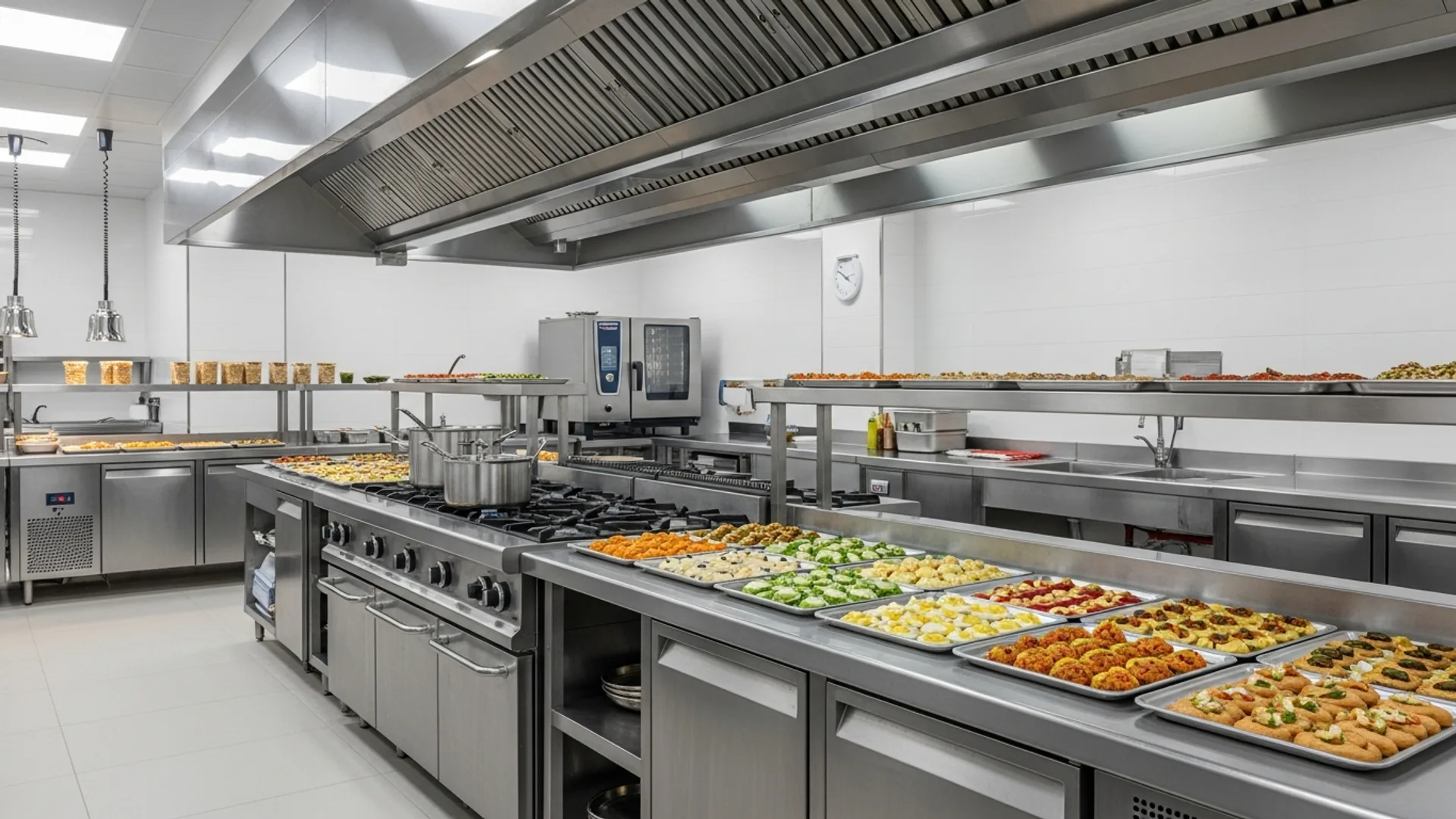
Your production kitchen must meet hygiene, ventilation, cold-storage and waste-handling requirements. Inspectors check separation of raw and cooked areas, temperature control, pest management and potable-water supply. Plan the layout before you sign a lease.
Food-handler health certificates
Staff who handle food generally need valid health certificates issued via the municipal health system. Build this into your hiring timeline so kitchen staff are cleared before your first contract.
Labelling and traceability
Packaged and delivered meals must follow SFDA labelling rules, and many institutional clients (hospitals, schools, airlines) require documented HACCP-style food-safety management. Strong traceability is both a compliance requirement and a competitive advantage when bidding for large contracts.
Hiring staff: Qiwa, Saudization and GOSI
Catering is people-intensive, so labour compliance is central. Three systems govern it:
- Qiwa (qiwa.sa) — your labour establishment file, work-visa quota, employment contracts and Saudization (Nitaqat) status all live here.
- GOSI (gosi.gov.sa) — social-insurance registration for every employee; total contribution for a Saudi employee is around 21.5% combined employer and employee.
- MHRSD — the Ministry of Human Resources and Social Development sets Saudization targets and labour rules that your category must meet.
Plan your Saudization ratio early. Meeting Nitaqat requirements unlocks smoother visa processing and government services, while a strong national-hiring plan also strengthens bids for public and semi-government catering contracts. Our team maps the right ratio for your activity during onboarding — and our MISA licence guide explains how the investment licence interacts with your labour quota.
The portals you will use for staff
Once your labour file is live, day-to-day workforce administration runs through a small set of government services. Knowing which screen does what saves time:
- Qiwa (qiwa.sa) — issue and authenticate employment contracts, request work-visa quota and track your Nitaqat band.
- Absher Business (absher.sa) — government identity and entry services linked to your establishment.
- Muqeem (muqeem.sa) — issue and renew Iqamas, manage exit/re-entry and check residency status for your staff.
- MOFA Enjaz / visa platform (visa.mofa.gov.sa) — process work-visa stamping for new hires recruited from abroad.
- GOSI (gosi.gov.sa) — register each employee for social insurance and pay monthly contributions.
For a catering operation that scales kitchen staff up and down around large events, fluency in Qiwa and Muqeem is especially valuable, since seasonal hiring depends on quota availability and quick Iqama processing.
Tax, invoicing and ongoing compliance (ZATCA)
Once you are trading, ZATCA compliance is continuous. Key obligations:
- VAT at 15% on taxable catering supplies, filed periodically through the ZATCA portal.
- E-invoicing (Fatoora) — you will generate compliant electronic invoices and integrate with ZATCA’s platform in your assigned wave. Catering businesses issuing high invoice volumes should set up a compatible POS/invoicing system from day one.
- Zakat / corporate tax depending on ownership structure — Zakat for GCC-owned shares, corporate income tax on the foreign-owned portion.
- Annual CR confirmation — under the new Commercial Register Law, the CR no longer expires, but you must file the annual confirmation to keep it active.
Late or non-compliant invoicing is a common and avoidable cost. Setting up Fatoora-ready systems before your first event saves significant rework.
Choosing a location and sizing your kitchen
Where you place your production kitchen shapes both your permit path and your commercial reach. Riyadh offers the largest corporate and institutional catering market; Jeddah serves a strong events, hospitality and travel-catering demand; and the Eastern Province has substantial industrial and labour-accommodation contracts. Whichever region you choose, three location factors decide whether a premises can be permitted:
- Zoning. The site must be zoned for food production. Confirm this with the municipality before signing any lease — residential or unsuitable commercial zoning is a frequent and costly surprise.
- Utilities and drainage. A commercial kitchen needs adequate power, potable water, grease management and ventilation. Retrofitting these is expensive.
- Logistics access. Loading bays, refrigerated-vehicle parking and delivery routing matter for cold-chain integrity, especially for institutional contracts.
Size the kitchen for the contracts you are actually bidding for, not just day-one volume. Institutional and airline catering require documented capacity and traceability, so a kitchen built only for small events may need re-permitting when you scale. Building modest spare capacity into the initial layout is usually cheaper than a later move.
Common errors that delay catering setups
Most delays are predictable. Watch for these:
- Signing a kitchen lease before checking municipal zoning — not every premises can be permitted as a food-production site.
- Choosing the wrong activity code at the MISA/CR stage, which can block the matching food permit later.
- Underestimating the SFDA-aligned inspection — layout, cold storage and raw/cooked separation issues force re-inspections.
- Hiring before food-handler certificates are arranged, leaving staff unable to legally work in the kitchen.
- Ignoring Saudization from the start, then scrambling to meet Nitaqat before visas can be issued.
- Treating VAT/Fatoora as an afterthought, then retrofitting compliant invoicing under deadline pressure.
- Budgeting from outdated fee figures — always reconfirm on the official portal, since 2026 brought several changes.
Common mistakes to avoid
- Assuming a restaurant licence and a catering licence are interchangeable — the permits and premises requirements differ.
- Skipping document attestation in the home country, which stalls the MISA and CR stages.
- Forgetting the annual CR confirmation under the post-3-April-2026 rules, risking your register lapsing.
- Not registering with GOSI and Qiwa before onboarding staff.
- Relying on a single quote without confirming current government fees on misa.gov.sa, mc.gov.sa and zatca.gov.sa.
- Overlooking cold-chain and traceability needs when bidding for institutional contracts.
How Noble Core helps you launch faster
Noble Core handles the full catering-setup chain end to end so you can focus on menus, clients and contracts rather than portals. Our team coordinates your MISA investment licence, trade-name reservation and Commercial Register, Chamber membership, MoA notarisation, bank-account opening, ZATCA and GOSI registration, and the municipal food-establishment permit — including preparing your kitchen for the SFDA-aligned inspection.
Because we sequence every step in the right order and pre-check your documents against current 2026 requirements, we remove the back-and-forth that typically stretches a catering setup. Packages start from SAR 36,999, with transparent scope and no surprise government-fee mark-ups. Talk to us about a fixed-scope launch plan, and let our specialists confirm the latest fees on the official portals before you commit a single riyal.
Need help setting up in Saudi Arabia? Noble Core handles your MISA licence, commercial registration, and visas end-to-end — done right the first time.
Frequently Asked Questions
How do I start a catering company in Saudi Arabia?
To start a catering company in Saudi Arabia, foreign investors first obtain a MISA investment licence (about 3 to 10 business days), then issue a Commercial Register with the Ministry of Commerce, register the Chamber membership, and finally secure a municipal food-establishment permit aligned with SFDA food-safety standards before preparing food for paying clients.
Can foreigners own 100% of a catering company in Saudi Arabia?
Yes. Under the current investment rules, most catering and food-service activities allow 100% foreign ownership through a MISA investment licence, so you do not need a Saudi partner. Confirm your specific activity code is eligible on the MISA portal, since a small number of activities remain restricted or require additional conditions.
How much does it cost to set up a catering company in Saudi Arabia?
Indicative 2026 government costs include a Commercial Register fee of around SAR 1,200 to 2,000, Chamber membership of roughly SAR 2,000 to 3,000 per year, plus municipal food-permit and visa fees. MISA licence issue and renewal fees are suspended in 2026. Noble Core launch packages start from SAR 36,999; confirm current figures on official portals.
How long does it take to open a catering business in Saudi Arabia?
A well-prepared foreign-owned catering company can typically go from MISA application to an operational, permitted kitchen in roughly 6 to 10 weeks. The MISA licence takes about 3 to 10 business days, the Commercial Register 1 to 3 days, and the municipal food-establishment inspection is usually the longest single step at around 1 to 4 weeks.
What licences and permits does a catering company in Saudi Arabia need?
A catering company needs a MISA investment licence (for foreign investors), a Commercial Register from the Ministry of Commerce, Chamber of Commerce membership, ZATCA tax and VAT registration, Qiwa and GOSI labour registration, and a municipal food-establishment permit meeting Saudi Food and Drug Authority standards. Food-handler health certificates for kitchen staff are also required.
What are the food-safety requirements for catering in Saudi Arabia?
Catering kitchens must meet Saudi Food and Drug Authority standards enforced through the municipal food-establishment permit. Inspectors check raw and cooked area separation, cold storage, temperature control, ventilation, pest management and potable water. Food-handling staff need valid health certificates, and institutional clients often require documented HACCP-style food-safety management and SFDA-compliant labelling.
Do catering companies in Saudi Arabia pay VAT?
Yes. Catering supplies are subject to VAT at the standard rate of 15%, registered and filed through the ZATCA portal at zatca.gov.sa. Catering businesses also join the ZATCA e-invoicing (Fatoora) programme in their assigned integration wave, so setting up a compatible invoicing or POS system from day one avoids costly compliance rework later.
How can Noble Core help me start a catering company in Saudi Arabia?
Noble Core coordinates the full catering setup end to end: MISA investment licence, trade-name and Commercial Register, Chamber membership, MoA notarisation, bank account, ZATCA and GOSI registration, and the municipal food-establishment permit including SFDA inspection preparation. Packages start from SAR 36,999, with documents pre-checked against current 2026 requirements to remove avoidable delays.