Doing Business in NEOM (2026): Opportunities & How to Enter
Business setup in NEOM means entering Saudi Arabia’s flagship Vision 2030 development as an investor or operating company — most realistically today through Oxagon, NEOM’s Red Sea industrial and innovation hub. Foreign investors can hold 100% ownership under Saudi Arabia’s 2026 investment framework, and special economic zones in the Kingdom advertise a reduced 5% corporate income tax for up to 20 years alongside customs relief — a major step down from the standard 20% rate.
This guide explains what NEOM actually is in 2026, the sectors driving its growth, how companies engage with it, the special economic and regulatory framing, and the practical route a foreign business takes to enter — starting with the Ministry of Investment of Saudi Arabia (MISA) and a Commercial Registration.
What is NEOM? The giga-project explained
NEOM is a flagship development on Saudi Arabia’s north-western Red Sea coast, launched under Vision 2030 to build new engines for the non-oil economy. It is owned by the Public Investment Fund and is organised into several distinct regions, each with its own purpose:
- Oxagon — a reimagined industrial city on the Red Sea, designed as NEOM’s manufacturing, logistics and advanced-industry hub. Of all NEOM’s regions, Oxagon has the clearest commercial logic and the most active path for businesses to engage today.
- The Line — a long-term linear urban concept reimagining how a future city is laid out, prioritising walkability and zero-car mobility.
- Trojena — a mountain destination in the Sarawat range positioned for tourism, sport and outdoor leisure.
- Sindalah — an island leisure and yachting destination in the Red Sea.
For a business owner, the practical takeaway is simple: when people talk about “business setup in NEOM” in 2026, they usually mean engaging with Oxagon and NEOM’s industrial and clean-energy ecosystem, where investment, partnerships and physical operations are most advanced. NEOM is not a single licensing authority you register with directly; it is a development and a set of operating companies, so the legal entry point for almost every business is Saudi Arabia’s national investment system, layered on top of NEOM’s own commercial and zone arrangements.
It also helps to understand the scale of ambition. NEOM spans a vast area of roughly 26,500 square kilometres along the Red Sea coast and the Gulf of Aqaba, with neighbouring Egypt and Jordan a short distance across the water. That geography places NEOM at the meeting point of three continents and astride one of the world’s busiest shipping lanes — a logistics advantage that underpins much of Oxagon’s industrial case. For founders, the question is rarely “is NEOM real?” but rather “which part of the ecosystem fits my business, and what is the cleanest legal route in?”
Oxagon: NEOM’s industrial and innovation hub
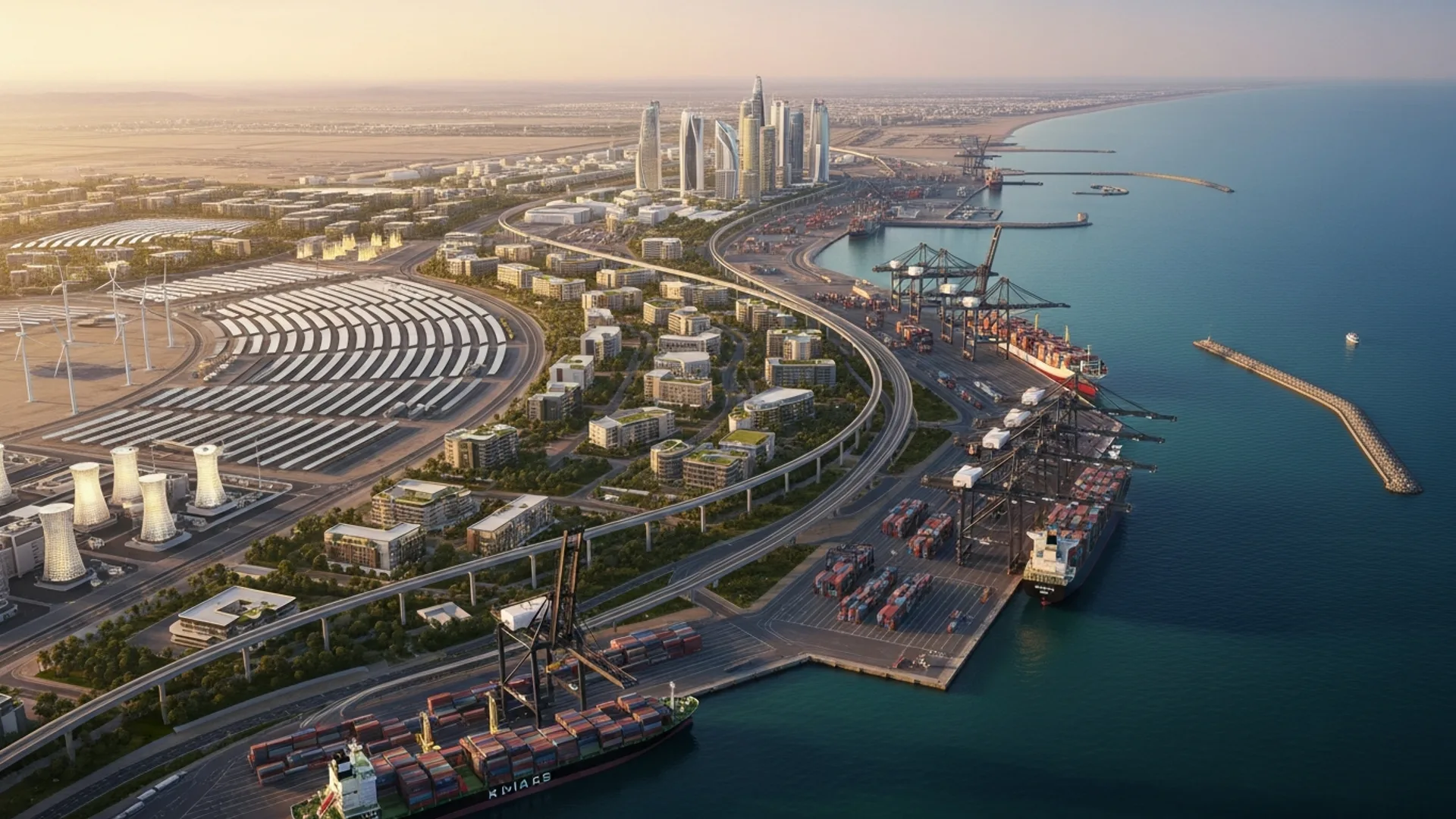
Oxagon sits near the existing port of Duba and is built around a deep-water port and integrated logistics. It is positioned as a model for next-generation manufacturing — combining industry, technology, research and supply-chain infrastructure in one location. For a foreign company, Oxagon is where the giga-project intersects with real commercial activity: industrial plots, logistics, energy projects and technology campuses.
Two anchor developments illustrate the scale. NEOM Green Hydrogen Company — a joint venture between NEOM, ACWA Power and Air Products — reached around 90% completion in early 2026 and is on track to produce up to 600 tonnes of green hydrogen per day, with commercial output targeted for 2027 and green-ammonia exports following. In February 2026, Oxagon also announced a major partnership to build a large-scale AI data-centre campus expected to be operational later this decade, signalling its push into digital infrastructure. These are not concept renders; they are funded, contracted projects with named partners, and they define the kind of businesses Oxagon is actively courting.
What makes Oxagon distinctive is its integration of port, industry and innovation in a single planned environment. A manufacturer can, in principle, import raw inputs through the deep-water port, process them in an adjacent industrial plot, draw on clean power, and ship finished goods back out — all within one zone designed around advanced logistics and automation. For sectors where energy cost and supply-chain proximity drive competitiveness — hydrogen derivatives, batteries, building components, and data infrastructure — that co-location is the core commercial argument. Companies evaluating Oxagon typically assess three things: access to competitively priced clean energy, the availability of suitable industrial land or campus space, and the offtake or partnership relationship with NEOM’s own ventures.
Key sectors and opportunities for foreign businesses
NEOM’s investment priorities map closely to Vision 2030’s diversification goals. The sectors with the clearest near-term opportunity include:
- Clean energy and green hydrogen — generation, electrolysis, ammonia, and the supply chain feeding flagship projects at Oxagon.
- Advanced manufacturing — modular construction, mobility, batteries, components and high-value industrial production.
- Technology and digital infrastructure — data centres, AI, robotics, and connectivity.
- Logistics and supply chain — built around Oxagon’s port and its position on a major global shipping route.
- Tourism and hospitality — across NEOM’s leisure regions and the wider Red Sea coast.
- Construction, engineering and services — supporting the build-out of the giga-project itself.
Foreign companies typically engage either by supplying these projects, partnering on them, or establishing a local entity to operate inside the ecosystem. The opportunity is not limited to mega-contractors. The build-out of an industrial city generates demand across a long supply chain — specialist engineering, environmental and water technology, safety and inspection services, modular fabrication, software and automation, facilities management, recruitment, training and professional services. A focused small or mid-sized company with genuine technical capability can find a niche servicing the larger anchor projects, often without the capital intensity of an industrial plot of its own.
Clean energy and green hydrogen deserve a special mention because they are the spine of NEOM’s industrial identity. Beyond the flagship hydrogen plant itself, there is an emerging supply chain — electrolyser components, ammonia handling, storage, transport, and the engineering and maintenance ecosystem around it. Companies positioned in renewables, power systems, or industrial gases have a clearer route to relevance here than almost anywhere else in the region, and aligning early with the Kingdom’s energy-transition priorities is viewed favourably.
How companies engage with NEOM
There is no single “NEOM business licence” you simply buy off the shelf. In practice, engagement happens through several routes, and most businesses combine them:
1. As a supplier or contractor
Many companies first work with NEOM by winning contracts — construction, engineering, equipment, technology, or professional services — supplying the projects under way. This often does not require a NEOM-based entity at all, only a valid Saudi presence and a MISA registration to invoice and operate.
2. With NEOM as an investor or partner
NEOM and its subsidiaries act as co-investors and joint-venture partners — the green hydrogen venture is the clearest example. Companies with strong technology or capability can partner directly, with NEOM taking an equity or offtake position.
3. As a company set up in Oxagon
Businesses that want a physical industrial, logistics or technology base establish an entity and take space within Oxagon. This is the route most people mean by “setting up in NEOM,” and it runs through Saudi Arabia’s standard foreign-investment process plus the relevant zone and municipal approvals.
4. As a Regional Headquarters (RHQ)
Multinationals that want to base their regional leadership in the Kingdom — and qualify for incentives such as the RHQ programme’s long-term corporate-tax relief — can establish an RHQ in Saudi Arabia while supplying or partnering with NEOM. By early 2026, more than 600 multinationals had established regional headquarters in the Kingdom, an approach that pairs a strategic Saudi base with project-level engagement at NEOM. Most companies move along this spectrum over time: they begin as a supplier or partner, then graduate to a local entity or a physical presence as their NEOM business grows.
The special economic and regulatory framing
Saudi Arabia has built a layered system of special economic zones (SEZs) under the Economic Cities and Special Zones Authority (ECZA) to attract industry with competitive incentives. While zones such as King Abdullah Economic City, Jazan, Ras Al-Khair and the Cloud Computing SEZ have published headline frameworks, the broad incentive model that NEOM and Oxagon are aligned with includes:
| Incentive area | Typical SEZ benefit (2026) |
|---|---|
| Corporate income tax | Reduced rate (advertised at 5% for qualifying activities for up to 20 years, subject to conditions) |
| Customs duties | Deferral / relief on capital equipment and inputs used inside the zone |
| VAT | Suspended on qualifying goods related to zone activities |
| Withholding tax | Exemptions on certain payments to non-residents during the incentive period |
| Foreign ownership | 100% foreign ownership in most activities |
| Licensing | Streamlined, zone-specific procedures |
SEZ incentives are activity-specific and conditional. Always confirm the exact rate, eligibility and terms for your zone and activity on the official ECZA portal and with MISA before relying on any figure.
The regulatory logic behind these zones is straightforward: the Kingdom wants to attract industry, technology and capital into priority sectors, so it offers a more competitive cost base than the mainland — lower headline tax, deferred or relieved customs on equipment and inputs, and streamlined, zone-specific licensing — in exchange for genuine activity and substance inside the zone. Eligibility typically depends on operating a qualifying activity, meeting substance requirements, and remaining compliant with national bodies such as ZATCA. Importantly, the incentives are not a way to avoid registration: companies still register their entity, file with ZATCA, and meet labour obligations. The benefit is a more favourable operating framework once you are properly established and qualifying.
For a NEOM-focused business, the practical question is which framework applies to your specific activity and footprint. Some companies will operate under standard mainland rules while serving NEOM as suppliers; others taking dedicated space in Oxagon will assess the zone-specific terms that apply there. Because the details are activity-by-activity, the right sequence is to confirm your classification with MISA and the relevant zone authority before modelling your tax position — never assume the headline 5% applies to you automatically.
How to enter: the practical route for a foreign investor
Whether you set up inside Oxagon or simply want to operate in the Kingdom to serve NEOM, the entry path runs through Saudi Arabia’s national investment system. Under the updated Investment Law that reached full maturity by 2026, the old licence-only model has shifted toward a streamlined registration with the Ministry of Investment of Saudi Arabia (MISA). The core steps:
- Confirm your activity and route. Decide whether you need a Saudi entity, a branch, a Regional Headquarters (RHQ), or simply a supplier registration to serve NEOM projects.
- Register with MISA. Submit your attested corporate documents to obtain your MISA investment registration — typically issued within 3 to 10 business days when paperwork is complete. MISA licence issuance and renewal fees were suspended in 2026 as part of investor facilitation.
- Obtain your Commercial Registration (CR). Register the company with the Ministry of Commerce via the Saudi Business Center to receive your CR under the unified national system.
- Secure zone, municipal and sector approvals. For an Oxagon presence, coordinate land/space, the relevant SEZ approvals and any activity-specific permits.
- Complete post-setup registrations. Register with ZATCA (Zakat, tax, VAT and e-invoicing), GOSI (social insurance), and Qiwa/Muqeem for labour and Iqama management, and open a corporate bank account.
For a deeper walk-through of the national process, see our guide to company formation in Saudi Arabia, and for the licence itself, our explainer on the MISA licence.
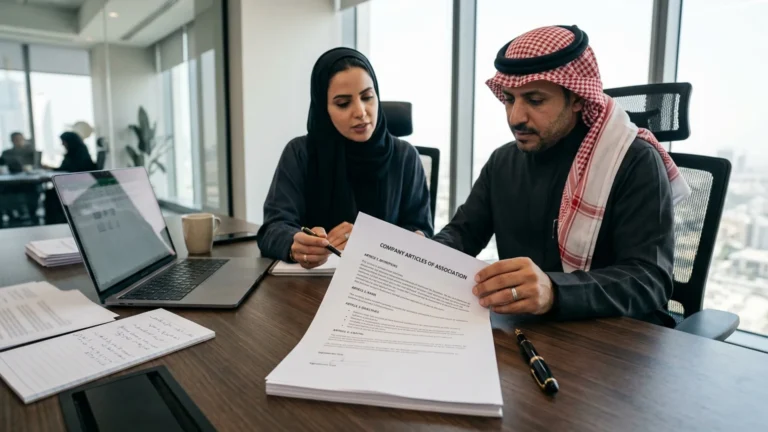
A few documents are common to almost every route. You will need the parent company’s certificate of registration and articles of association, board resolutions authorising the Saudi entity and appointing managers, passport copies of shareholders and directors, and — for a Standard Investment Registration — typically evidence that the parent has been established abroad for at least a year, along with audited financial statements. Each foreign document must be notarised in its country of origin, legalised through the Saudi embassy, and translated into Arabic by an approved translator inside the Kingdom. Getting this pack right the first time is the single biggest determinant of how fast your entry goes.
Compliance and what to plan for after setup
Entering NEOM’s ecosystem is the beginning, not the end. Once your entity is live you operate within the Kingdom’s national compliance framework, and planning for it early prevents costly delays:
- ZATCA — registration for Zakat or corporate tax, VAT where applicable, and mandatory e-invoicing (Fatoora). This is required regardless of any zone incentive.
- GOSI — enrolment of employees in the social-insurance system.
- Qiwa and Muqeem — your labour file, work visas, and the management of resident (Iqama) permits for foreign staff.
- Saudization (Nitaqat) — meeting the Saudi-national hiring ratio that applies to your sector and company size. NEOM’s industrial focus also creates real opportunities to build local talent, which aligns with national workforce-development goals.
- Banking — opening a corporate account, which depends on having your CR and authorised-signatory documents in order.
A practical sequencing tip: line up the people side (labour file, Saudization plan, banking) in parallel with the entity setup rather than after it. Companies that treat hiring and compliance as an afterthought often find their go-live date slips even though the licence and CR were issued quickly.
Costs and timeline: what to budget
There is no fixed “NEOM setup fee”; your cost is the national setup cost plus any zone-specific space and approvals. The table below shows indicative components for a standard foreign-owned company in 2026.
| Cost component | Indicative amount (SAR) | Notes |
|---|---|---|
| MISA investment registration | Issuance/renewal fee suspended in 2026 | Previously SAR 12,000 first year / 62,000 renewal |
| Commercial Registration (CR) | 1,200 – 2,000 | One-time, via Saudi Business Center |
| Chamber of Commerce | 2,000 – 3,000 / year | Annual subscription |
| Zone space / industrial plot | Varies by activity & footprint | Oxagon land, logistics or tech-campus space |
| Attestation & translation | Varies | Notarisation, Saudi embassy legalisation, certified Arabic translation |
| Government & advisory support (Noble Core) | from 36,999 | Transparent end-to-end package |
For a straightforward entity, the national registration and CR can be completed in days to a few weeks with attested documents ready. Securing Oxagon space and sector-specific approvals adds time depending on the project. Document attestation in your home country is usually the longest-lead item — start it first.
Why NEOM and Saudi Arabia in 2026
Saudi Arabia is the largest economy in the Gulf, and the Public Investment Fund is channelling significant capital into the non-oil sectors NEOM represents — clean energy, advanced manufacturing, technology and tourism. With 100% foreign ownership available in most activities, suspended MISA fees, competitive SEZ incentives, and more than 600 multinationals having established regional headquarters in the Kingdom by early 2026, the entry window for foreign founders and industrial operators is one of the most open it has ever been. Engaging with Oxagon’s clean-energy and industrial ecosystem positions a company at the centre of one of the region’s most ambitious growth stories.
Common mistakes to avoid
- Looking for a one-step “NEOM licence.” Entry runs through the national MISA registration and CR plus zone approvals — not a single off-the-shelf permit.
- Assuming you must have physical space in Oxagon to do business with NEOM. Many companies start purely as suppliers or partners with a standard Saudi registration.
- Treating advertised SEZ tax figures as guaranteed. The 5% rate and customs relief are activity-specific and conditional — verify your eligibility with ECZA and MISA.
- Leaving document attestation to the last minute. Notarisation, embassy legalisation and Arabic translation are the most common cause of delay.
- Skipping post-setup registrations. ZATCA, GOSI and Qiwa/Muqeem are mandatory before you can invoice, hire or sponsor staff.
- Ignoring Saudization (Nitaqat). Hiring ratios apply once you employ staff — factor them into your operating plan from day one.
Need help setting up in Saudi Arabia? Noble Core handles your MISA licence, commercial registration, and visas end-to-end — done right the first time.
Frequently Asked Questions
What is the easiest way to set up a business in NEOM in 2026?
The most practical route is engaging with Oxagon, NEOM’s industrial hub. You register with MISA to obtain an investment registration, then complete your Commercial Registration via the Saudi Business Center, and secure any Oxagon space and sector approvals. Many companies begin even more simply as suppliers or partners with a standard Saudi registration.
Can a foreign company own 100% of a business in NEOM?
Yes. Under Saudi Arabia’s 2026 investment framework, foreign investors can own 100% of a company in most activities, including within NEOM and its special economic zones, without a Saudi partner. A small number of restricted activities are the exception, so confirm your specific activity with MISA before applying.
What is Oxagon and why does it matter for business?
Oxagon is NEOM’s industrial and innovation city on the Red Sea, built around a deep-water port and integrated logistics. It is the region with the clearest commercial path, hosting flagship projects in green hydrogen, advanced manufacturing, logistics and digital infrastructure — making it the main entry point for companies setting up in NEOM.
What tax incentives apply to NEOM and Saudi special economic zones?
Saudi special economic zones, governed by ECZA, advertise incentives such as a reduced corporate income tax rate (5% for qualifying activities for up to 20 years), customs duty deferral, VAT suspension on qualifying goods, and withholding-tax exemptions. These are activity-specific and conditional, so verify eligibility and exact terms on the official ECZA and MISA portals.
Do I need an office in Oxagon to work with NEOM?
Not necessarily. Many foreign companies engage with NEOM as suppliers, contractors or joint-venture partners with only a standard Saudi MISA registration and Commercial Registration. A physical Oxagon presence is needed when you want an industrial, logistics or technology base inside the zone itself.
How long does it take to enter the Saudi market to serve NEOM?
With complete, attested documents, the MISA investment registration is typically issued within 3 to 10 business days, and the Commercial Registration follows shortly after. Securing Oxagon space and sector-specific approvals adds time. Document attestation in your home country is usually the longest-lead step, so begin it first.
What sectors does NEOM prioritise for investment?
NEOM focuses on clean energy and green hydrogen, advanced manufacturing, technology and digital infrastructure including AI and data centres, logistics, tourism, and the construction and engineering services supporting the giga-project. These align with Vision 2030’s diversification goals and offer the clearest opportunities for foreign businesses.
What does it cost to set up a company to operate in NEOM?
There is no fixed NEOM fee. You pay the national setup cost — Commercial Registration around SAR 1,200–2,000, Chamber of Commerce SAR 2,000–3,000 per year, plus attestation and any Oxagon space — while MISA issuance and renewal fees are suspended in 2026. Noble Core offers a transparent end-to-end package from SAR 36,999.