
Starting an Agriculture / Agritech Company in Saudi Arabia (2026)
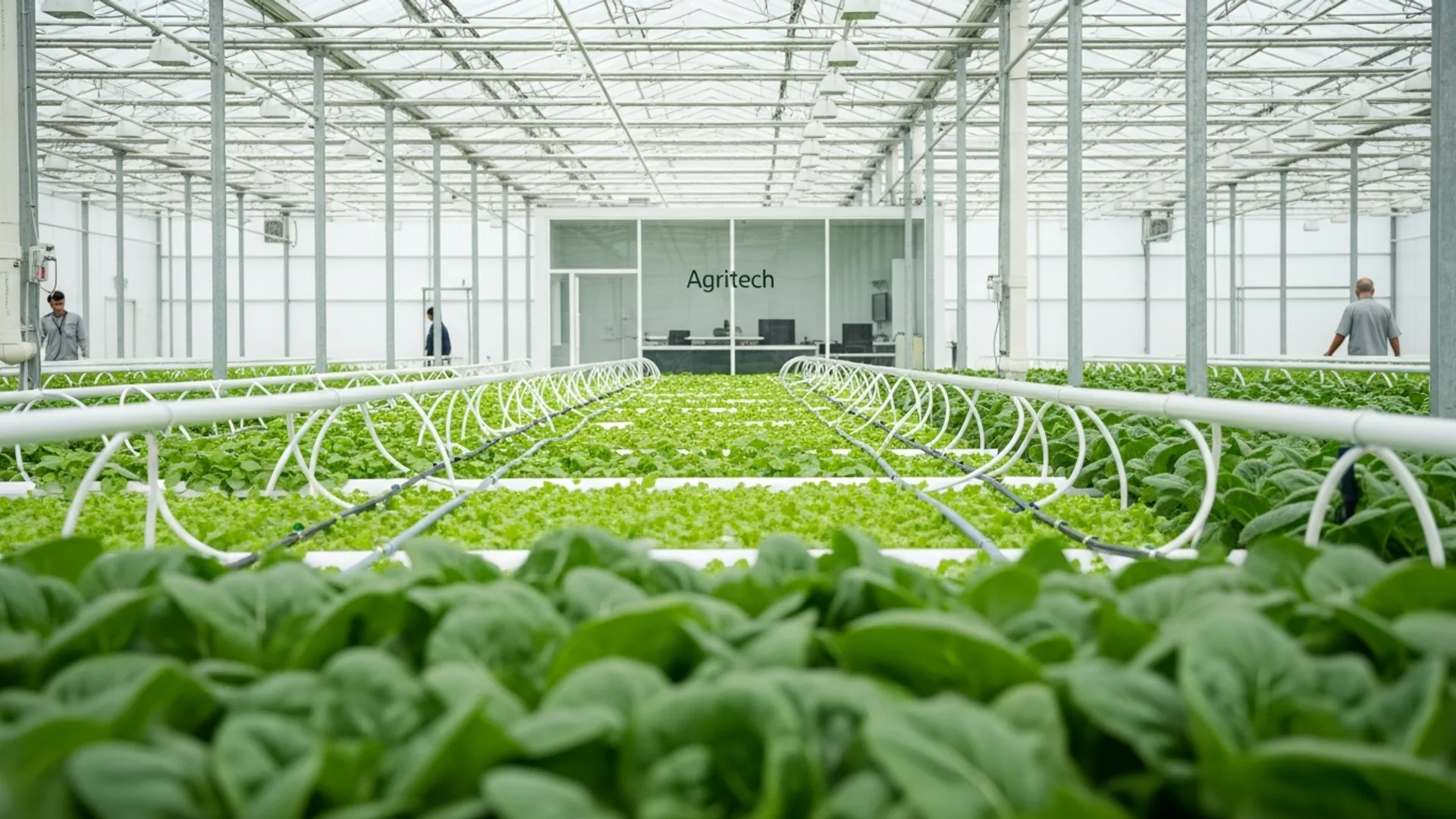
To start an agriculture or agritech company in Saudi Arabia in 2026, you obtain a MISA investment licence (issued in roughly 3–10 business days), then register a unified national Commercial Register through the Ministry of Commerce (CR fee ~SAR 1,200–2,000). Foreign investors can hold 100% ownership in most farming, food-production and agri-technology activities, MISA licence issue and renewal fees are suspended in 2026, and a typical Noble Core launch package starts from SAR 36,999.
Saudi Arabia is one of the most active agriculture and agritech markets in the region. Under Vision 2030 and the Kingdom’s food-security and sustainability programmes, demand is rising for greenhouse and hydroponic farming, controlled-environment agriculture (CEA), precision-irrigation technology, cold-chain logistics, aquaculture, dairy, poultry, dates and high-value horticulture. This guide walks you through exactly what an agriculture company licence is, who needs it, the step-by-step setup on the official portals, the documents required, indicative fees and timelines, the common mistakes investors make, and how Noble Core handles the entire process for you.
What is an agriculture / agritech company licence in Saudi Arabia?
An agriculture or agritech company in Saudi Arabia is a legal entity authorised to carry out farming, food production, agricultural services or agriculture-related technology activities under a licence regulated by the Ministry of Investment of Saudi Arabia (MISA) and registered with the Ministry of Commerce. For foreign investors, the journey begins with a MISA investment licence, which is the federal permission for non-Saudi shareholders to own and operate a business in the Kingdom.
“Agriculture” is a broad umbrella. Depending on the exact ISIC activity codes you select, your company can cover:
- Crop and plant production — open-field farming, greenhouses, hydroponics, vertical and controlled-environment agriculture.
- Livestock and animal production — poultry, dairy, sheep, beekeeping and related services.
- Aquaculture and fisheries — fish and shrimp farming, hatcheries and aquatic feed.
- Agritech and AgriTech services — precision agriculture, IoT sensors, drone surveying, irrigation automation, farm-management software and agri-analytics.
- Agricultural trade and processing — food processing, packing, cold storage, distribution and the import/export of agricultural inputs and produce.
The activity you choose determines which secondary approvals you may need (for example, from the Ministry of Environment, Water and Agriculture, MEWA) and whether your activity qualifies for 100% foreign ownership, which most agriculture and agritech activities now do.
Who needs an agriculture company in Saudi Arabia?
You need to set up a licensed agriculture or agritech company if you intend to operate commercially in the Kingdom rather than simply trade from abroad. Typical investors include:
- International agribusiness groups establishing greenhouse, dairy, poultry or aquaculture operations to supply the domestic market.
- Agritech founders and start-ups deploying precision-farming, irrigation-efficiency, vertical-farming or farm-management software inside Saudi Arabia.
- Food-security and import-substitution ventures producing crops, proteins or processed foods locally.
- Equipment and input suppliers distributing seeds, fertilisers, feed, machinery or controlled-environment systems.
- GCC and UAE companies expanding cross-border into the Saudi market and needing a registered Saudi entity to bid for contracts and hire staff.
If you only export produce or equipment to Saudi buyers without a local presence, you may not need a full company; but to manufacture, farm, employ residents, sign government or retail supply contracts, or access local incentives, a registered Saudi entity is required. If you are still deciding between a branch, a limited liability company or a regional headquarters, our company formation in Saudi Arabia guide breaks down each structure and its cost.
Step-by-step: how to set up an agriculture company in Saudi Arabia
The process is sequential and largely digital. Below is the route most foreign-owned agriculture and agritech companies follow in 2026.
- Reserve a trade name and pick activities. Choose a company name and select your agriculture/agritech ISIC activity codes. Under the new Commercial Register Law effective 3 April 2026, English trade names are now allowed alongside Arabic.
- Apply for the MISA investment licence. Submit your application to the Ministry of Investment of Saudi Arabia through the MISA investor portal at misa.gov.sa. You upload your corporate documents and choose the licence category that matches your activity. MISA licensing typically takes about 3–10 business days, and issue/renewal fees are suspended in 2026.
- Issue the unified Commercial Register (CR). Once the MISA licence is granted, register the company with the Ministry of Commerce via the Saudi Business Center at mc.gov.sa. Under the 2026 CR reform, you receive one unified national CR whose ID starts with “7”, has no expiry date (you file an annual confirmation instead), and benefits from a 5-year grace period for compliance.
- Draft and notarise the Articles of Association. For a limited liability company, the AoA defines shareholders, capital and management. This is filed electronically with the Ministry of Commerce.
- Register with the Chamber of Commerce. Membership of the relevant regional Chamber is required and runs at roughly SAR 2,000–3,000 per year depending on capital and category.
- Open a corporate bank account and deposit capital. With the CR and AoA, open a Saudi corporate account. Capital requirements vary by activity and structure.
- Register for tax with ZATCA. Enrol for VAT (15%) and corporate tax with the Zakat, Tax and Customs Authority at zatca.gov.sa, and prepare for ZATCA’s e-invoicing (Fatoora) integration, which is rolling out in waves.
- Set up labour and social-insurance files. Open your employer file with the Ministry of Human Resources and Social Development (MHRSD) on Qiwa at qiwa.sa and register with the General Organization for Social Insurance (GOSI) at gosi.gov.sa. Total GOSI contributions for a Saudi employee are around 21.5% (employer and employee combined).
- Obtain sector approvals where required. Certain agriculture activities — water-intensive farming, livestock, aquaculture or agro-chemical handling — may require additional permits from the Ministry of Environment, Water and Agriculture (MEWA).
- Process visas and residency for staff. Use Qiwa for work permits and the MOFA visa platform (Enjaz) at visa.mofa.gov.sa for entry visas; residency (Iqama) is then issued and managed through Absher at absher.sa and Muqeem at muqeem.sa.
Because the MISA licence is the gateway to everything else, getting it right the first time saves weeks. Our dedicated MISA license in Saudi Arabia guide explains the categories, capital thresholds and document standards in detail.
Required documents and IDs
Document requirements vary by shareholder type (individual vs corporate) and activity, but the core set for a foreign-owned agriculture or agritech company usually includes:
- Corporate documents of the foreign parent — certificate of incorporation, commercial register/extract and Articles of Association, attested and translated into Arabic.
- Audited financial statements of the parent company for the most recent year (commonly requested by MISA).
- Board resolution authorising the Saudi investment and appointing a representative.
- Passport copies of shareholders, directors and the proposed general manager.
- Proposed Saudi company name(s) and the chosen ISIC activity codes.
- Power of attorney if a consultant such as Noble Core files on your behalf.
- Lease or premises evidence for office, farm, greenhouse or facility (may be required at a later stage).
- Sector-specific approvals from MEWA for relevant farming, water or livestock activities.
Foreign documents must usually be legalised/apostilled in the country of origin and attested for use in Saudi Arabia, then translated by a certified translator. Getting attestation done early is one of the biggest time-savers in the whole process.
Indicative fees and timeline
The table below summarises the main government and setup costs for an agriculture/agritech company. All figures are indicative for 2026 — confirm current figures on the official portal before budgeting, as government fees and thresholds are periodically updated.
| Item | Authority / Portal | Indicative cost (SAR) | Typical timeline |
|---|---|---|---|
| MISA investment licence (issue) | MISA — misa.gov.sa | Fee suspended in 2026 (was 12,000) | 3–10 business days |
| MISA licence renewal | MISA — misa.gov.sa | Fee suspended in 2026 (was 62,000) | Annual |
| Unified Commercial Register (CR) | Ministry of Commerce — mc.gov.sa | ~1,200–2,000 | 1–3 business days |
| Chamber of Commerce membership | Regional Chamber | ~2,000–3,000 / year | 1–2 business days |
| VAT / tax registration | ZATCA — zatca.gov.sa | No fee (VAT charged at 15%) | 1–3 business days |
| Iqama (residency) per employee | Absher / MOFA | ~650 / year + levies | 1–2 weeks |
| GOSI social insurance (Saudi staff) | GOSI — gosi.gov.sa | ~21.5% of salary (employer+employee) | Ongoing monthly |
| Noble Core launch package | Noble Core Ventures | From 36,999 | End-to-end managed |
A realistic end-to-end timeline for a straightforward foreign-owned agriculture company, assuming documents are ready and attested, is roughly 3–6 weeks from MISA application to a fully operational entity with bank account, tax file and employer registration. Complex activities needing MEWA approvals can take longer.
Sector approvals: working with MEWA and other regulators
Many agriculture activities touch natural resources, so a second regulatory layer often applies on top of the standard MISA + Ministry of Commerce track. The Ministry of Environment, Water and Agriculture (MEWA) oversees water usage, agricultural land, livestock, plant health and food production. Depending on your activity, you may need:
- Water-use permits for irrigation-intensive farming or groundwater wells.
- Agricultural-land allocation or use approvals for open-field cultivation.
- Veterinary and animal-health registration for livestock, poultry and dairy.
- Aquaculture site and species permits for fish or shrimp farming.
- Plant-protection and import permits for seeds, seedlings and agro-inputs.
Agritech companies that build software, sensors or analytics, rather than farming directly, often face a lighter approval path because they are classified under technology or professional services. Where your business spans both — for example, a vertical-farming operator that also licenses its growing software — your consultant will help map activities so you capture the right codes without triggering unnecessary permits.
Saudisation, hiring and social insurance
Once your entity is live, hiring is managed through Qiwa (the MHRSD labour platform) and GOSI (social insurance). Saudi Arabia operates the Nitaqat Saudisation framework, which sets a target percentage of Saudi nationals in your workforce based on company size and sector. Agriculture and food-production activities have their own Saudisation bands, and meeting them unlocks smoother work-permit issuance for foreign staff.
Practical steps after incorporation:
- Open your Qiwa establishment file and confirm your Nitaqat category.
- Register employees with GOSI (total contributions around 21.5% for Saudi staff; a lower rate applies to non-Saudi staff covering occupational hazards).
- Issue work permits via Qiwa and entry visas via the MOFA Enjaz platform.
- Process Iqama issuance and renewals through Absher and track residency status on Muqeem.
Planning your Saudisation ratio before you hire — rather than after — keeps your entity in a favourable Nitaqat band and avoids hiring bottlenecks during a busy planting or production season.
Taxes, e-invoicing and ongoing compliance
After setup, your agriculture company has recurring obligations administered mainly by ZATCA and the Ministry of Commerce:
- VAT at 15% on most taxable supplies, filed periodically through ZATCA.
- E-invoicing (Fatoora) — ZATCA is integrating businesses into the e-invoicing system in waves; your accounting system must generate compliant electronic invoices once your wave applies.
- Zakat and/or corporate income tax — Saudi/GCC-owned shares are subject to Zakat, while foreign-owned shares are subject to corporate income tax; mixed ownership is apportioned.
- Annual CR confirmation — under the 2026 Commercial Register Law the CR no longer expires, but you must file an annual confirmation to keep it active.
- GOSI and payroll filings — monthly social-insurance contributions and wage-protection compliance.
Keeping these obligations current protects your licence and your eligibility for government tenders, subsidies and incentive programmes that support local food production.
High-opportunity agriculture and agritech segments in 2026
Choosing the right segment shapes your activity codes, capital needs and approval path. Under the Kingdom’s food-security and sustainability priorities, several agriculture and agritech segments are attracting strong investor interest in 2026:
- Controlled-environment agriculture (CEA) — greenhouses, hydroponics and vertical farms that grow leafy greens, tomatoes, herbs and strawberries year-round using a fraction of the water of open-field farming. CEA suits the climate and aligns with water-efficiency goals.
- Precision agriculture and farm IoT — soil and moisture sensors, satellite and drone imagery, variable-rate irrigation and farm-management dashboards that raise yields and cut input waste.
- Aquaculture — Red Sea and inland fish and shrimp farming, hatcheries and aquatic feed, supporting domestic protein supply.
- Dairy, poultry and red-meat production — large-scale local production that reduces reliance on imports.
- Dates and high-value horticulture — the Kingdom is a global leader in date production, and value-added processing, packing and export sit alongside it.
- Cold chain and agri-logistics — refrigerated storage, processing and distribution that reduce post-harvest loss and connect farms to retail.
- Agri-inputs and bio-solutions — seeds, fertilisers, feed, biological crop protection and soil amendments.
Pairing a production activity with a technology or processing activity — for example, a hydroponic farm that also licenses its growing software, or a date producer that adds packing and export — can broaden your revenue and your eligibility for incentive programmes, provided the activity codes are mapped cleanly at the MISA and Commercial Register stage.
Choosing your location: region, land and facility type
Where you base your agriculture company affects logistics, water access, land allocation and proximity to markets. Practical considerations include:
- Proximity to demand — operations near Riyadh, Jeddah, Makkah and the Eastern Province sit close to the largest consumer markets and retail distribution.
- Water and land availability — open-field and water-intensive farming depend on MEWA allocations, so site selection and permits go hand in hand; CEA reduces this dependency.
- Climate suitability — cooler highland regions such as the southwest favour certain crops, while CEA lets you control conditions anywhere.
- Agri-industrial and economic zones — locating in a designated industrial city or economic zone can simplify utilities, logistics and approvals for processing and packing operations.
- Cold-chain links — perishable produce and proteins need to be close to refrigerated storage and transport corridors to minimise post-harvest loss.
For agritech software and services companies that do not farm directly, a standard commercial office address is usually sufficient, and you avoid the land and water-permit layer entirely. Mapping your physical footprint early — office, farm, greenhouse, hatchery or processing plant — ensures your lease evidence and any MEWA permits are ready when MISA and the Ministry of Commerce request them.
Common errors and how to avoid them
Most delays in agriculture company setup are avoidable. The recurring problems we see are document attestation gaps, mismatched activity codes, and skipping sector approvals until late in the process. Plan the regulatory map first, then execute.
Common mistakes to avoid
- Choosing the wrong ISIC activity codes — too broad and you trigger permits you don’t need; too narrow and you can’t legally operate. Map activities precisely before filing.
- Leaving document attestation to the end — apostille and legalisation of parent-company documents abroad is the single most common cause of delay.
- Ignoring MEWA approvals for water, land, livestock or aquaculture until after the CR is issued, then having to backtrack.
- Underestimating Saudisation — failing to plan your Nitaqat band before hiring slows work-permit issuance.
- Assuming old MISA fees still apply — issue and renewal fees are suspended in 2026; budget from current portal figures, not outdated quotes.
- Overlooking e-invoicing readiness — buying accounting software that isn’t ZATCA Fatoora-compliant causes problems once your wave begins.
- Not filing the annual CR confirmation — under the new no-expiry CR system, a missed annual confirmation can deactivate your register.
How Noble Core helps you launch your agriculture company
Noble Core Ventures manages the full agriculture and agritech setup journey in Saudi Arabia so you can focus on production, not paperwork. Our team handles:
- Activity and structure mapping — selecting the right ISIC codes and entity type (LLC, branch or regional HQ) for your farming, processing or agritech model.
- MISA licence application — preparing and submitting your file on the MISA investor portal, typically within the 3–10 business-day window.
- Commercial Register and AoA — issuing your unified national CR through the Saudi Business Center and drafting your Articles of Association.
- Sector permits — coordinating MEWA and other approvals for water, land, livestock and aquaculture activities.
- Tax, banking and payroll — ZATCA registration, e-invoicing readiness, corporate bank account introductions, and Qiwa/GOSI employer setup.
- Visas and residency — work permits via Qiwa, entry visas via MOFA Enjaz, and Iqama processing via Absher and Muqeem.
With packages starting from SAR 36,999, Noble Core gives you a single point of contact across MISA, the Ministry of Commerce, ZATCA, MHRSD, GOSI and MEWA — turning a multi-portal, multi-authority process into one managed timeline. Whether you are planting a greenhouse operation, scaling an agritech platform, or expanding from the UAE into the Kingdom, we get your agriculture company in Saudi Arabia licensed, registered and ready to grow.
Need help setting up in Saudi Arabia? Noble Core handles your MISA licence, commercial registration, and visas end-to-end — done right the first time.
Frequently Asked Questions
How do I start an agriculture company in Saudi Arabia in 2026?
To start an agriculture company in Saudi Arabia, first obtain a MISA investment licence (issued in about 3-10 business days), then register a unified Commercial Register through the Ministry of Commerce. Foreign investors can own 100% of most agriculture and agritech activities, MISA licence fees are suspended in 2026, and certain farming activities also need MEWA sector approvals.
Can foreigners own 100% of an agriculture company in Saudi Arabia?
Yes, foreign investors can own 100% of an agriculture company in Saudi Arabia in most farming, food-production and agritech activities. Ownership is authorised through a MISA investment licence from the Ministry of Investment of Saudi Arabia. A small number of restricted or strategic activities may require a Saudi partner or extra approvals, so confirm your exact ISIC activity codes before applying.
How much does it cost to set up an agriculture company in Saudi Arabia?
Indicative 2026 costs include a MISA licence (issue and renewal fees suspended this year), a unified Commercial Register at roughly SAR 1,200-2,000, and Chamber of Commerce membership around SAR 2,000-3,000 per year. VAT applies at 15% and GOSI contributions are about 21.5% for Saudi staff. Noble Core managed packages start from SAR 36,999. Confirm current figures on the official portals.
How long does it take to register an agriculture company in Saudi Arabia?
A straightforward foreign-owned agriculture company usually takes about 3-6 weeks end to end, assuming documents are attested and ready. The MISA investment licence itself is typically issued within 3-10 business days, and the unified Commercial Register follows in 1-3 business days. Activities needing MEWA water, land or livestock permits can extend the timeline.
What documents are needed for an agriculture company in Saudi Arabia?
You typically need the foreign parent’s certificate of incorporation, commercial register extract and Articles of Association (attested and translated into Arabic), recent audited financials, a board resolution authorising the investment, passport copies of shareholders and the general manager, the chosen company name and ISIC codes, and any MEWA sector approvals. A power of attorney is required if a consultant files for you.
What is a MISA licence for an agriculture company in Saudi Arabia?
A MISA licence is the investment permission from the Ministry of Investment of Saudi Arabia that lets foreign investors own and operate an agriculture or agritech company in the Kingdom. It is the first step before issuing a Commercial Register. In 2026 MISA issue and renewal fees are suspended, and the licence is usually granted within 3-10 business days through the MISA investor portal at misa.gov.sa.
Do agritech companies in Saudi Arabia need different approvals than farms?
Agritech companies that build software, sensors, drones or analytics often follow a lighter path, usually classified under technology or professional services, and may not need MEWA permits. Direct farming, livestock, aquaculture and water-intensive activities typically require additional approvals from the Ministry of Environment, Water and Agriculture (MEWA). Companies that both farm and license technology should map activities carefully to capture the right codes.
What taxes apply to an agriculture company in Saudi Arabia?
An agriculture company in Saudi Arabia registers for VAT at 15% with ZATCA and must prepare for e-invoicing (Fatoora), which rolls out in waves. Saudi and GCC-owned shares are subject to Zakat, while foreign-owned shares are subject to corporate income tax, with mixed ownership apportioned. Under the 2026 Commercial Register Law the CR no longer expires but requires an annual confirmation to stay active.