Opening a Cloud Kitchen in Saudi Arabia (2026)
Opening a cloud kitchen in Saudi Arabia in 2026 takes roughly 4 to 8 weeks and combines a Ministry of Commerce Commercial Register (CR), a municipal food licence, and Saudi Food and Drug Authority (SFDA) registration. Foreign investors first obtain a MISA investment licence (issued in about 3–10 business days, licence fees suspended in 2026), then complete CR, municipality, and Civil Defence steps across roughly 5 official portals. A cloud kitchen — also called a ghost kitchen, dark kitchen, or delivery-only kitchen — is a commercial food-preparation facility built purely for delivery orders, with no dine-in seating. This guide walks you through every authority, portal, document, and indicative fee so you can launch with confidence.
What is a cloud kitchen and why Saudi Arabia in 2026?
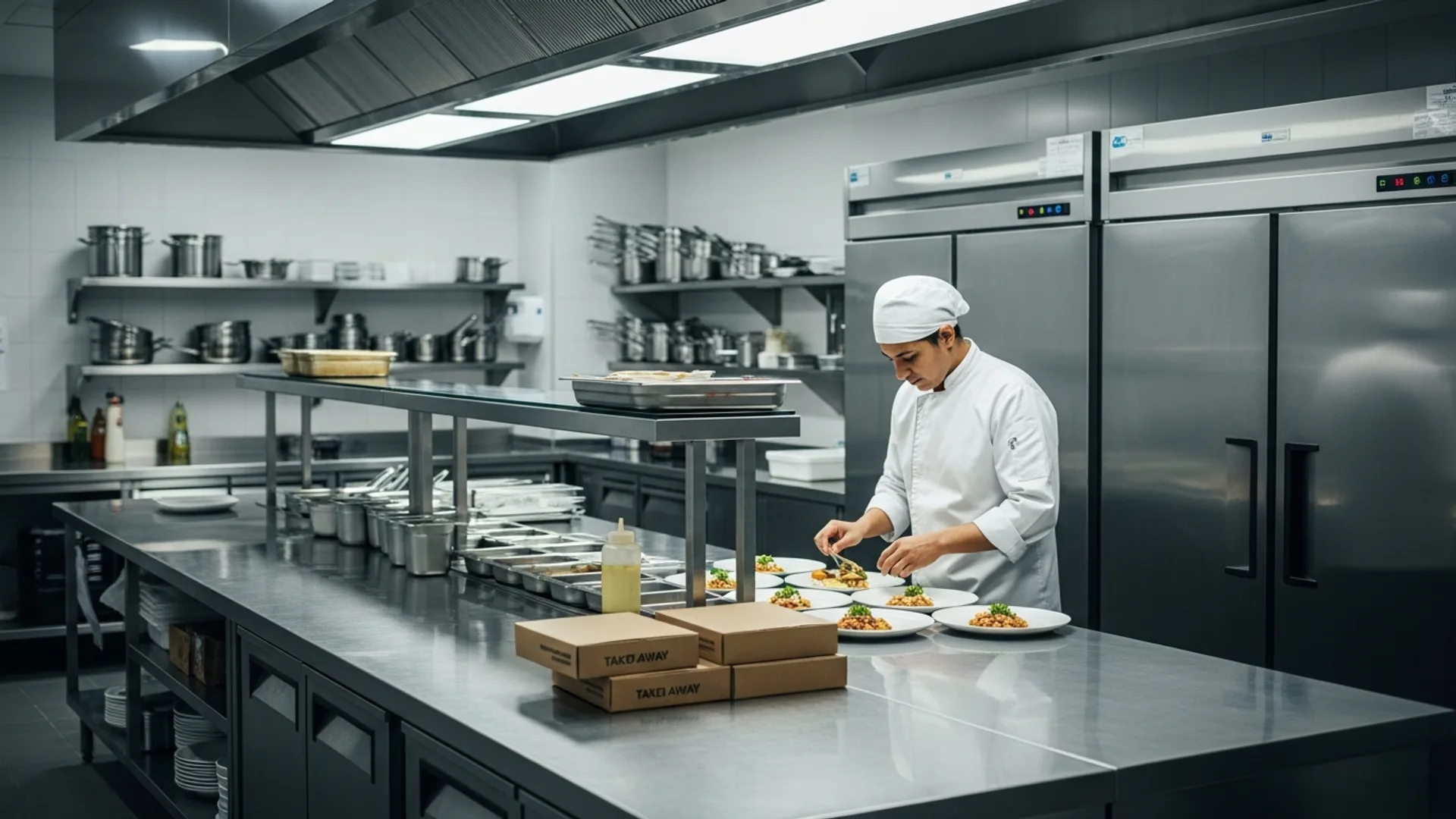
A cloud kitchen is a licensed commercial kitchen that prepares food exclusively for delivery and takeaway through apps such as HungerStation, Jahez, ToYou, Mrsool, and Keeta. There is no front-of-house dining area, which means lower rent, lower fit-out cost, and the ability to run several virtual restaurant “brands” out of a single kitchen.
The Kingdom’s online food-delivery market has grown rapidly under the digital-economy goals of Vision 2030. A young, smartphone-first population in Riyadh, Jeddah, and the Eastern Province orders delivery frequently, and 100% foreign ownership is permitted in most food-service activities. That combination — strong demand plus an investor-friendly framework — is why “cloud kitchen Saudi Arabia” has become one of the most searched food-business models among new entrants.
Operationally, cloud kitchens come in three common formats:
- Single-brand cloud kitchen — one operator, one brand, one delivery menu.
- Multi-brand cloud kitchen — one operator running several virtual brands from the same licensed kitchen.
- Shared / commissary kitchen — a facility operator rents fully-equipped kitchen pods to multiple food businesses (each tenant still needs its own licensing).
The economics are the real draw. Because there is no dining room, no waiting staff, and no prime-street rent, a delivery-only kitchen can reach break-even on a fraction of the capital a full restaurant needs. Investors can test a menu, gather real order data from the delivery apps, and iterate quickly — closing an underperforming virtual brand and launching a new one without touching the licence or the lease. That agility is exactly why the model has spread so quickly across Riyadh and Jeddah, and why both first-time founders and established restaurant groups are opening dedicated delivery kitchens in 2026.
Who needs a cloud kitchen licence?
Any business that prepares food for sale — even delivery-only — must be licensed in Saudi Arabia. You will need the full set of approvals if you are:
- A foreign investor or foreign-owned company launching a delivery food brand (requires a MISA investment licence first).
- A Saudi or GCC national setting up a delivery-only restaurant or commissary.
- An existing restaurant adding a separate delivery-only kitchen or a new virtual brand at a new address.
- A franchise operator localising an international food concept for the Saudi delivery market.
Foreign investors should treat the Ministry of Investment (MISA) licence as step zero. Without it, a non-Saudi shareholder cannot register the company on the Saudi Business Center (mc.gov.sa). Our MISA licence guide for Saudi Arabia explains eligibility, documents, and timelines in detail.
The authorities and portals involved
A cloud kitchen touches more government bodies than a typical trading company because food safety is tightly regulated. Name-check these before you start so nothing surprises you later:
- MISA (misa.gov.sa) — the investment licence for foreign owners.
- Ministry of Commerce / Saudi Business Center (mc.gov.sa) — the Commercial Register (CR) and trade name.
- The municipality (Amanah / Baladi) via balady.gov.sa — the municipal food-activity licence for the kitchen premises.
- SFDA (sfda.gov.sa) — food-establishment registration and food-safety compliance.
- General Directorate of Civil Defence — fire-safety and premises-safety approval.
- ZATCA (zatca.gov.sa) — VAT registration (15%) and Fatoora e-invoicing.
- MHRSD, Qiwa and GOSI (qiwa.sa, gosi.gov.sa) — labour file, Saudization (Nitaqat), and social-insurance registration once you hire.
- Absher / Muqeem (absher.sa, muqeem.sa) — visas, Iqamas, and residency management for foreign staff.
Step-by-step: how to open a cloud kitchen in Saudi Arabia
Follow these steps in order. Foreign investors start at Step 1; Saudi nationals can begin at Step 2.
- Obtain the MISA investment licence. Apply on the MISA portal (misa.gov.sa), upload your commercial registration from your home country (attested) and financial statements, and select the relevant food-service activity. MISA licensing typically takes about 3–10 business days. The MISA issuance and renewal fees that were historically SAR 12,000 / SAR 62,000 are suspended in 2026 — confirm the current position on the official portal.
- Reserve a trade name and issue the Commercial Register (CR). Log in to the Saudi Business Center (mc.gov.sa) with your Nafath/Absher credentials, reserve your company name (English trade names are now permitted under the new Commercial Register Law effective 3 April 2026), and issue the CR. Under the new law the unified national CR has no expiry — instead you file a free annual confirmation — and the CR ID begins with “7”. The CR issuance fee is indicative around SAR 1,200–2,000; confirm current figures on the official portal.
- Register Chamber of Commerce membership. Activate your Chamber membership (indicative SAR 2,000–3,000 per year) so you can authenticate documents and powers of attorney.
- Secure premises and apply for the municipal food licence. Lease a kitchen unit zoned for food activity, register the lease on the Ejar platform, then apply on Baladi (balady.gov.sa) for the municipal commercial-activity licence covering “cloud kitchen / catering / food preparation.” The municipality inspects the premises for hygiene, ventilation, drainage, and layout.
- Pass Civil Defence safety approval. Submit your fire-safety plan (extinguishers, gas detection, emergency exits, suppression hood) and book the Civil Defence inspection. The safety certificate is a prerequisite for the municipal licence to be finalised.
- Register the food establishment with SFDA. Register the facility and your food handlers with the Saudi Food and Drug Authority, ensure food-handler health cards and HACCP-aligned practices are in place, and comply with labelling and storage rules.
- Register for VAT and e-invoicing with ZATCA. Register for VAT (15%) on zatca.gov.sa once you cross the mandatory threshold, and integrate your POS with the Fatoora (e-invoicing) system in line with your assigned wave.
- Open the labour file and hire. Open your MHRSD/Qiwa labour file, register staff on GOSI (total social-insurance contribution for a Saudi employee is about 21.5%, split employer/employee), check your Nitaqat (Saudization) band, and process work visas and Iqamas via Absher/Muqeem.
- Open a corporate bank account and go live. With the CR, MISA licence, and national address in hand, open a Saudi business bank account, onboard with the delivery aggregators, and launch your menu.
Documents and IDs you will need
Prepare a single, attested document pack to avoid resubmission delays. For a foreign-owned cloud kitchen you will typically need:
- Attested home-country commercial registration and Articles of Association (for the corporate shareholder).
- Passport copies and photos of shareholders and the appointed manager.
- Audited financial statements (often requested by MISA).
- The reserved trade name and the draft Articles of Association for the Saudi entity.
- Ejar-registered lease contract for the kitchen premises.
- Premises layout/floor plan for municipal and Civil Defence review.
- Food-handler health cards and food-safety plan for SFDA.
- National Address registration and the company’s corporate bank details.
Indicative fees and timeline table
The figures below are indicative 2026 planning estimates. Government fees change and depend on activity, city, and kitchen size — always confirm current figures on the official portal before you budget.
| Step / item | Authority / portal | Indicative fee (SAR) | Typical timeline |
|---|---|---|---|
| MISA investment licence | MISA (misa.gov.sa) | Issue fee suspended in 2026 | 3–10 business days |
| Commercial Register (CR) | Saudi Business Center (mc.gov.sa) | ~1,200–2,000 | 1–3 business days |
| Chamber of Commerce membership | Chamber | ~2,000–3,000 / year | 1–2 business days |
| Municipal food licence | Baladi (balady.gov.sa) | ~2,000–6,000 | 1–3 weeks (incl. inspection) |
| Civil Defence safety approval | General Directorate of Civil Defence | ~1,000–3,000 | 1–2 weeks |
| SFDA food-establishment registration | SFDA (sfda.gov.sa) | Variable | 1–2 weeks |
| VAT registration + Fatoora | ZATCA (zatca.gov.sa) | No registration fee | Same week |
| Work visa + Iqama (per foreign worker) | Absher / Muqeem / MOFA Enjaz | ~650/year govt fee + levies | 2–4 weeks |
| Indicative total to launch | — | Activity-dependent | ~4–8 weeks |
Choosing your location and kitchen format
Location strategy for a delivery-only business is different from a dine-in restaurant. You are optimising for delivery radius and rider density, not foot traffic. Practical pointers:
- Delivery heat map first. Pick a unit within a 5–7 km radius of high-order neighbourhoods in Riyadh, Jeddah, or Dammam/Khobar.
- Confirm zoning. The unit must be municipally approved for food preparation; a retail or warehouse-only zone will be rejected on Baladi.
- Plan the layout for inspection. Separate raw and cooked areas, adequate ventilation and grease traps, hand-wash stations, and cold storage — these are checked by both the municipality and SFDA.
- Decide single-brand vs multi-brand early. Multi-brand kitchens maximise revenue per square metre but need a clean menu-engineering and packaging system.
Many investors choose a shared commissary for the first brand to validate demand before committing to a standalone build-out. Whichever model you pick, the licensing pathway is the same; the difference is mainly in lease structure and fit-out cost.
Setting up the delivery and technology side
Licensing gets you legal; technology gets you orders. A cloud kitchen lives or dies by how smoothly it connects to the delivery aggregators and how cleanly its kitchen workflow runs at peak. Plan these layers alongside your licensing so you can switch on revenue the day your approvals clear.
The main delivery platforms in the Kingdom — HungerStation, Jahez, ToYou, Mrsool, and Keeta — each require a valid CR, the municipal food licence, and SFDA registration before they activate a merchant account. Build that onboarding into your timeline so you are not waiting weeks for app approval after the kitchen is ready.
- Aggregator onboarding. Register each brand as a separate storefront, upload menus with delivery-optimised photography, and confirm commission rates (typically a percentage of each order) before you commit to a platform mix.
- Order-management system. A kitchen display system or aggregator-integration tool that consolidates orders from multiple apps into one screen prevents missed tickets during rush periods.
- POS and e-invoicing. Your point-of-sale must be ZATCA Fatoora-compliant so every order generates a compliant e-invoice automatically.
- Packaging and last-mile. Insulated, leak-proof, branded packaging protects food quality during delivery and reinforces the brand even though customers never see your premises.
Treat menu engineering as a profit lever, not an afterthought. Items that travel well, hold temperature, and have strong margins should anchor each virtual brand. Because you can read live order data from the apps, you can refine pricing, portion sizes, and bundles continuously — one of the few advantages a delivery-only kitchen has over a traditional restaurant.
Hiring, Saudization, and food-safety compliance
Once licensed, your obligations shift to people and food safety. Open your labour file through MHRSD and Qiwa (qiwa.sa), then register every employee with GOSI (gosi.gov.sa). For a Saudi employee, total GOSI contributions are about 21.5%, shared between employer and employee. Check your Nitaqat (Saudization) band, because food-service activities have minimum Saudi-hiring targets that affect your ability to issue new work visas.
For foreign chefs and kitchen staff, process block visas, then individual work visas through the MOFA Enjaz platform (visa.mofa.gov.sa), and manage Iqama issuance and renewals via Absher (absher.sa) and Muqeem (muqeem.sa). The indicative Iqama government fee is around SAR 650 per year plus applicable levies — confirm current figures on the official portal.
On food safety, SFDA expects valid food-handler health cards, temperature control, traceable suppliers, and HACCP-aligned procedures. Many delivery aggregators also run their own hygiene checks before onboarding a kitchen, so getting SFDA-ready early speeds up your go-live with the apps.
Understanding the new Commercial Register Law (2026)
One change worth understanding before you register is the new Commercial Register Law, effective 3 April 2026. It modernises how every company in the Kingdom — including cloud kitchens — is registered through the Ministry of Commerce and the Saudi Business Center (mc.gov.sa). The headline updates that affect a new food business are:
- A unified national CR. The old split between “main” and “branch” registers is replaced by a single national Commercial Register that covers the whole Kingdom, so you do not need a separate CR in each city you operate a kitchen.
- No expiry date. The CR no longer expires annually. Instead you file a free annual confirmation to keep the data current, which removes the old risk of an expired register freezing your operations.
- A new CR number format. Registers issued under the new law carry an identifier that begins with “7”.
- English trade names allowed. You can now register an English trade name, which is useful for delivery-app branding and international food concepts.
- A five-year grace period. Existing businesses have a transition window to align with the new rules.
For a cloud-kitchen operator planning to scale into multiple kitchens across Riyadh, Jeddah, and the Eastern Province, the unified national CR is genuinely helpful — it simplifies multi-location expansion under one registration. Confirm the exact procedure and any updated fees on the official Saudi Business Center portal, since transitional details continue to be published.
Budgeting realistically beyond the licence fees
The official fees in the table above are only part of the picture. A realistic launch budget for a cloud kitchen in Saudi Arabia should also account for the commercial costs that determine whether the unit is profitable. Plan for:
- Kitchen fit-out and equipment. Stainless-steel stations, extraction hoods, refrigeration, and cooking lines are usually the largest single cost, varying widely by kitchen size and menu complexity.
- Lease and deposit. Even a small delivery unit needs an Ejar-registered lease, a security deposit, and any landlord fit-out contribution.
- Staffing. Chefs, kitchen porters, and packers, plus GOSI contributions (about 21.5% total for a Saudi employee) and any work-visa and Iqama costs for foreign staff.
- Working capital. Initial inventory, packaging stock, delivery-app commissions deducted from each order, and a runway to cover the ramp-up period before order volume stabilises.
Because delivery commissions and packaging are recurring percentage costs on every order, model them into your per-order margin from the start. A kitchen that looks profitable on paper can be squeezed if menu pricing does not absorb aggregator commission and packaging. This is where early advice on structure and pricing pays for itself.
Common errors that delay a cloud kitchen launch
Most delays come from sequencing and paperwork, not from the rules themselves. Watch for these:
- Signing a lease before checking zoning. A unit that is not approved for food activity will fail the Baladi application — verify zoning first.
- Skipping Civil Defence early. The fire-safety certificate gates the municipal licence; book the inspection as soon as the fit-out is ready.
- Un-attested foreign documents. Corporate documents from your home country must be properly attested for MISA, or the licence stalls.
- Ignoring Saudization before hiring. Issuing work visas without checking your Nitaqat band leads to rejected visa requests.
- Late VAT and Fatoora setup. Trading before VAT registration and e-invoicing integration creates ZATCA compliance problems from day one.
- Assuming old MISA fees still apply. The historic SAR 12,000 / 62,000 MISA fees are suspended in 2026 — budget from the current official figures, not from outdated guides.
How Noble Core helps you open a cloud kitchen
Noble Core is a Saudi business-setup consultancy that manages the entire cloud-kitchen pathway end to end, so you deal with one team instead of six government portals. We handle your MISA investment licence, trade-name reservation and Commercial Register on the Saudi Business Center, Chamber membership, the municipal food licence on Baladi, Civil Defence coordination, SFDA registration, ZATCA VAT and Fatoora onboarding, and the GOSI/Qiwa labour file — then we help you open the corporate bank account and onboard with the delivery apps.
Our cloud-kitchen setup packages start from SAR 36,999, and we tailor the scope to single-brand, multi-brand, or commissary models. Because we coordinate every authority in parallel rather than in series, we routinely compress the timeline and pre-empt the inspection issues that delay first-time operators. See our full company formation in Saudi Arabia service for the complete setup framework, and talk to us about the right structure before you sign a lease — getting the sequence right is the single biggest time-saver in opening a cloud kitchen in Saudi Arabia.
Need help setting up in Saudi Arabia? Noble Core handles your MISA licence, commercial registration, and visas end-to-end — done right the first time.
Frequently Asked Questions
Can foreigners open a cloud kitchen in Saudi Arabia?
Yes. Foreign investors can own 100% of a cloud kitchen in most food-service activities in Saudi Arabia. You first obtain a MISA investment licence (issued in about 3-10 business days), then register the company on the Saudi Business Center (mc.gov.sa) and complete the municipal food licence, SFDA registration, and Civil Defence approval before launching with delivery apps.
How much does it cost to open a cloud kitchen in Saudi Arabia in 2026?
Government and setup costs are activity- and city-dependent, but Noble Core cloud-kitchen packages start from SAR 36,999. Indicative official fees include a CR around SAR 1,200-2,000, Chamber membership around SAR 2,000-3,000 per year, plus municipal food licence, Civil Defence, and SFDA fees. MISA licence issue fees are suspended in 2026. Confirm current figures on each official portal.
What licences do I need for a cloud kitchen in Saudi Arabia?
A cloud kitchen in Saudi Arabia needs a Commercial Register (CR) from the Ministry of Commerce, a MISA investment licence if foreign-owned, a municipal food-activity licence via Baladi (balady.gov.sa), SFDA food-establishment registration, and Civil Defence safety approval. You then register for VAT with ZATCA and open a labour file with MHRSD, Qiwa, and GOSI before hiring staff.
How long does it take to set up a cloud kitchen in Saudi Arabia?
Setting up a cloud kitchen in Saudi Arabia typically takes about 4 to 8 weeks. MISA licensing takes roughly 3-10 business days, the Commercial Register 1-3 days, and the municipal food licence with inspection around 1-3 weeks. Civil Defence and SFDA approvals run in parallel. Lining up your lease, documents, and inspections early is the biggest time-saver.
Do I need an SFDA licence for a cloud kitchen?
Yes. Any establishment that prepares food in Saudi Arabia, including a delivery-only cloud kitchen, must register with the Saudi Food and Drug Authority (SFDA). You will need valid food-handler health cards, HACCP-aligned hygiene procedures, and compliant storage and labelling. Delivery aggregators often run their own hygiene checks too, so being SFDA-ready early speeds up onboarding with the apps.
What is the difference between a cloud kitchen and a regular restaurant?
A cloud kitchen, also called a ghost or dark kitchen, prepares food only for delivery and takeaway with no dine-in seating, while a regular restaurant serves customers on-site. Cloud kitchens have lower rent and fit-out costs and can run several virtual brands from one licensed kitchen, but they still require the same core food licences as a dine-in restaurant in Saudi Arabia.
Do cloud kitchens in Saudi Arabia have to register for VAT?
Yes. Once a cloud kitchen crosses the mandatory turnover threshold, it must register for 15% VAT with ZATCA (zatca.gov.sa) and integrate its point-of-sale system with the Fatoora e-invoicing system according to its assigned wave. Registering for VAT and e-invoicing early avoids ZATCA compliance issues and keeps your delivery-app payouts and reporting clean from day one.
Can I run multiple food brands from one cloud kitchen?
Yes. A multi-brand cloud kitchen lets one operator run several virtual restaurant brands from a single licensed kitchen in Saudi Arabia, which maximises revenue per square metre. You operate under one Commercial Register and one municipal food licence at that address, but you need clean menu engineering, separate packaging, and clear branding on the delivery apps for each virtual brand.