Iqama in Saudi Arabia (2026): Renewal, Transfer & Status
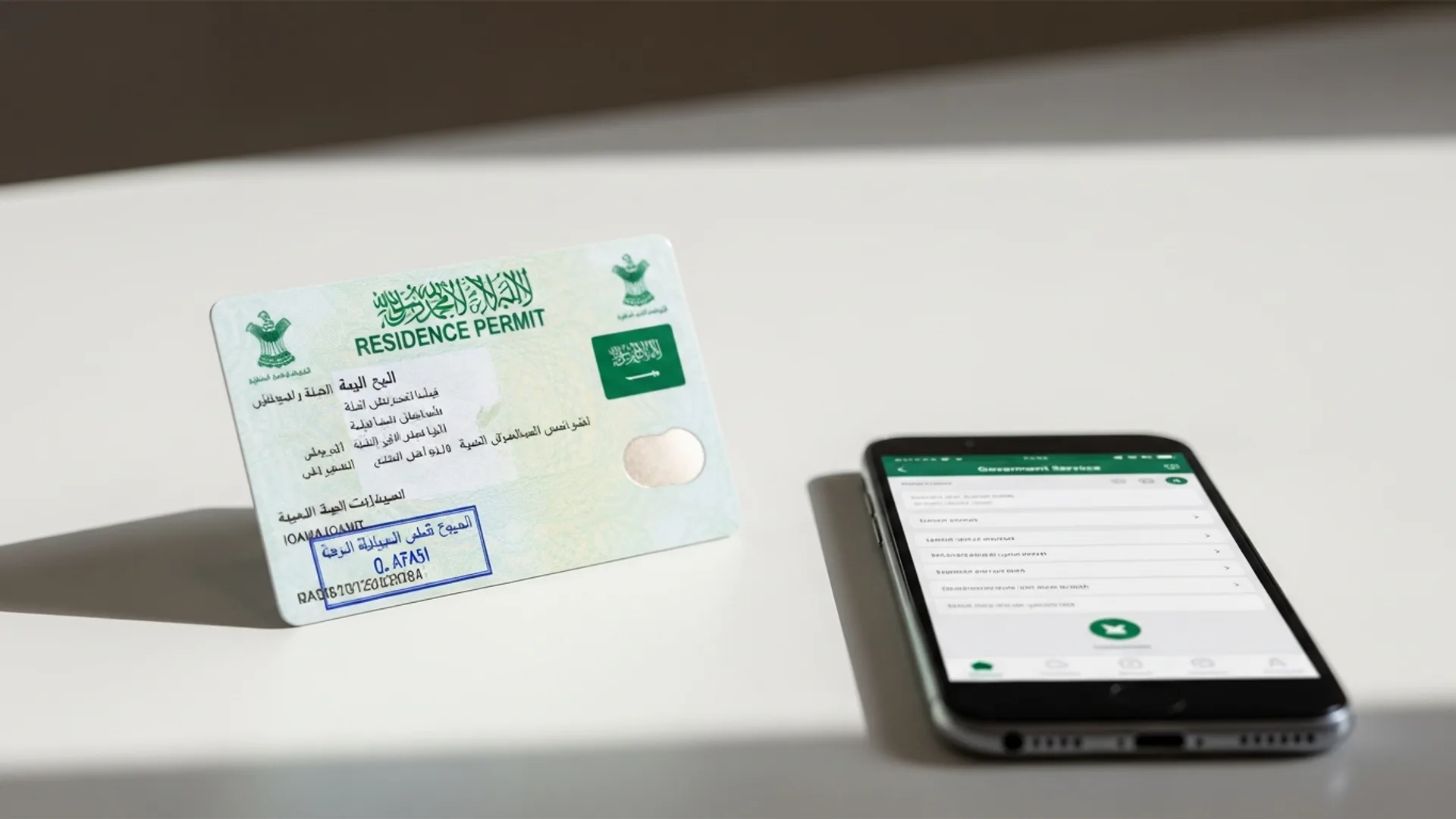
The Iqama is your official residence permit in Saudi Arabia — the card that proves a foreign national lives and works in the Kingdom legally. It is issued within roughly 90 days of arriving on a work visa, renewed every 1 or 2 years, and managed digitally through Absher and Muqeem. In 2026 the base government renewal fee is about SAR 650 per year, on top of the separate work-permit levy your employer pays.
This guide explains exactly how the Iqama works in 2026 — how it is issued, how renewal and its fees and levies work, how to check your validity and status on Absher and Muqeem, the basics of sponsorship transfer, dependents, exit and re-entry permits, and what your employer is responsible for.
What is the Iqama (residence permit) in Saudi Arabia?
The Iqama (الإقامة) is the residency identity document issued by the Ministry of Interior (Jawazat — the General Directorate of Passports) to every foreign national who lives in Saudi Arabia on a work or family residency. It functions as your national ID inside the Kingdom: you need a valid Iqama to open a bank account, sign a lease, get a SIM card, register a vehicle, access healthcare, enrol children in school, and travel in and out of the country.
Each Iqama carries a unique Iqama number (residency number) that starts with the digit 2, your profession as registered on your work permit, your sponsor (employer) details, and the expiry date. Because so much of daily life is tied to it, keeping the Iqama valid is one of the most important compliance tasks for any expatriate and their employer.
It is worth understanding how the Iqama fits into the wider system of Saudi residency. The Iqama number is the thread that links together your work permit on Qiwa, your social-insurance record with GOSI, your health-insurance policy, your bank file, and your mobile and utility accounts. When any one of these is suspended — for example because a fine is unpaid or a renewal lapses — it can cascade into the others, which is why expatriates and HR teams treat Iqama validity as a single point of control. There is also a separate Premium Residency (the Saudi “green card”) for investors and skilled professionals who want long-term residency without a traditional employer sponsor, but the standard work-linked Iqama covers the vast majority of foreign workers in the Kingdom.
How the Iqama is issued after you enter Saudi Arabia
If you arrive on an employment visa, you do not receive the Iqama at the airport — it is issued after entry. The standard sequence is:
- Enter on a work (employment) visa stamped in your passport before travel.
- Complete the medical examination at an approved centre in Saudi Arabia.
- Employer applies for the Iqama through Absher Business / Muqeem, pays the Iqama issuance fee and the work-permit (labour) fee, and registers your biometrics.
- Iqama is issued — typically within 90 days of your entry, which is the legal window in which your employer must convert your entry visa into a residence permit.
The employer carries the cost and the legal duty to complete this on time. Working in the Kingdom without a valid Iqama once the 90-day window passes exposes both the worker and the employer to penalties, so confirm the status early through your HR or the Muqeem portal.
A few practical points smooth out the first-issuance stage. Your registered profession on the Iqama should match the activity you were actually hired for, because it affects which services you can access and, later, your eligibility for certain transfers. The medical examination must be done at a centre approved by the Ministry of Health and is a precondition for issuance. And because the Iqama is digital first, you and your employer can both see its status the moment it is issued — there is no need to wait for a physical card to confirm that you are legally resident. If you arrived with dependents on the same trip, their family-residency Iqamas are processed under your file once your own is live.
Iqama renewal in 2026: fees and levies
The Iqama must be renewed before it expires — usually annually, though two-year renewals are available in some cases. Renewal is processed by the employer through Absher (absher.sa) Business or the Muqeem (muqeem.sa) platform once all linked dues are cleared. Renewal bundles several separate charges, so the total you see is rarely a single “Iqama fee.” The table below shows the typical 2026 components.
| Component | Indicative 2026 amount (SAR) | Who pays / notes |
|---|---|---|
| Iqama renewal (government fee) | 650 / year | Base residency fee (around SAR 600 for domestic workers) |
| Work-permit / labour levy (high Saudization) | ~8,400 / year | Paid by employer where Saudi nationals are >50% of workforce |
| Work-permit / labour levy (low Saudization) | ~9,600 / year | Paid by employer where Saudi nationals are <50% of workforce |
| Dependent fee (per dependent) | 400 / month (4,800 / year) | Paid by the expatriate sponsor for spouse and children |
| Medical insurance | Varies | Mandatory; cost depends on plan and age |
| Late-renewal fine | From 500 (first offence) | Rises for repeat late renewals — renew on time |
Figures are indicative for 2026 and can change. The labour levy is being adjusted for some sectors — in December 2025 the Cabinet permanently cancelled the expatriate workforce levy for companies holding a valid industrial licence. Always confirm the exact payable amount on Absher, Muqeem, Qiwa or your employer’s HR portal before paying.
How renewal is done step by step
- Clear any outstanding traffic violations, work-permit dues and the dependent fee — the system blocks renewal if linked dues are unpaid.
- The employer logs in to Absher Business or Muqeem, selects the worker, and pays the Iqama renewal fee.
- Renewal is reflected immediately and the new expiry date appears on the digital Iqama.
The single most common reason a renewal stalls is an unrelated unpaid charge — a traffic fine, an overdue dependent fee, or a lapsed medical-insurance policy. Because the Iqama number links to all of these, clearing them first turns the renewal itself into a one-click payment. Where a labour levy applies, it is collected with the work-permit renewal rather than the residency fee, so the worker’s own annual cost is essentially the base SAR 650 plus insurance and any dependent fees, while the larger levy sits on the employer’s account.
How to check Iqama validity and status
You can verify your Iqama expiry and status yourself, without waiting for HR. Two official routes are used most:
- Absher (absher.sa) / Absher app — log in to the individual account linked to your Iqama number to view the expiry date, profession, and linked services.
- Muqeem (muqeem.sa) — the platform used by employers and authorised partners to check Iqama validity, print Iqama details, and manage exit/re-entry permits. Some Muqeem validity checks can be run using the Iqama number and expiry without a full login.
It is good practice to check your Iqama validity at least 30 days before the printed expiry so there is time to clear dues and renew. If the status shows as expired or “not valid,” raise it with your employer immediately, because the renewal duty and most fees sit with them.
When you run a status check, look beyond the headline expiry date. The record also shows your work-permit (labour-card) expiry, which is a separate date and must also be valid, plus any active exit/re-entry permit and any “absence from work” (huroob) flag. A huroob report filed by an employer is serious: it can block renewal, transfer and travel until resolved, so it should be challenged quickly if filed in error. Keeping a simple personal calendar reminder a month before each expiry — Iqama, work permit, dependents, and insurance — prevents almost every avoidable fine. Many expatriates also save the digital Iqama to their phone wallet so the number is always to hand for the dozens of services that ask for it.
Sponsorship transfer basics (changing employer)
Sponsorship transfer — moving your Iqama from one employer to another — has been steadily liberalised under the Labour Reform Initiative led by the Ministry of Human Resources and Social Development (MHRSD, hrsd.gov.sa). In 2026 the whole process runs digitally through the Qiwa platform.
In the standard route, you accept a new job offer on Qiwa and your current employer approves the transfer. Importantly, eligible workers can now transfer without the current employer’s consent in defined situations, including:
- The employment contract has expired or been terminated.
- Salary has not been paid for three consecutive months.
- The employer failed to renew the Iqama or work permit after expiry.
- A 90-day notice period (for workers with over one year of service) has been served after accepting the new contract.
To transfer, you must be currently employed, not already in another transfer, not hold a final exit visa, and not be flagged as a runaway (huroob). The new employer must clear any outstanding fines. Rules and eligibility evolve, so confirm your specific case on Qiwa or with a licensed advisor before resigning.
A useful detail of the 2026 framework is that a transfer can proceed even where the Iqama has already expired, provided the new employer settles any late fines and initiates the move on Qiwa — this protects workers whose previous sponsor failed to renew. The reforms have effectively replaced the old consent-only model with a contract-based system: your written employment contract, its term, and the notice you have served increasingly govern your mobility rather than a single signature from a sponsor. For employers, this means retention now depends on competitive terms rather than administrative control, and for workers it means reading the contract carefully before signing, since its expiry date and notice clauses determine when a no-consent transfer becomes available.
Dependents: spouse and children
Eligible expatriates can sponsor their immediate family — spouse and children — for family residency Iqamas. Each dependent is added to the sponsor’s file and carries the dependent fee of SAR 400 per dependent per month (SAR 4,800 per year), which is paid by the expatriate sponsor, not the employer. This fee is due whenever you renew a dependent’s Iqama and must be cleared before the renewal will process.
Dependent Iqamas follow the same validity and renewal logic as the principal’s: check expiry on Absher, clear the annual dependent fee, and renew before expiry to avoid fines. Dependents also need exit/re-entry permits to travel, which the sponsor arranges through Absher.
Eligibility to sponsor family generally depends on your profession and salary level, so confirm your category before bringing dependents to the Kingdom. Plan the cost realistically: a family of four — spouse and two children — represents three dependent fees, which adds up to roughly SAR 14,400 per year on top of each dependent’s own Iqama renewal and insurance. Domestic-worker sponsorship sits under a separate framework with its own fees and is handled through the Musaned platform rather than the standard family-residency route. Because dependent fees and insurance recur annually, many expatriates budget for them at the same time as their own Iqama renewal so nothing is missed.
Exit and re-entry permits
An Iqama alone does not let you leave and return — you also need an exit and re-entry permit, issued electronically via Absher or Muqeem and linked to the Iqama. There are two types:
- Single exit/re-entry — one trip out and back; indicative base fee from SAR 200.
- Multiple exit/re-entry — unlimited trips within the permit period; indicative base fee from SAR 500, with additional months charged up to the Iqama expiry.
The permit validity cannot exceed the Iqama expiry, so always renew the Iqama first if it is close to expiring. Under the reforms, qualifying workers can in some cases obtain exit and re-entry permits without sponsor approval. Always confirm current fees and your eligibility on Absher before booking travel.
Two timing rules catch travellers out. First, a single permit is consumed once you leave, so if you expect more than one trip during the period a multiple permit is usually cheaper overall despite the higher base fee. Second, you must return before the permit expires — overstaying abroad on an exit/re-entry can cancel your residency, so build in a buffer against flight delays. There is a separate final exit visa for leaving the Kingdom permanently at the end of employment; it ends your residency rather than pausing it, and it should only be issued when you genuinely intend to depart for good. If your trip dates change, you can usually cancel an unused exit permit on Absher and have the unused portion handled according to the current rules. Families travelling together need a permit for each person, including dependents, so arrange them all before the trip and confirm that every family member’s Iqama is valid through the return date.
Employer responsibilities and common compliance points
Saudi residency compliance is shared, but the employer (sponsor) carries the heaviest legal duties. Authorities such as the Ministry of Interior, MHRSD, Qiwa, Muqeem and GOSI all track parts of the relationship. An employer is generally responsible for:
- Converting the entry visa into an Iqama within the legal window after arrival.
- Renewing the Iqama and work permit on time and paying the labour levy.
- Registering employees with GOSI (gosi.gov.sa) for social insurance and maintaining the labour file on Qiwa.
- Tracking expiry dates and starting renewal at least three working days before expiry.
- Not withholding passports or the Iqama, in line with the labour reforms.
For a foreign-owned business setting up in the Kingdom, getting these residency processes right from day one is part of operating legally — see our guide to company formation in Saudi Arabia and the MISA licence, which together set up the legal entity and the labour files that make Iqama sponsorship possible.
Employers should also plan around Saudization (Nitaqat), because it directly affects the labour levy and how many work permits — and therefore Iqamas — a company can issue. A higher proportion of Saudi nationals not only lowers the per-worker levy but also unlocks faster access to new permits, so workforce planning and residency cost are closely linked. Practical governance matters too: assign a named person to monitor Qiwa and Muqeem dashboards, keep contact details current so renewal alerts reach the right inbox, and reconcile GOSI registrations against actual headcount each month. Companies that treat residency as a routine monthly task — rather than a once-a-year scramble — rarely incur fines and find onboarding new hires far smoother.
Where a business lacks the in-house capacity to run all of this, a licensed government-relations (GR) partner can manage Iqama issuance, renewals, transfers and exit permits end to end, freeing the founder to focus on the business. Whichever route you choose, the underlying principle is the same: a valid Iqama is the foundation on which every other right to live, work and travel in Saudi Arabia rests, so it deserves the same attention as payroll or tax.
Common mistakes to avoid
- Letting the Iqama lapse — late renewal triggers escalating fines and can block bank, travel and government services.
- Forgetting the dependent fee — the SAR 400/month per-dependent charge is the sponsor’s, and the system won’t renew until it’s paid.
- Travelling without an exit/re-entry permit — a valid Iqama is not enough to leave and return.
- Assuming a sponsorship transfer is automatic — check eligibility, notice periods and any final-exit or huroob flags on Qiwa first.
- Booking a permit past Iqama expiry — exit/re-entry validity can’t exceed the Iqama, so renew the Iqama first.
- Relying on memory for expiry dates — verify on Absher or Muqeem at least 30 days ahead.
Need help setting up in Saudi Arabia? Noble Core handles your MISA licence, commercial registration, and visas end-to-end — done right the first time.
Frequently Asked Questions
What is an Iqama in Saudi Arabia?
The Iqama is the official residence permit issued by the Ministry of Interior (Jawazat) to foreign nationals living in Saudi Arabia. It acts as your national ID inside the Kingdom and is needed to bank, lease a home, get a SIM, access healthcare and travel. Each Iqama has a residency number starting with the digit 2.
How much does Iqama renewal cost in 2026?
The base government Iqama renewal fee is about SAR 650 per year (around SAR 600 for domestic workers). Separately, the employer pays a work-permit labour levy of roughly SAR 8,400–9,600 per year, and sponsors pay SAR 400 per month for each dependent. Confirm exact dues on Absher, Muqeem or Qiwa before paying.
How do I check my Iqama validity or status?
Log in to Absher (absher.sa) or the Absher app with the account linked to your Iqama number to see the expiry date and status. Employers and authorised users can also check and print Iqama details on Muqeem (muqeem.sa). Check at least 30 days before expiry so there is time to clear dues and renew.
When is the Iqama issued after I arrive in Saudi Arabia?
If you enter on an employment visa, the Iqama is issued after arrival — not at the airport. After your medical exam, the employer applies through Absher Business or Muqeem and the Iqama is normally issued within 90 days of entry, which is the legal window to convert an entry visa into a residence permit.
Can I transfer my Iqama sponsorship to another employer?
Yes. Sponsorship transfer is handled digitally on the Qiwa platform under MHRSD. Usually your current employer approves it, but eligible workers can transfer without consent in defined cases — for example contract expiry, three months of unpaid salary, an unrenewed Iqama, or after serving the required notice period.
Who pays the dependent Iqama fee?
The expatriate sponsor pays the dependent fee, not the employer. It is SAR 400 per dependent per month (SAR 4,800 per year) for a spouse or child, and it must be cleared before each dependent’s Iqama renewal will process. Dependents also need exit/re-entry permits to travel, arranged by the sponsor on Absher.
Do I need an exit and re-entry permit if my Iqama is valid?
Yes. A valid Iqama alone does not let you leave and return. You need an exit/re-entry permit issued via Absher or Muqeem — a single trip from about SAR 200 and a multiple permit from about SAR 500. The permit validity cannot exceed your Iqama expiry, so renew the Iqama first if needed.
What are an employer’s Iqama responsibilities?
The employer (sponsor) must issue the Iqama within the legal window after arrival, renew the Iqama and work permit on time, pay the labour levy, register staff with GOSI, maintain the Qiwa labour file, track expiry dates and not withhold the passport or Iqama. They should start renewal at least three working days before expiry.