Business Setup in Riyadh (2026): Costs, Steps & Free Zones
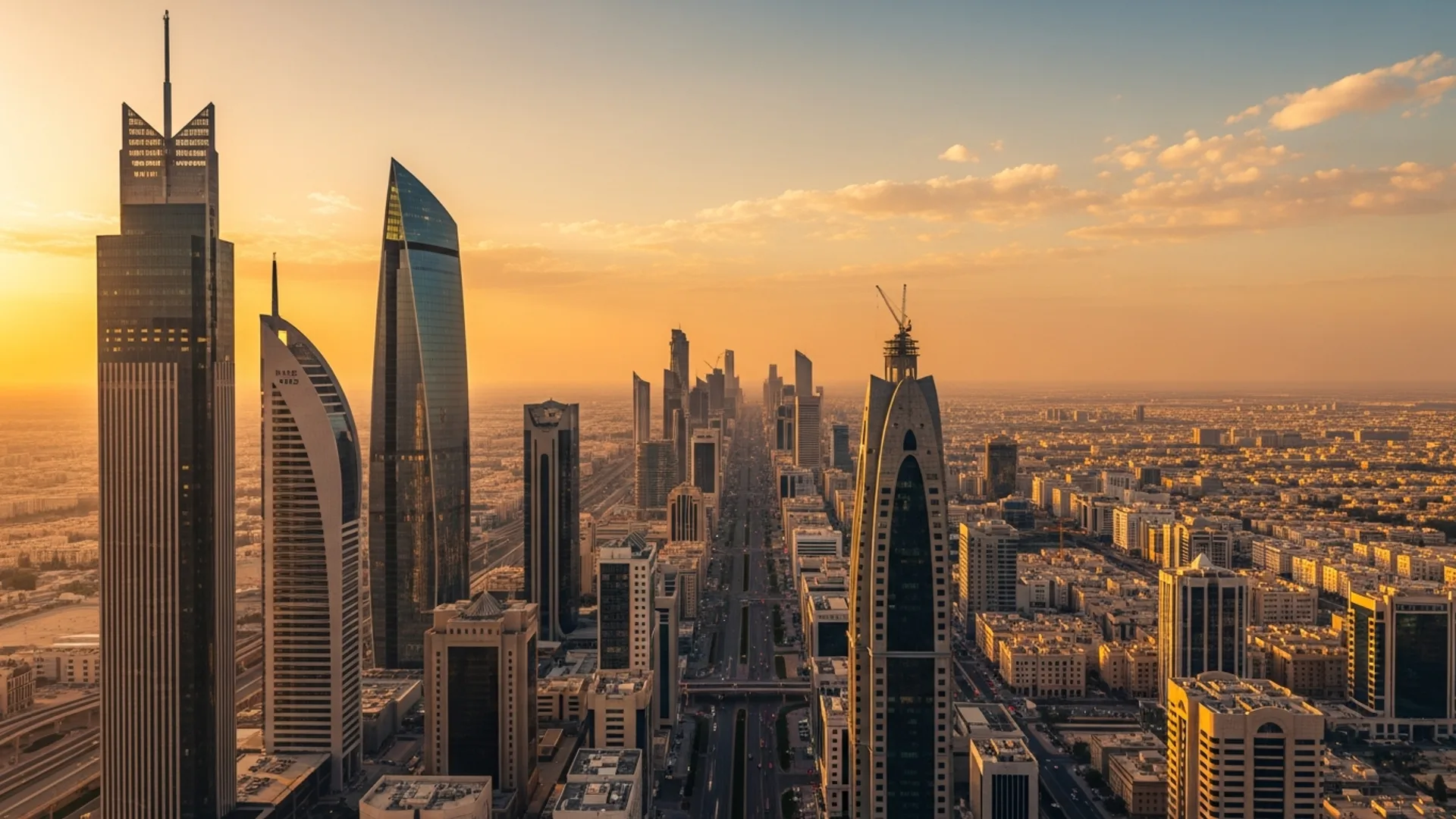
Business setup in Riyadh starts with a MISA investment licence that grants 100% foreign ownership in most activities, typically issued in 3 to 10 business days. As Saudi Arabia’s capital and largest market, Riyadh hosts over 700 multinational Regional Headquarters and more than 140 office tenants in the King Abdullah Financial District alone. In 2026, MISA licence issuance and renewal fees remain suspended, making it one of the most accessible entry windows yet.
This guide explains exactly how to set up a company in Riyadh in 2026 — why founders choose the capital, the MISA-plus-Commercial-Registration process, the special zones (KAFD, the Special Integrated Logistics Zone, and the RHQ programme), the real costs in Saudi riyals, and the local chamber and authorities you will deal with.
Why set up your business in Riyadh?
Riyadh is the political and economic centre of Saudi Arabia and the gateway to the largest consumer market in the Gulf. The city concentrates government ministries, the Saudi Central Bank (SAMA), the Public Investment Fund (PIF), the country’s banking sector, and the headquarters of most major Saudi corporates. For a foreign founder, that proximity to decision-makers, regulators, and capital is the single biggest reason to base in the capital rather than elsewhere in the Kingdom.
Several structural advantages make Riyadh the default choice in 2026:
- Largest market — Riyadh is home to roughly 7 million people and the highest concentration of corporate purchasing power in Saudi Arabia.
- RHQ hub — more than 700 multinationals have established their Regional Headquarters in Riyadh, ahead of the original 2030 target, creating a dense ecosystem of partners, talent, and suppliers.
- Financial district — the King Abdullah Financial District (KAFD) gives the city a purpose-built business core with global tenants such as Goldman Sachs, BNP Paribas, and Saudi Aramco.
- Government access — ministries, MISA, the Ministry of Commerce, ZATCA, and the Royal Commission for Riyadh City are all headquartered here.
- Infrastructure — the Riyadh Metro, King Khalid International Airport, and Vision 2030 megaprojects make the capital a logistics and connectivity hub.
Beyond the headline points, the capital offers a depth of professional services that a younger market cannot match. Riyadh has the Kingdom’s largest pool of accountants, lawyers, bankers, and bilingual managerial talent, the busiest network of government one-stop service centres, and the most active deal-making environment in Saudi Arabia. For a foreign company that needs to recruit quickly, raise capital, or sell to large enterprise and government buyers, that concentration shortens timelines at every stage of growth. The trade-off is cost — office rents and salaries in the capital sit at a premium to other Saudi cities — which is why matching your location and zone to your business model matters from day one.
The two licences you need to set up in Riyadh
Every foreign-owned company in Riyadh rests on two core documents, obtained in sequence:
- MISA investment licence — issued by the Ministry of Investment of Saudi Arabia (MISA). This is the mandatory first step that gives a non-Saudi investor the legal right to do business in the Kingdom, including 100% ownership in most sectors. MISA replaced the former SAGIA and is the single gateway for foreign capital into the Saudi economy.
- Commercial Registration (CR / السجل التجاري) — issued by the Ministry of Commerce through the Saudi Business Center. The CR is your company’s official identity on the national registry and is required to open a bank account, sign contracts, lease an office, and hire staff.
You secure the MISA licence first, then use it to register the company and obtain the CR. For a full breakdown of both documents, see our guides to company formation in Saudi Arabia and the MISA licence.
The 2026 regulatory backdrop makes the second step noticeably easier than in previous years. The new Commercial Register Law, effective 3 April 2026, introduced a unified national Commercial Register with no expiry date — instead of renewing the CR each year, companies simply confirm their details annually. Registration numbers now begin with the digit 7, English trade names are permitted alongside Arabic, and existing businesses have a five-year grace period to migrate to the new framework. For a Riyadh-based founder, this means fewer renewal deadlines and a cleaner path to keeping the company in good standing.
It is worth understanding why both documents exist. The MISA licence is about who may invest — it is the instrument that opens the Saudi market to foreign capital and sets the activities you are licensed to perform. The CR is about what the company legally is — its name, structure, capital, managers, and registered activities on the national commercial registry. Banks, landlords, government portals, and counterparties all key off the CR, which is why nothing operational can happen until it is issued.
Step-by-step: how to set up a company in Riyadh
1. Choose your activity and legal structure
Most foreign investors in Riyadh set up a Limited Liability Company (LLC). Larger groups often choose a Regional Headquarters (RHQ) or a branch of a foreign company. Confirm your specific activity against the MISA list, because a small number of activities remain restricted or carry capital thresholds.
2. Prepare and attest your documents
Your parent company’s commercial registration, articles of association, and board resolutions must be notarised in the country of origin, legalised by the Saudi embassy, and officially translated into Arabic by an approved translator. This is usually the slowest step, so start it early.
3. Apply for the MISA licence
Submit the attested documents and your chosen activities through the MISA portal. With complete paperwork, the licence is typically issued in 3 to 10 business days.
4. Reserve a trade name and register the CR
Reserve a company name and complete the Commercial Registration with the Ministry of Commerce through the Saudi Business Center. Notarise the Articles of Association to finalise the entity. Under the new Commercial Register Law effective 3 April 2026, the CR is a unified national record with no expiry — you simply confirm details annually.
5. Join the Riyadh Chamber and complete post-licence registrations
Register with the Riyadh Chamber of Commerce and the remaining authorities (below) so you can invoice, hire, and operate legally in the capital. This includes activating files with ZATCA for tax and e-invoicing, GOSI for social insurance, and Qiwa and Muqeem for labour and visas. Skipping any of these leaves your file incomplete and blocks practical operations such as issuing invoices or sponsoring an employee’s Iqama.
6. Secure premises and open a bank account
You will need a registered national (Wasel) address in Riyadh and, for most activities, a municipality (Baladi) licence tied to your premises. Once the CR and authorised-signatory documents are ready, you can open a corporate bank account — typically the final gate before you are fully trading. In Riyadh, choosing the right district at this stage matters: a finance or consulting firm may prioritise KAFD or the central business district, while a logistics operator should be looking at the Special Integrated Logistics Zone near the airport.
Cost of business setup in Riyadh (2026)
Your total cost depends on activity, structure, office space, and visa count. The headline change for 2026 is that MISA’s licence issuance and renewal fees remain suspended, removing what used to be the largest single line item. The table below shows the typical components for a standard LLC in Riyadh.
| Cost component | Typical amount (SAR) | Notes |
|---|---|---|
| MISA investment licence | Fee suspended in 2026 | Issuance and renewal fees suspended (previously SAR 12,000 first year / SAR 62,000 renewal) |
| Commercial Registration (CR) | 1,200 – 2,000 | One-time, via Ministry of Commerce / Saudi Business Center |
| Riyadh Chamber of Commerce membership | 2,000 – 3,000 / year | Annual subscription |
| Municipality (Baladi) licence | Varies by activity & district | Required for premises-based activities |
| Office / registered address | Varies (Riyadh CBD higher) | A national (Wasel) address is required; KAFD and CBD rents are premium |
| Document attestation & translation | Varies | Notarisation, Saudi embassy legalisation, certified Arabic translation |
| Government & service support (Noble Core) | from 36,999 | Transparent end-to-end package |
Government fees are indicative for 2026 and can change — always confirm current figures on the official MISA and Saudi Business Center portals, or ask our team for a live quote.
Two cost drivers deserve extra attention in Riyadh specifically. The first is office space: the capital’s central business district and KAFD command premium rents, and a prestige address adds materially to your first-year budget — though it can pay back in credibility and proximity to clients. The first is balanced by flexible options such as serviced offices and business centres that satisfy the Wasel-address requirement at lower cost while you establish. The second is visa and Saudization planning: each work visa carries fees and obligations, and your Nitaqat band influences how many foreign hires you can sponsor, so the true cost of setup is best modelled alongside your hiring plan rather than as a flat one-off.
A useful way to think about budgeting is to separate one-time costs (CR, attestation, incorporation, initial office fit-out) from recurring costs (Chamber membership, office rent, accounting and ZATCA compliance, GOSI contributions, visa renewals). Foreign founders frequently underestimate the recurring layer, particularly compliance and payroll-related obligations once staff are hired. Building a 12-month operating budget — not just a setup budget — gives a far more accurate picture of what a Riyadh entity costs to run.
Special zones in Riyadh: KAFD, the Logistics Zone and RHQ
Riyadh offers several specialised environments that can change the economics of your setup. Each suits a different kind of business.
King Abdullah Financial District (KAFD)
KAFD is a purpose-built financial and business district spanning roughly 1.6 million square metres, with 95 buildings and the largest development globally to achieve LEED Platinum certification. As of 2026 it hosts more than 140 office tenants and over 75 Regional Headquarters, including Saudi Aramco, Goldman Sachs, BNP Paribas, PepsiCo, and Pfizer Saudi. KAFD is being developed as a special zone with competitive regulations and is connected toward King Khalid International Airport, making it the natural home for finance, fintech, and professional-services firms that want a prestige Riyadh address.
Special Integrated Logistics Zone (SILZ)
The Special Integrated Logistics Zone, regulated by the General Authority of Civil Aviation (GACA), sits about 8 km from King Khalid International Airport and is linked to its cargo village by a bonded corridor. The zone is built for storage, processing, assembly, import/export, and re-export. Its incentives are among the most generous in the Kingdom:
- 0% income tax for up to 50 years on qualifying activities.
- Customs and VAT suspension on goods that remain in the zone.
- 100% foreign ownership and exemption from Saudization for the first five years.
- No restrictions on capital repatriation, profit transfer, or international borrowing.
Regional Headquarters (RHQ) programme
The RHQ programme — a joint initiative of the Royal Commission for Riyadh City and MISA — is designed for multinationals that want to base their MENA leadership in the capital. Qualifying RHQs that meet ZATCA’s economic-substance requirements receive a 30-year package of 0% corporate income tax and 0% withholding tax on eligible RHQ activities, plus a 10-year Saudization exemption and unlimited work visas for RHQ staff. RHQs must employ at least 15 full-time staff (including three C-suite executives) within the first year, begin mandatory strategic-management activities within six months of licensing, and commence at least three optional functions — such as sales and marketing support, human-resources management, or financial management — within the first year. Top executives also gain access to Premium Residency. By early 2026, more than 700 multinationals had qualified, with firms such as Amazon, Google, PwC, and Deloitte already embedded in the capital.
Choosing between these environments comes down to fit. A bank, asset manager, or professional-services firm gains the most from a KAFD address and its ecosystem. A distributor, e-commerce fulfilment operator, or light-manufacturing business is best served by the Logistics Zone’s tax and customs incentives. A multinational consolidating regional control should evaluate the RHQ route for its long tax shelter. Many founders, however, run a straightforward mainland LLC anywhere in Riyadh — the zones are optional accelerators, not prerequisites.
Key sectors and opportunities in Riyadh
Riyadh’s economy is diversifying fast under Vision 2030, and certain sectors are especially open to foreign founders:
- Financial services and fintech — anchored by SAMA, the banking sector, and KAFD.
- Technology and digital — cloud, AI, and software, with major global players already established.
- Professional and consulting services — driven by the RHQ wave and government transformation programmes.
- Logistics and supply chain — supported by the Logistics Zone and the airport.
- Construction, real estate, and contracting — fuelled by giga-projects and Riyadh’s expansion.
- Healthcare, education, tourism, and entertainment — all priority Vision 2030 verticals.
The common thread is non-oil diversification. Riyadh is the command centre for Vision 2030 spending, which means government and PIF-backed programmes are creating sustained demand across these verticals. For a foreign founder, the practical implication is that being physically present in the capital — close to the agencies awarding contracts and the corporates building supply chains — is itself a commercial advantage, not just an administrative convenience. Procurement, partnerships, and talent all concentrate where the decisions are made.
| Sector | Why Riyadh | Best-fit zone or structure |
|---|---|---|
| Financial services & fintech | SAMA, banks, capital markets concentrated here | KAFD address / mainland LLC |
| Technology & digital | Government digital transformation, cloud demand | Mainland LLC / RHQ |
| Logistics & supply chain | Airport proximity, bonded corridor | Special Integrated Logistics Zone |
| Professional & consulting | RHQ wave, transformation programmes | Mainland LLC / RHQ |
| Construction & real estate | Giga-projects, city expansion | Mainland LLC |
The Riyadh Chamber and authorities you will deal with
Once your CR is live, you register with the Riyadh Chamber of Commerce and a set of national authorities to operate legally:
- Riyadh Chamber of Commerce — membership and authorised-signatory registration for the capital.
- ZATCA (Zakat, Tax and Customs Authority) — Zakat/corporate tax, VAT, and e-invoicing (Fatoora).
- GOSI (General Organization for Social Insurance) — employee social insurance.
- Qiwa & Muqeem — labour files, work visas, and resident (Iqama) management.
- Saudization (Nitaqat) — meeting the Saudi-national hiring ratio for your sector and size.
- Corporate bank account — opened once the CR and signatory documents are in place.
Most of these registrations are now handled through unified digital portals, which has compressed timelines significantly compared with a few years ago. ZATCA’s Fatoora e-invoicing system, for example, is mandatory and rolled out in phases, so a new Riyadh company should align its accounting software with the e-invoicing requirement from the outset rather than retrofitting later. Similarly, GOSI registration and Qiwa establishment files should be opened as soon as the CR is issued, because they are prerequisites for sponsoring visas and onboarding your first employees. Treating these as a single coordinated workstream — rather than a series of afterthoughts — is what keeps a setup on schedule.
Why companies headquarter in Riyadh
The combination of market size, government proximity, RHQ incentives, and purpose-built districts explains why over 700 multinationals chose Riyadh as their regional base ahead of schedule. For groups serving the wider Gulf and MENA region, the capital offers a credible HQ location with a 30-year tax shelter on RHQ activities, deep local talent, and direct lines to regulators and the Public Investment Fund. For SMEs and founders, the same ecosystem means partners, clients, and suppliers are concentrated in one city.
Common mistakes to avoid
- Leaving document attestation to the end — embassy legalisation and certified Arabic translation are the slowest steps; start them first.
- Assuming every activity allows 100% ownership — a few activities are restricted or carry capital thresholds; confirm yours with MISA.
- Choosing the wrong zone — a logistics business belongs in the SILZ, not a CBD office; a finance firm benefits from KAFD; pick the environment that matches your activity.
- Ignoring Saudization from day one — Nitaqat ratios affect your ability to hire and renew visas; plan your Saudi-national hires early.
- Underbudgeting Riyadh office costs — CBD and KAFD rents are premium; factor location into your total setup budget.
- Skipping post-CR registrations — ZATCA, GOSI, Qiwa, and Muqeem are not optional; an incomplete file blocks invoicing and hiring.
Need help setting up in Saudi Arabia? Noble Core handles your MISA licence, commercial registration, and visas end-to-end — done right the first time.
Frequently Asked Questions
How much does business setup in Riyadh cost in 2026?
MISA licence issuance and renewal fees remain suspended in 2026. Beyond that, expect roughly SAR 1,200–2,000 for the Commercial Registration, SAR 2,000–3,000 per year for Riyadh Chamber of Commerce membership, plus municipality, office, attestation, and translation costs. Office rents in the CBD and KAFD are premium. Noble Core offers a transparent end-to-end package from SAR 36,999.
Can a foreigner own 100% of a company in Riyadh?
Yes. In most activities a foreign investor can own 100% of a Riyadh company through a MISA investment licence, with no Saudi partner or sponsor required. A small number of activities remain restricted or carry capital thresholds, so confirm your specific activity against the MISA list before applying.
How long does it take to set up a business in Riyadh?
With complete, properly attested documents, the MISA licence is typically issued within 3 to 10 business days. The Commercial Registration and post-licence registrations (Chamber, ZATCA, GOSI, Qiwa) add a few more days to a few weeks. Document attestation in your home country is usually the variable that extends the overall timeline.
What is the King Abdullah Financial District (KAFD)?
KAFD is Riyadh’s purpose-built financial and business district, spanning about 1.6 million square metres with 95 buildings. As of 2026 it hosts more than 140 office tenants and over 75 Regional Headquarters, including Saudi Aramco, Goldman Sachs, and BNP Paribas. It is being developed as a special zone with competitive regulations, ideal for finance, fintech, and professional services.
What incentives does the Special Integrated Logistics Zone in Riyadh offer?
The Special Integrated Logistics Zone (SILZ), near King Khalid International Airport and regulated by GACA, offers 0% income tax for up to 50 years on qualifying activities, customs and VAT suspension on goods kept in the zone, 100% foreign ownership, a five-year Saudization exemption, and no restrictions on capital repatriation or profit transfer.
Why do multinationals headquarter in Riyadh?
Riyadh combines the largest Saudi market, proximity to ministries, MISA, ZATCA, SAMA, and the Public Investment Fund, and the RHQ programme’s 30-year package of 0% corporate income tax and 0% withholding tax on eligible activities. By early 2026, more than 700 multinationals had established Regional Headquarters in the capital, ahead of target.
What is the RHQ programme and who qualifies?
The Regional Headquarters (RHQ) programme, run by the Royal Commission for Riyadh City and MISA, is for multinationals basing their MENA leadership in Riyadh. Qualifying RHQs meeting ZATCA’s economic-substance rules receive a 30-year package of 0% corporate income tax and 0% withholding tax on RHQ activities, plus a 10-year Saudization exemption. RHQs must employ at least 15 full-time staff, including three C-suite executives, within the first year.
Does Noble Core handle the full setup in Riyadh?
Yes. Noble Core manages the entire process end-to-end — MISA licence, document attestation and translation, Commercial Registration, Riyadh Chamber and post-licence registrations (ZATCA, GOSI, Qiwa, Muqeem), visas, and bank account support — and advises on the right zone for your activity, so you deal with one team from start to finish.