
Work Visa in Saudi Arabia (2026): Types, Process & Cost
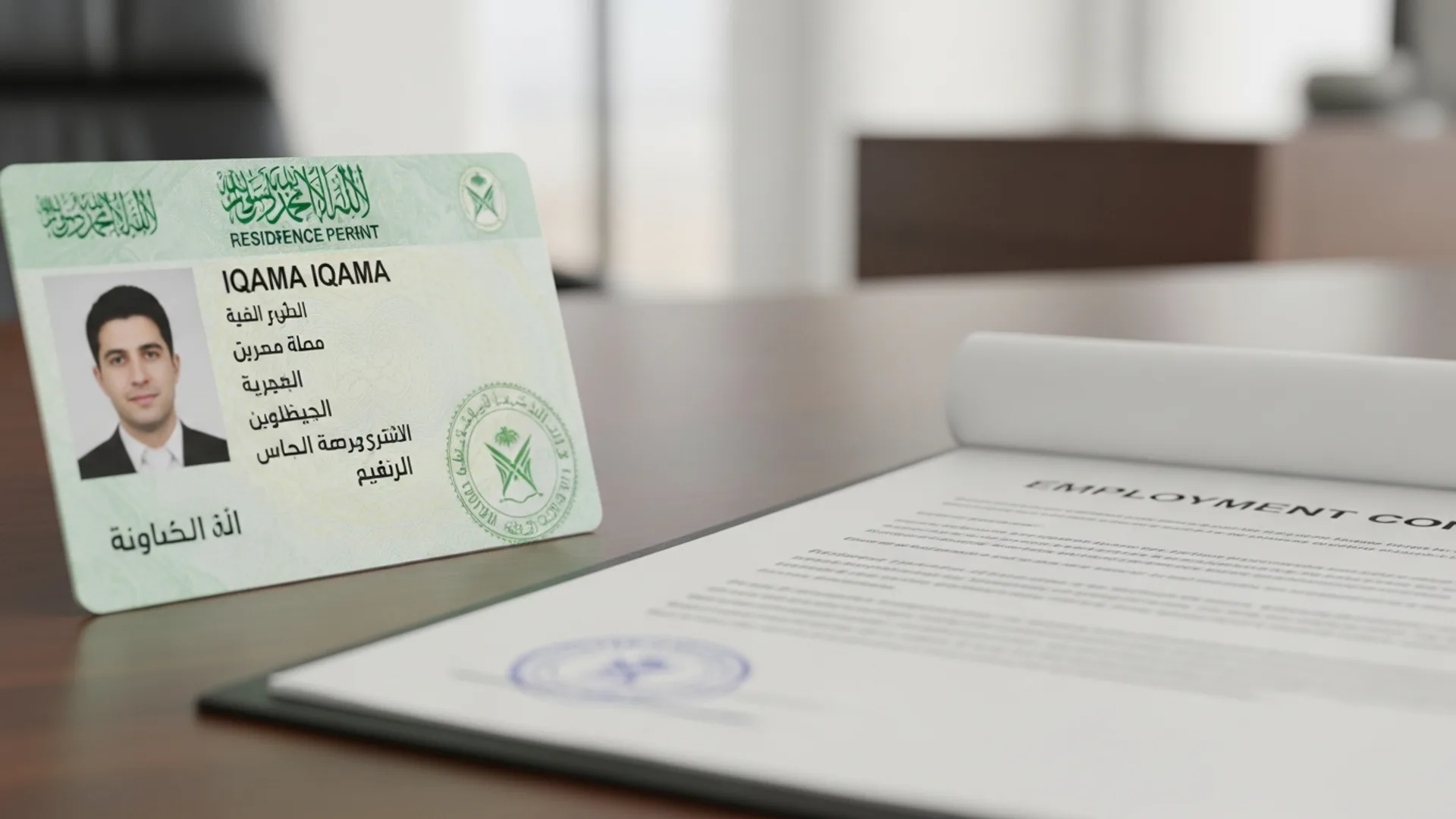
A work visa in Saudi Arabia is employer-sponsored: your company first secures a block visa quota through the Qiwa platform (MHRSD), then a named visa authorisation, before you enter the Kingdom and convert to an Iqama residence permit. The standard work visa fee is around SAR 2,000 via Qiwa, plus an annual labour levy of about SAR 9,600, and the end-to-end process typically takes 3 weeks to 2 months.
That single chain — block visa, visa authorisation, entry, Iqama — is the heart of Saudi Arabia’s labour mobility system, and almost every delay or rejection traces back to a step taken out of order. This guide explains the work visa types available in 2026, the employer’s role, the full step-by-step process from block visa to Iqama, the new skill-based classification, professional verification, real costs in Saudi riyals, and the mistakes that most often slow an application down.
Who can sponsor a work visa in Saudi Arabia?
A work visa in Saudi Arabia cannot be self-applied — it must be sponsored by a registered Saudi employer. The employer needs an active Commercial Registration, a labour file opened with the Ministry of Human Resources and Social Development (MHRSD), and a compliant Saudization (Nitaqat) status before it is allowed to request foreign worker quotas at all. In practice the sponsorship relationship is now a formal, contract-based arrangement governed digitally through Qiwa, with the employment contract authenticated before the worker even travels.
Foreign investors who want to hire staff must therefore complete their own company setup first. There is no shortcut: you cannot recruit a single foreign employee until the entity exists, the CR is live, and the labour file is open. Our guide on company formation in Saudi Arabia walks through the MISA licence and Commercial Registration that precede any hiring, and explains why the order matters for your visa timeline.
The government bodies that drive the process are the Ministry of Human Resources and Social Development (MHRSD), which approves the labour quota and sets Saudization rules; the Ministry of Foreign Affairs (MOFA), which authorises the visa for stamping at a Saudi mission abroad; and the General Organization for Social Insurance (GOSI), with which every worker is registered. The employer manages most steps digitally through Qiwa, the national labour platform, and through Absher and Muqeem for residency.
Work visa types in Saudi Arabia (2026)
There are several routes into the Kingdom for work, and choosing the right one matters because each has a different cost, duration, and approval path. Picking the wrong category — for example treating a business visit as a work permit — is one of the most common and most costly errors. The main categories in 2026 are below.
| Visa type | Best for | Duration | Indicative cost (SAR) |
|---|---|---|---|
| Employment (work) visa | Foreign hires on a formal Saudi employment contract | Leads to renewable Iqama | ~2,000 work visa fee + ~9,600/yr levy |
| Work visit visa (short-term) | Project-based or temporary technical work | Up to 90 days, extendable | ~1,000 |
| Business visit visa | Meetings, training, conferences (no employment) | Single/multiple entry, short stay | Varies by nationality |
| Freelancer visa | Self-employed professionals in qualifying fields | Renewable | Varies |
| Premium Residency (permanent) | Investors and high earners wanting citizen-like rights | Permanent | 800,000 one-time |
| Premium Residency (limited) | Flexible multi-year residency | 1–5 years, renewable | 100,000 / year |
Figures are indicative for 2026 and vary by nationality, profession, and skill tier — confirm current fees on Qiwa, Absher, and the Premium Residency portal before you budget.
Employment (work) visa — the standard route
This is the pathway for a foreign professional joining a Saudi employer under a formal contract. It is the only route that leads to a full Iqama and the right to live and work long-term, and it is what most of this guide describes. It runs through the block-visa-to-Iqama chain and is the route an employer uses to build a permanent team.
Work visit visa — short-term and project-based
The short-term work visit visa lets a company bring in a worker for a specific, time-limited engagement — commissioning equipment, a defined project, or specialist technical support — usually for up to 90 days and extendable in some cases. It is faster and lighter than a full employment visa but does not create residency, so it is unsuitable for a permanent hire.
Business visit visa — meetings, not work
A business visit visa covers meetings, training, conferences, and exploratory trips. It explicitly does not permit employment or paid work for a Saudi entity. Using one to actually perform a job is a compliance breach that can lead to fines and a future ban, so it should never be used as a back-door work permit.
Freelancer and Premium Residency routes
The freelancer visa supports self-employed professionals in qualifying fields without a traditional employer sponsor. At the other end of the scale, Premium Residency offers a permanent option at a one-time SAR 800,000, or a limited-duration option around SAR 100,000 per year, granting citizen-like rights such as property ownership and the ability to do business without a local sponsor — attractive to investors and senior executives who want to remove the sponsorship dependency entirely.
The block visa: how the employer’s quota works
The journey starts with a block visa — an approval from MHRSD that allocates the employer a number of foreign worker slots. Through Qiwa, the company specifies the nationalities, professions, and skill tiers it wants to recruit. MHRSD checks the request against the employer’s Nitaqat (Saudization) colour band and its existing workforce ratios before granting the quota. A company in a higher Nitaqat band — meaning it employs a healthy proportion of Saudi nationals — is granted larger, faster quotas than one that is behind on its Saudization targets.
A block visa is not tied to a named person — it is permission to bring in a defined number of workers in defined roles. Once granted, the employer draws down from this block each time it issues an individual visa authorisation for a specific candidate. Think of the block as a credit line of headcount: you negotiate the size and composition up front, then spend it candidate by candidate.
Because the block visa is the gate to everything that follows, getting it right is worth time. Practical points that shape approval:
- Nitaqat first. If your Saudization ratio is low, increase Saudi hiring or correct your GOSI records before requesting the block — quotas track your band.
- Match professions precisely. The professions you list in the block must align with your licensed activities and with the skill tiers you intend to recruit.
- Plan the whole team. Requesting a realistic block once is cleaner than repeatedly returning for small top-ups.
The skill-based classification (2025–2026)
Saudi Arabia replaced the old professional/non-professional model with a skill-based classification built on the Saudi Standard Classification of Occupations (SSCO). Every work permit now sits in one of three tiers, which affects eligibility, salary thresholds, and fees. This is one of the most important changes for employers to understand in 2026, because the tier you select must be backed by the candidate’s actual qualifications and pay.
- High-Skilled — e.g. doctors, engineers, senior specialists; typically a relevant degree, around 5 years of experience, and a salary of roughly SAR 15,000 or more.
- Skilled — e.g. technicians and supervisors; secondary education, about 2 years of experience, and a salary around SAR 7,000–14,999.
- Basic — general operational roles; a lower salary band of roughly SAR 3,000–6,999, with age limits applying in some categories.
When applying for the block visa and individual permits, the employer selects the correct tier, and the worker’s documented qualifications and contractual salary must support it. A misaligned tier — for example classifying a candidate as High-Skilled without the degree, experience, or salary to match — is a common cause of rejection and re-work. Aligning the offer letter, the contract, and the SSCO occupation code from the outset avoids that.
Professional verification (Mihni / QVP) and Mowaamah
For many qualified roles, the candidate must pass professional verification before the visa is stamped. Under the Qualified Visa Program (commonly described as the professional accreditation or Mihni verification, administered through the Professional Accreditation channel at pacc.sa), the applicant’s academic and professional certificates are checked, alongside an initial medical examination and a criminal-record check, to confirm the person genuinely meets the classified occupation. The aim is to ensure that someone entering on, say, an engineering permit truly holds the engineering credentials claimed.
Verification typically requires attested degree certificates and a certified Arabic translation, so this is another reason to start attestation in the home country early. For regulated professions — engineering, medicine, accounting and similar — additional accreditation from the relevant Saudi professional body may also be needed before the worker can practise, even after the visa is issued.
Separately, Mowaamah is the MHRSD certification programme that recognises employers who build accessible, inclusive workplaces for people with disabilities. It relates to your labour-compliance and employer profile rather than to an individual visa, but it is worth knowing as part of the wider MHRSD framework and can strengthen a company’s standing as a responsible employer in the Kingdom.
A practical tip: keep a single, well-organised document pack for each candidate — attested degree, certified Arabic translation, passport, photographs, medical report, police clearance, and the signed contract. Verification stalls most often not because a worker is unqualified but because one document is missing, expired, or not yet legalised. Front-loading this pack before you draw the visa from the block is the single biggest lever on speed.
Step-by-step: from block visa to Iqama
1. Secure the block visa quota
The employer applies through Qiwa for an MHRSD block visa, selecting professions, nationalities, and skill tiers. Approval depends on the company’s Nitaqat status and existing workforce mix. This is the foundation — nothing else can start until the quota exists.
2. Issue the visa authorisation
For a named candidate, the employer draws a visa from the block and obtains MOFA authorisation, generating a visa number the worker can use at a Saudi mission abroad. The standard work visa fee is around SAR 2,000, and the authenticated employment contract is typically attached at this stage.
3. Complete verification, medical and stamping
The candidate completes the required medical examination, professional verification where applicable, and visa stamping at the relevant Saudi embassy or consulate. Biometrics and a police clearance are commonly part of this step, after which the worker travels to Saudi Arabia on the work entry visa.
4. Enter the Kingdom and register the worker
On arrival, the worker undergoes a confirmatory medical examination inside Saudi Arabia, and the employer registers them with GOSI and on the labour file. These registrations are prerequisites for the Iqama.
5. Convert to an Iqama (residence permit)
Within 90 days of arrival the employer must issue the worker’s Iqama — the residence and ID card — via Absher and Muqeem. The Iqama is the legal basis for living and working in the Kingdom, opening a bank account, signing a lease, and sponsoring eligible dependents.
6. Maintain and renew
The Iqama is renewed annually — indicatively around SAR 650 for the resident plus about SAR 500 per dependent — and the employer keeps the labour levy and GOSI contributions current. Late renewal triggers fines starting at around SAR 500, and prolonged lapses can risk account freezing, so most companies automate renewal reminders.
Work visa cost in Saudi Arabia (2026)
Total cost combines government fees, the annual labour levy, medical and verification charges, and Iqama issuance. It is rarely a single number, which is why budgeting per worker per year — rather than just the headline visa fee — gives a truer picture. The headline components for a standard employment visa are:
| Cost component | Indicative amount (SAR) | Notes |
|---|---|---|
| Work visa fee (Qiwa) | ~2,000 | Per worker, at authorisation stage |
| Annual labour levy (expat fee) | ~9,600 / year | Paid by employer; varies with workforce ratio |
| Iqama issuance / renewal | ~650 / year (resident) | Plus ~500 per dependent (indicative) |
| Medical exam & insurance | Varies | Mandatory before stamping and for Iqama; private health cover required |
| Professional verification (QVP) | Varies | Certificate + medical + record checks |
| Attestation & translation | Varies | Degrees and contracts attested and translated into Arabic |
| Short-term work visit visa | ~1,000 | Project-based alternative |
These are 2026 indicative figures and change with nationality, profession, and skill tier — always confirm current amounts on the official Qiwa and Absher portals or ask our team for a live quote.
The annual labour levy is usually the largest recurring line and the one founders underestimate most. Because it is charged per expatriate worker each year and can scale with your Saudi-to-non-Saudi ratio, improving your Nitaqat band by hiring Saudi nationals reduces both your levy exposure and your future quota friction. In other words, the cost of a work visa is best modelled across the full year, not just at issuance.
For founders building a budget, a useful rule of thumb is to plan for the visa fee and verification once, then the levy, Iqama renewal, and health insurance every year the worker stays. Dependents add their own Iqama and insurance lines, so a family relocation costs meaningfully more than a single worker. Because several of these figures move with policy and with your Saudization band, treat any planning number as indicative and reconcile it against the live Qiwa and Absher portals — or a fixed quote from an advisor — before you commit headcount.
How long does a Saudi work visa take?
For a standard employment visa with a compliant employer and complete documents, expect 3 weeks to 2 months from block visa request to a stamped visa. The Iqama must then be issued within 90 days of arrival. The variable that most often stretches the timeline is paperwork prepared abroad: attestation of foreign degrees, professional verification, and police clearances. Nitaqat checks and any mismatch between the requested skill tier and the candidate’s documents can also add rounds of correction.
A founder hiring a first team should therefore sequence the work backwards from the desired start date — entity and CR live, labour file open, block visa approved, then candidate documents attested — well before recruitment. Our overview of the MISA licence and labour file explains how the investment licence and the hiring file connect, so the visa stage does not stall on a missing earlier step.
As a rough timeline: allow one to two weeks to open or confirm the labour file and obtain the block visa for a compliant employer, a few days to issue the named visa authorisation, one to three weeks for the candidate to complete attestation, verification, medicals, and stamping abroad, and then up to 90 days after arrival to finalise the Iqama. The biggest single accelerant is having all candidate documents attested and translated before the block is drawn down — companies that prepare this in parallel routinely land at the faster end of the 3-week-to-2-month range.
Common mistakes to avoid
- Trying to apply for a work visa without an employer — it must be sponsored by a registered Saudi entity.
- Requesting a block visa before the company’s Nitaqat (Saudization) status supports the quota.
- Selecting the wrong skill tier for the candidate’s qualifications or salary, causing rejection.
- Leaving degree attestation and certified Arabic translation until the last minute.
- Confusing a business visit visa with a work visa — visit visas do not permit employment.
- Missing the 90-day window to convert the entry visa into an Iqama, which triggers fines.
- Forgetting that regulated professions may need extra accreditation from a Saudi professional body to practise.
- Letting Iqama renewal, the labour levy, or GOSI contributions lapse and risking account freezing.
Need help setting up in Saudi Arabia? Noble Core handles your MISA licence, commercial registration, and visas end-to-end — done right the first time.
Frequently Asked Questions
Can I apply for a Saudi work visa myself?
No. A Saudi work visa must be sponsored by a registered Saudi employer with an active labour file and compliant Saudization status. The employer secures a block visa quota through Qiwa (MHRSD), then issues an individual visa authorisation for you. Self-employed routes such as the freelancer visa are the exception.
What is a block visa in Saudi Arabia?
A block visa is an MHRSD approval that allocates an employer a number of foreign worker slots by profession, nationality, and skill tier. It is not tied to a named person. The employer draws individual visa authorisations from this block each time it recruits a specific candidate, subject to Nitaqat compliance.
How much does a Saudi work visa cost in 2026?
The standard work visa fee is around SAR 2,000 per worker via Qiwa, plus an annual labour levy of roughly SAR 9,600 paid by the employer. Add medical exams, professional verification, attestation, and Iqama issuance of about SAR 650 per year. A short-term work visit visa is around SAR 1,000. Confirm current figures on Qiwa and Absher.
What are the work visa skill tiers in Saudi Arabia?
Saudi Arabia classifies work permits into three tiers under the SSCO: High-Skilled (degree plus around 5 years’ experience and roughly SAR 15,000+ salary), Skilled (secondary education, about 2 years and SAR 7,000–14,999), and Basic (lower band of about SAR 3,000–6,999). The employer must select the tier that matches the candidate’s qualifications.
What is the process from block visa to Iqama?
First the employer secures a block visa quota via Qiwa (MHRSD). Then it issues a named visa authorisation with MOFA approval. The worker completes a medical, professional verification, and visa stamping abroad, enters the Kingdom, and the employer issues the Iqama residence permit within 90 days of arrival.
What is professional verification (QVP) for a Saudi work visa?
For many qualified roles, the Qualified Visa Program verifies the applicant’s academic and professional certificates, an initial medical examination, and a criminal-record check before the visa is stamped. It confirms the worker genuinely meets the classified occupation. Degrees usually need attestation and certified Arabic translation for this step.
How long does it take to get a Saudi work visa?
For a standard employment visa with a compliant employer and complete documents, expect 3 weeks to 2 months from block visa request to a stamped visa. The Iqama must be issued within 90 days of arrival. Degree attestation, professional verification, and Nitaqat checks are the most common causes of delay.
What is the difference between a work visa and a business visit visa?
A work (employment) visa, sponsored by a Saudi employer, allows you to be hired and to live in the Kingdom on an Iqama. A business visit visa is for short trips such as meetings, training, or conferences and does not permit employment. Using a visit visa to work is a compliance breach.