Cost to Open a Restaurant in Saudi Arabia (2026)
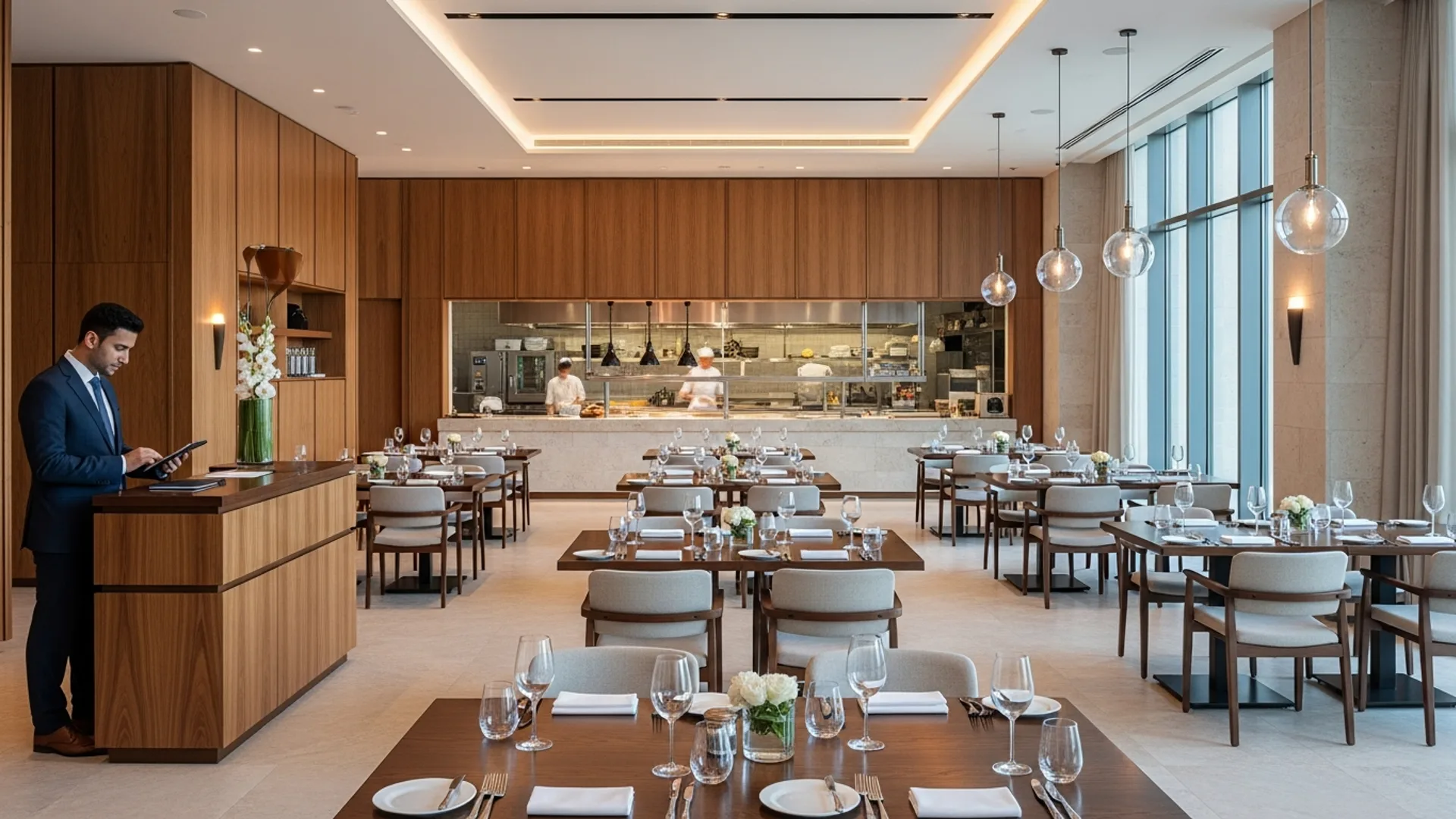
The cost to open a restaurant in Saudi Arabia in 2026 typically ranges from SAR 250,000 to SAR 1.5 million-plus, depending on size, location and fit-out. Government setup costs are modest: a Commercial Register runs about SAR 1,200-2,000, Chamber of Commerce membership SAR 2,000-3,000 per year, and Noble Core’s full formation package starts at SAR 36,999. Foreign investors can hold 100% ownership in most food-service activities, with MISA licensing usually issued in 3-10 business days.
Opening a restaurant in the Kingdom is one of the most popular entry routes for foreign founders, thanks to a fast-growing dining-out culture, the tourism push under Vision 2030, and a young, high-spending population. But the headline question, what does it actually cost, has many moving parts: government fees, licences, rent and fit-out, equipment, staffing, and working capital. This guide breaks every line item down with indicative 2026 figures in Saudi Riyals, names the exact portals and authorities you will deal with, and shows the step-by-step process so you can budget accurately before you commit.
Throughout this guide we use indicative figures drawn from current market practice and verified 2026 government anchors. Fees and thresholds can change during the year, so treat every number here as a planning estimate and confirm the current figure on the relevant official portal, MISA, the Saudi Business Center, ZATCA, Qiwa or GOSI, before you commit funds. The goal is to give you a realistic, bucket-by-bucket picture so there are no surprises between signing your lease and serving your first cover.
What “cost to open a restaurant in Saudi Arabia” really covers
When founders ask about the cost to open a restaurant in Saudi Arabia, they are usually thinking only of fit-out and equipment. In reality the total budget falls into five buckets, and underestimating any one of them is the most common reason a launch stalls:
- Government and licensing costs — your foreign-investment licence (if applicable), Commercial Register, Chamber membership, municipal permits and the food-establishment/tourism licences.
- Premises costs — rent, key money, and a refundable deposit, plus the municipality and Civil Defence approvals tied to the location.
- Fit-out and equipment — kitchen build, dining-area design, furniture, signage, refrigeration, and point-of-sale systems.
- People and payroll setup — visas, Iqama, GOSI registration, and Saudization (Nitaqat) compliance through Qiwa.
- Working capital — typically three to six months of rent, salaries, utilities and food cost before the venue is cash-flow positive.
A small grab-and-go café in a secondary city can launch for SAR 250,000-400,000, while a mid-size full-service restaurant in Riyadh or Jeddah more realistically needs SAR 700,000 to SAR 1.5 million all-in. A flagship fine-dining or branded franchise outlet can exceed SAR 2 million. Knowing which bucket each cost sits in keeps your projections honest.
How concept and city shift the number
Two restaurants with identical floor plans can have very different budgets. A specialty-coffee or dessert concept needs far less kitchen infrastructure than a charcoal-grill or full-service kitchen, which requires heavy extraction, gas lines and cold rooms. Location matters just as much: a unit inside a Riyadh or Jeddah mall carries higher rent and stricter fit-out specifications than a standalone shop in a residential district or a growing secondary city such as Dammam, Khobar or Abha. When you read any “cost to open a restaurant in Saudi Arabia” figure online, always ask which concept and which city it assumes, because a single national average hides a wide range.
Who needs a foreign-investment licence to open a restaurant
If you are a Saudi or GCC national, you can register a restaurant directly through the Saudi Business Center without a foreign-investment licence. If you are a non-GCC foreign investor, your first step is an investment licence from the Ministry of Investment of Saudi Arabia (MISA). The good news for 2026: foreign investors can own 100% of most food-and-beverage activities, with no mandatory local partner, and MISA licence issue and renewal fees have been suspended this year (previously SAR 12,000 to issue and around SAR 62,000 over later years).
Restaurants generally fall under MISA’s “services” track, which is among the faster categories to license. If you plan to operate a chain, a tourism-classified venue, or a hospitality concept inside a hotel, additional sector approvals from the Ministry of Tourism may apply. Our MISA licence guide for Saudi Arabia explains the investor categories and document set in detail.
For the MISA application, foreign founders should prepare a clean document set up front to avoid delays. The typical requirements include:
- A copy of the investor’s passport (for an individual) or the attested commercial registration of the parent company (for a corporate investor).
- Audited financial statements of the parent company, usually for the most recent year.
- The company’s articles of association or memorandum, attested where issued outside the Kingdom.
- A board resolution authorising the Saudi investment and naming the local manager, where a corporate investor is applying.
- Proof of the proposed activity and, for some food concepts, an outline of the business plan.
Documents issued abroad generally need attestation and an Arabic translation. Getting this right the first time is the single biggest factor in hitting the 3-10 business-day issuance window rather than facing a return-for-correction.
Step-by-step: how to set up and licence a restaurant in 2026
The end-to-end path moves through several federal and municipal portals. Here is the sequence, naming the exact screens and authorities at each stage:
- Obtain a MISA investment licence (foreign investors). Apply on the Ministry of Investment portal at misa.gov.sa, upload your corporate documents, and select the food-service activity. Issuance is typically 3-10 business days.
- Reserve your trade name and issue the Commercial Register (CR). Use the Saudi Business Center at mc.gov.sa (Ministry of Commerce). Under the new Commercial Register Law effective 3 April 2026, the CR is a unified national register with an ID starting with “7”, no expiry date (you file an annual confirmation instead), a five-year grace mechanism, and English trade names are now allowed.
- Join the Chamber of Commerce. Membership is required to authenticate company documents; budget SAR 2,000-3,000 per year.
- Secure premises and municipal approvals. Sign a lease, then apply for the municipal (Baladiya) building and activity permit and a food-establishment permit. Civil Defence (safety) approval is required for the kitchen and dining areas.
- Register for tax with ZATCA. Enrol for VAT (15%) and prepare for Fatoora e-invoicing on the Zakat, Tax and Customs Authority portal at zatca.gov.sa.
- Open labour and social-insurance files. Create your establishment file on Qiwa at qiwa.sa (MHRSD) and register with GOSI at gosi.gov.sa for social-insurance contributions.
- Recruit and process visas. Issue work visas via Qiwa and the MOFA Enjaz platform at visa.mofa.gov.sa, then complete Iqama issuance for staff through Absher and Muqeem at absher.sa and muqeem.sa.
Each portal is integrated to a degree, but the sequence matters: you cannot register staff on Qiwa before the CR exists, and you cannot apply for the food-establishment permit before the lease is signed.
Government and licensing costs (indicative 2026)
Government costs are a small slice of the total restaurant budget, but they are the items founders most often get wrong. The table below shows indicative figures in Saudi Riyals. Treat these as planning numbers and confirm current figures on the official portal before you transfer any payment.
| Item | Authority / Portal | Indicative cost (SAR) | Typical timeline |
|---|---|---|---|
| MISA investment licence | MISA (misa.gov.sa) | Issue/renew fee suspended in 2026 | 3-10 business days |
| Commercial Register (CR) | Saudi Business Center (mc.gov.sa) | 1,200-2,000 | 1-3 days |
| Chamber of Commerce membership | Chamber of Commerce | 2,000-3,000 / year | 1-2 days |
| Municipal (Baladiya) permit | Local municipality | 2,000-8,000 | 1-3 weeks |
| Food-establishment permit | Municipality / SFDA-aligned | 1,000-5,000 | 1-2 weeks |
| Civil Defence safety approval | Civil Defence | 1,000-3,000 | 1-2 weeks |
| VAT registration | ZATCA (zatca.gov.sa) | Free | Same day-3 days |
| GOSI / Qiwa file opening | GOSI, MHRSD (qiwa.sa) | Free to open | Same day |
| Iqama (per employee, govt fee) | Absher / MOFA | ~650 / year + applicable levies | 1-2 weeks |
As a rule of thumb, pure government and licensing fees for a single restaurant total roughly SAR 15,000-30,000 in year one, before any commercial setup support. That is a fraction of the fit-out and working-capital line items below.
Premises, fit-out and equipment: where the real money goes
The largest share of your budget is physical. Rent in prime Riyadh or Jeddah dining districts can run SAR 1,500-3,500 per square metre per year, and landlords often require a year’s rent up front plus a refundable deposit. A typical 150-200 square-metre venue therefore needs SAR 250,000-700,000 in annual rent alone in a premium location.
Fit-out and equipment are the next big block:
- Commercial kitchen build — extraction, gas, drainage, cold rooms and stainless steel: SAR 150,000-500,000.
- Dining-area design, furniture and finishes — SAR 100,000-400,000 depending on concept.
- Signage and branding — SAR 20,000-80,000.
- POS, kitchen-display and accounting systems — SAR 15,000-50,000, plus ZATCA-compliant e-invoicing integration.
- Initial inventory and consumables — SAR 30,000-100,000.
Founders launching a branded franchise should also budget franchise fees and royalties, which sit outside these ranges and are negotiated with the brand owner.
One practical tip on premises: negotiate a rent-free fit-out period into your lease. Landlords in competitive locations will often grant one to three months free while you build out the kitchen and dining area, which can save tens of thousands of riyals during the cash-burning pre-opening phase. Also confirm whether the unit is delivered as a “cold shell” (bare concrete, no services) or a “warm shell” (with basic mechanical, electrical and plumbing in place), because a cold shell can add SAR 100,000 or more to your build cost.
People, payroll and Saudization costs
Staffing is an ongoing cost, but the setup has up-front components. Every employee needs a work visa and Iqama, processed through Qiwa, the MOFA Enjaz platform and Absher/Muqeem. The government Iqama fee is roughly SAR 650 per year per worker, with additional levies that vary by your Saudi-to-expat ratio.
Two recurring obligations to plan for:
- GOSI social insurance — total contributions are around 21.5% for Saudi employees (employer and employee shares combined), registered through gosi.gov.sa.
- Saudization (Nitaqat) — the food-service sector has specific localisation targets, tracked on Qiwa. Meeting your band keeps visa issuance and renewals flowing smoothly, so factor Saudi salaries into your payroll from day one.
For a mid-size restaurant of 12-20 staff, monthly payroll commonly lands between SAR 90,000 and SAR 220,000, which is why three to six months of working capital is essential. Remember that payroll is not only salaries: housing allowances, end-of-service accruals and GOSI contributions all add to the true cost of each hire, so model your fully-loaded headcount cost rather than the basic wage.
It also pays to sequence your hiring. Senior roles such as a head chef and a general manager are often needed weeks before opening to oversee fit-out, menu development and trial service, so their salaries begin during the pre-revenue period. Junior front-of-house and kitchen staff can be onboarded closer to launch. Mapping who joins when keeps your pre-opening burn rate under control.
Ongoing tax and compliance costs
Once trading, your restaurant carries continuing obligations that affect cash flow:
- VAT at 15% on dine-in and delivery sales, filed periodically with ZATCA.
- Fatoora e-invoicing — ZATCA’s electronic-invoicing system is being rolled out in waves; your POS must integrate to the required phase.
- Annual CR confirmation — under the 2026 Commercial Register Law the CR no longer expires, but you file an annual confirmation to keep it active.
- Chamber renewal — SAR 2,000-3,000 per year.
- Municipal and food-safety renewals — annual permit renewals and periodic inspections.
Building these into your monthly model from the outset prevents the cash-flow surprises that catch many first-time operators.
Alcohol-free, family-friendly positioning
Restaurants in the Kingdom operate on a family-friendly, alcohol-free hospitality model, and your concept, menu and floor plan should be designed around that from day one. This shapes practical choices such as family and singles seating sections in some venues, prayer-time considerations in your service flow, and a beverage programme built around premium coffee, fresh juices, mocktails and specialty soft drinks. Aligning your concept with local dining culture is not only a compliance matter; it is a commercial advantage, because the Saudi family-dining and casual-dining segments are among the fastest-growing in the region.
A worked example: budgeting a mid-size Riyadh restaurant
To make the numbers concrete, here is an indicative all-in first-year budget for a 180 square-metre full-service restaurant in a good Riyadh location, seating around 70 covers:
| Budget line | Indicative amount (SAR) |
|---|---|
| Government licensing and setup (with support) | 50,000-70,000 |
| Annual rent + deposit + key money | 350,000-550,000 |
| Kitchen build and equipment | 250,000-450,000 |
| Dining fit-out, furniture, signage | 180,000-350,000 |
| POS, systems, initial inventory | 60,000-120,000 |
| Visas, Iqama, first-quarter payroll | 250,000-400,000 |
| Marketing and launch | 40,000-100,000 |
| Estimated total (year one) | 1,180,000-2,040,000 |
A smaller café or specialty-coffee concept can come in far lower, often SAR 250,000-500,000, by reducing kitchen scope, premises size and headcount. The point is to budget by bucket, not by guesswork, and to keep a contingency of 10-15% for permit delays and fit-out overruns.
Once you have your year-one total, build a simple month-by-month cash-flow forecast layered on top. Most restaurants do not break even until somewhere between month four and month twelve, depending on footfall, delivery mix and average spend per cover. Map your expected covers, average ticket and food-cost percentage (typically 28-35% of revenue) against fixed monthly costs to see exactly how much runway you need. This forecast, not the headline setup figure, is what tells you whether the venture is fundable and when it turns cash-positive.
Common mistakes to avoid
- Budgeting only for fit-out. Government fees are small, but rent, deposits and working capital are large, and skipping the latter is the top cause of early closure.
- Signing a lease before municipal feasibility. Always confirm the location is approved for a food-establishment activity before committing to a landlord; some zones restrict commercial kitchens.
- Underestimating fit-out timelines. Civil Defence and food-establishment approvals take weeks; build that into your rent-free or pre-opening period.
- Ignoring Saudization from day one. Plan your Saudi-to-expat ratio early so visa issuance through Qiwa is not blocked at launch.
- Treating suspended MISA fees as permanent. Fees can change; always confirm the current figure on the official portal before budgeting.
- Skipping ZATCA e-invoicing integration. Your POS must be Fatoora-ready, or you risk compliance issues on day one of trading.
- Forgetting working capital. Keep three to six months of fixed costs in reserve; profitability rarely arrives in month one.
How Noble Core helps you open a restaurant in Saudi Arabia
Pricing a restaurant launch is only half the job; executing the licensing path across MISA, the Saudi Business Center, the municipality, ZATCA, Qiwa and GOSI is where founders lose time. Noble Core manages the entire setup as a single, fixed-scope engagement, with packages starting from SAR 36,999, so you get one budget line instead of a dozen portal logins.
We help you choose the right activity and legal structure, secure your MISA investment licence, issue the Commercial Register under the 2026 rules, handle Chamber membership, register for VAT with ZATCA, open your Qiwa and GOSI files, and process work visas and Iqama for your team. Our company formation service in Saudi Arabia turns the cost estimate in this guide into a clear, sequenced plan with a realistic timeline, so your restaurant opens on schedule and on budget.
Because food-service licensing also touches municipal and food-safety approvals, having a single team coordinate the moving parts removes the back-and-forth that delays many independent launches. Whether you are opening a single café or a multi-branch concept, we map your full first-year cost, confirm the current government figures on each official portal, and keep the project moving from licence to launch.
Need help setting up in Saudi Arabia? Noble Core handles your MISA licence, commercial registration, and visas end-to-end — done right the first time.
Frequently Asked Questions
How much does it cost to open a restaurant in Saudi Arabia in 2026?
The total cost to open a restaurant in Saudi Arabia in 2026 typically ranges from SAR 250,000 for a small cafe to SAR 1.5 million or more for a mid-size full-service venue in Riyadh or Jeddah. Government licensing fees are modest at roughly SAR 15,000-30,000, while rent, fit-out, equipment and working capital make up the bulk of the budget.
What government fees apply when opening a restaurant in Saudi Arabia?
Core government fees include the Commercial Register at SAR 1,200-2,000, Chamber of Commerce membership at SAR 2,000-3,000 per year, plus municipal, food-establishment and Civil Defence permits totalling a few thousand riyals. MISA investment-licence issue and renewal fees are suspended in 2026. Always confirm current figures on the official portal before paying.
Can foreigners own 100% of a restaurant in Saudi Arabia?
Yes. Foreign investors can own 100% of most food-and-beverage activities in Saudi Arabia with no mandatory local partner, after obtaining an investment licence from the Ministry of Investment (MISA). MISA licensing is usually issued in 3-10 business days, and 2026 has seen the licence issue and renewal fees suspended, lowering the entry cost.
What licences do I need to open a restaurant in Saudi Arabia?
You need a MISA investment licence (for foreign investors), a Commercial Register from the Saudi Business Center, Chamber of Commerce membership, a municipal activity permit, a food-establishment permit, and Civil Defence safety approval. You also register for VAT with ZATCA and open Qiwa and GOSI files before hiring staff. Each is issued through its own official portal.
How long does it take to open a restaurant in Saudi Arabia?
Licensing milestones move quickly: a MISA licence takes 3-10 business days and the Commercial Register 1-3 days. Municipal, food-establishment and Civil Defence approvals usually add two to four weeks. Realistically, allow two to four months from decision to opening once fit-out, equipment installation and staff recruitment are included alongside the government approvals.
What are the ongoing costs of running a restaurant in Saudi Arabia?
Ongoing costs include VAT at 15% on sales, GOSI social-insurance contributions of around 21.5% for Saudi staff, annual Chamber renewal of SAR 2,000-3,000, municipal and food-safety renewals, Iqama fees of about SAR 650 per employee per year, plus rent, payroll and food cost. ZATCA Fatoora e-invoicing compliance applies to your point-of-sale system.
Which government authorities are involved in opening a restaurant?
Key authorities include the Ministry of Investment (MISA) for the investment licence, the Ministry of Commerce via the Saudi Business Center for the Commercial Register, ZATCA for VAT and e-invoicing, MHRSD through Qiwa for labour files, GOSI for social insurance, and the local municipality for food-establishment permits. MOFA and Absher handle visas and Iqama for staff.
How can Noble Core help with the cost to open a restaurant in Saudi Arabia?
Noble Core manages the full restaurant setup as a single fixed-scope engagement, with packages starting from SAR 36,999. We handle the MISA licence, Commercial Register, Chamber membership, ZATCA VAT registration, Qiwa and GOSI files, and staff visas and Iqama, then map your complete first-year budget and timeline so your restaurant opens on schedule and on budget.