Iqama Renewal Fees in Saudi Arabia (2026): Full Breakdown
Iqama renewal fees in Saudi Arabia start at roughly SAR 650 per year for the basic residence-permit (government) fee, but the total you pay depends on the dependent fee (currently around SAR 400 per month per family member) and, for workers, the work-permit levy. Most renewals are completed entirely online through the Absher and Muqeem portals in 3 to 4 steps, with the new permit reflected the same day once your SADAD balance clears. Below is the full 2026 breakdown of fees, timelines, the exact portal screens, and the documents you need.
What the iqama renewal fee actually covers
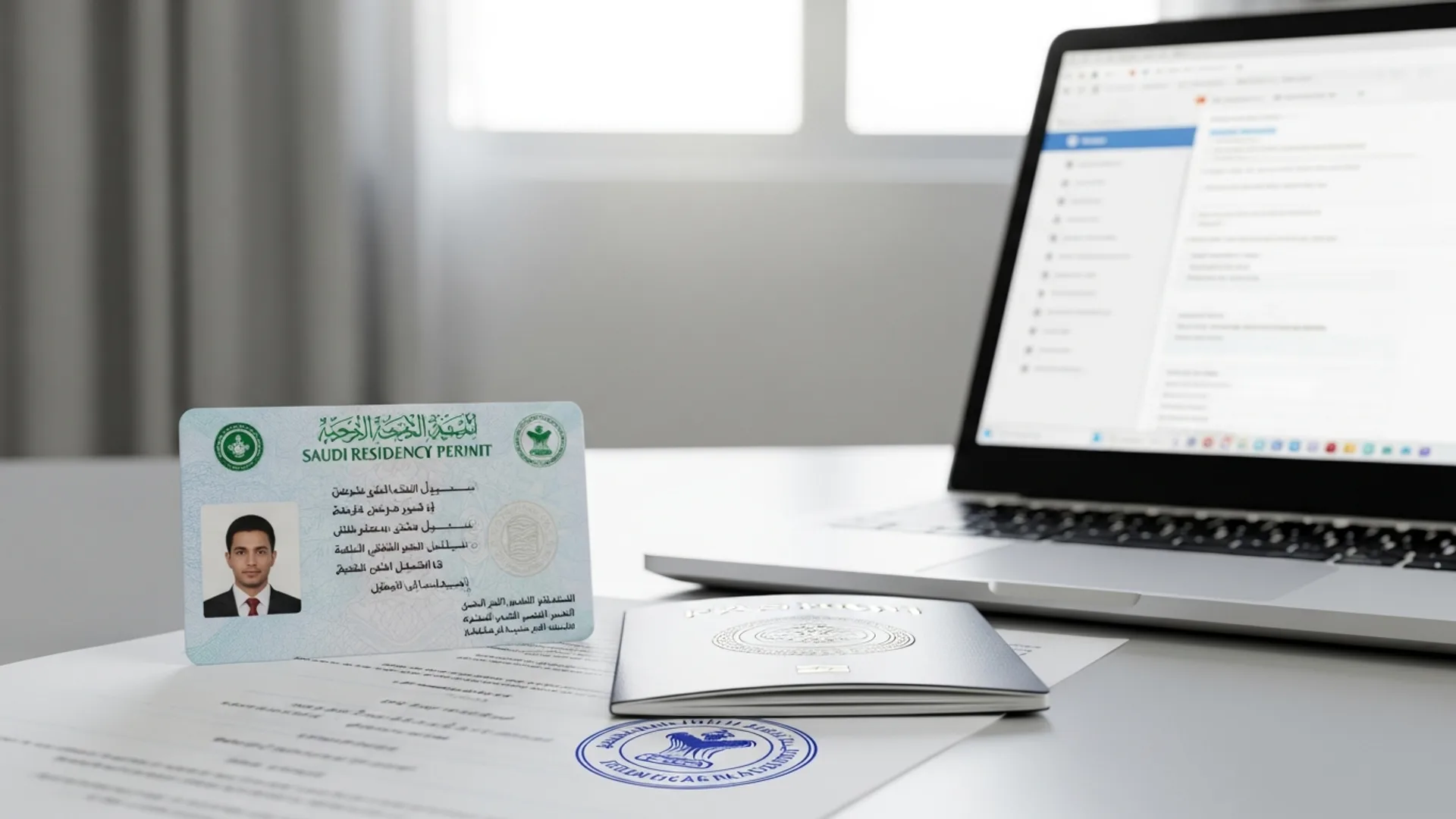
The iqama (residency permit, or Iqama) is the official identity card that lets a non-Saudi resident live, work, bank, and access government e-services in the Kingdom. Renewing it is not a single charge — it is a bundle of separate government fees, each collected through the SADAD bill-payment system before the renewal can be processed on Absher.
When people search for “iqama renewal fees Saudi Arabia,” they usually mean the combined total of three things: the core iqama (residence-permit) fee, the work-permit fee or levy that applies to employees, and any dependent fees for family members listed under the same sponsor. Understanding which of these applies to your situation is the single biggest factor in knowing your final cost, because a single professional with no dependents pays a fraction of what a family of five does.
For company owners and investors setting up in the Kingdom, iqama renewal is a routine, predictable line item rather than a one-off shock — and it is one of the operating costs we map out for every client during company formation in Saudi Arabia.
It also helps to separate the renewal fee from the cost of the iqama card itself. The annual fees you pay through SADAD are what extend the legal validity of your residency for another period. A new physical card is only printed in specific situations — a first issuance, a lost or damaged card, or a photo or data update — and that printing fee is separate from the recurring renewal fee. For the vast majority of renewals, no new card is printed at all: the digital record updates and the Absher app becomes your live proof of a valid iqama.
Who needs to renew an iqama (and who pays)
Any non-Saudi resident holding a valid iqama must renew it before it expires. The responsibility for paying and processing the renewal differs depending on your category:
- Employees on a company sponsorship: the employer (the sponsor) is normally responsible for renewing the iqama and paying the associated government fees, including the work-permit levy. This is the most common case.
- Investors and business owners (MISA / Premium Residency holders): the iqama is tied to your commercial registration and investor licence. Renewal is handled by your own establishment as the sponsor.
- Dependents (spouse, children, parents): the iqama of each dependent is renewed under the head-of-household sponsor, who pays the dependent fee for every family member.
- Domestic workers: renewed by the individual sponsor, usually through the Absher account of the head of the household.
If you run an establishment that sponsors staff, your renewals are managed through the Muqeem platform (run by Elm in coordination with the Ministry of Interior) and the labour-side systems of the Ministry of Human Resources and Social Development (MHRSD) via Qiwa. Individuals renewing their own or their family’s iqama use the personal Absher portal.
2026 iqama renewal fees: the full breakdown
The table below lists the main government charges that make up an iqama renewal. All figures are indicative for 2026 — rates are set by the Saudi government and can change, so always confirm the exact amount shown on your SADAD invoice before paying.
| Fee component | Who it applies to | Indicative amount (SAR) | Frequency |
|---|---|---|---|
| Iqama (residence permit) fee | All iqama holders | ~650 | Per year |
| Work-permit fee / levy | Sponsored employees | ~9,600–14,400 | Per year (varies by Saudi/expat ratio) |
| Dependent fee | Each family member | ~400 per month (~4,800/yr) | Monthly, paid in advance |
| Medical insurance (mandatory) | All residents | ~500–3,000+ | Per year (varies by age/cover) |
| Late-renewal penalty | If renewed after expiry | ~500 (1st offence) | Per occurrence |
Two important points for 2026. First, the work-permit levy depends on the balance of Saudi to non-Saudi employees in the establishment (the Nitaqat / Saudization band), so the per-worker figure varies between companies. Second, the dependent fee is charged per family member per month and is typically paid up front for the renewal period (for example, 12 months in advance), which is why families see the largest totals.
A worked example
A single professional renewing for one year typically pays the ~SAR 650 iqama fee plus their work-permit levy and insurance. A married employee with a spouse and two children renewing all four iqamas for a year would add roughly SAR 4,800 per dependent (3 dependents ≈ SAR 14,400) on top of their own fees — which is why budgeting per head matters.
Why two people on the same salary can pay very different totals
It surprises many residents that the iqama renewal fee is not a flat, one-size charge. Two colleagues earning identical salaries at the same company can face very different annual totals. The differences come down to three variables: how many dependents each person sponsors, the level of medical-insurance cover chosen for each family, and — at the establishment level — the Saudization band the employer sits in, which shapes the work-permit levy attributed to each worker. A single professional with comprehensive solo insurance might pay a few thousand riyals all-in, while a colleague with a spouse, three children, and a parent under sponsorship can pay several times that, almost entirely because of stacked dependent fees. Mapping these variables in advance is the only way to forecast the real number rather than guessing from a single headline figure.
Choosing a renewal duration
Where the system allows it, you can sometimes choose a renewal period — most commonly one year, though shorter or longer windows can appear depending on your category and passport validity. A longer renewal means paying more dependent fees up front but fewer trips through the process; a shorter one spreads the cost but requires renewing more often. Your passport expiry caps the maximum period, which is another reason to keep your passport comfortably valid before you start.
Step-by-step: how to renew an iqama on Absher (2026)
For individuals renewing their own iqama or a dependent’s, the process runs through absher.sa. Here is the exact sequence:
- Log in to Absher Individuals. Open absher.sa, sign in with your national/iqama number and password, and complete the OTP sent to your registered mobile.
- Open the resident’s services menu. From the dashboard, go to My Services → Services → Sponsored Persons (or “Muqeem services” if you sponsor staff).
- Select “Issue / Renew Iqama”. Choose the resident whose permit you are renewing and pick the renewal duration (commonly 1 year).
- Confirm the SADAD invoice. The system generates the fee invoice. Pay the iqama fee — and the dependent fee, if applicable — through your bank’s SADAD payment option using the bill number shown.
- Submit the renewal. Once SADAD confirms payment, return to Absher, confirm valid medical insurance is active, and click Renew. The new expiry date updates immediately.
For establishments renewing employee iqamas in bulk, the equivalent path is on muqeem.sa under Iqama Services → Renew Iqama, where you select one or more sponsored workers, generate the consolidated SADAD invoice, pay, and confirm. Labour-permit prerequisites are validated against Qiwa automatically.
Documents and prerequisites you need first
The renewal itself is fast, but it will be blocked unless these conditions are already met. Check them before you start:
- Valid passport with at least 3 months’ validity (more is safer).
- Active medical insurance registered with the Council of Health Insurance — renewal will not complete without it.
- Settled fees and fines. Any outstanding traffic fines or government dues linked to the record must be cleared first.
- Valid work permit (for employees) — the labour permit on Qiwa must be current and aligned with the iqama profession.
- Sponsor in compliance. The establishment’s Nitaqat status and commercial registration must be active; a suspended CR can block renewals.
- Sufficient SADAD balance / bank access to pay the generated invoice.
If you are an investor, your iqama is linked to your establishment’s records held with the Ministry of Investment (MISA) and the Ministry of Commerce. Keeping your commercial registration and MISA investor licence current is the prerequisite that makes investor-iqama renewals straightforward.
Fees and timeline at a glance
Once your prerequisites are in place, the renewal mechanics are quick. The table below shows the typical timeline.
| Stage | What happens | Typical time |
|---|---|---|
| Generate invoice | Absher/Muqeem creates the SADAD bill | Instant |
| Pay via SADAD | Bank or banking app processes payment | Minutes to a few hours |
| System confirmation | Payment reflects against the iqama record | Same day |
| Renewal completion | New expiry date issued on Absher/Muqeem | Same day |
| Updated iqama card (if needed) | Printed/collected where a new card is required | A few business days |
In most cases there is no need to visit a Jawazat (Passports) office — the digital iqama record and the Absher app are the legal proof. A physical replacement card is only needed for damage, loss, or photo updates.
How payment timing affects your renewal
The slowest part of the whole process is usually nothing to do with the government systems — it is the bank settlement. SADAD payments made through online banking or a banking app typically clear within minutes, but some banks batch payments, so an evening payment may only reflect the next morning. If you are renewing close to the expiry date, pay early in the day and through a channel you know settles quickly, then wait for the payment to show as cleared against the iqama record before clicking Renew. Trying to complete the renewal before SADAD has confirmed the payment is the single most common reason people think the portal is broken when it is simply waiting for funds to clear.
How to check your current iqama fees and expiry
Before renewing, confirm exactly what you owe and when your permit expires:
- Open Absher or the Absher app and sign in.
- Go to My Services → Query → Iqama Expiry Service (or “Resident Information”) to see the precise expiry date.
- Check the SADAD invoices or “Financial dues” section to see any pending fees before they are paid.
- Establishments can pull the same information for all sponsored staff on Muqeem under Reports → Iqama Expiry.
Knowing your exact expiry lets you renew within the window and avoid the late-renewal penalty entirely.
Common errors that block or inflate your renewal
Most renewal problems are caused by an unmet prerequisite rather than the fee itself. The usual culprits:
- Expired or missing medical insurance — the most frequent blocker; renew insurance first.
- Passport too close to expiry — a passport with under 3 months remaining can stop the renewal.
- Unpaid traffic fines or government dues still showing on the record.
- Lapsed work permit on Qiwa for employees, or a profession mismatch between the iqama and the labour permit.
- Sponsor (establishment) out of compliance — an expired commercial registration or red Nitaqat band.
- Paying the wrong SADAD bill number — always pay the exact invoice generated for that renewal.
- Insufficient account balance — the renewal cannot be submitted until the full invoice, including dependent fees paid in advance, has cleared.
A useful habit is to fix the prerequisites in order before you even open the renewal screen: passport validity first, then medical insurance, then fines and dues, then work-permit status. If all four are green, the renewal itself is a two-minute task. If any one is red, the portal will stop you at the invoice or submission stage, and you will spend far longer diagnosing the block than it would have taken to check up front.
Avoiding the late-renewal penalty
If an iqama lapses, a penalty applies — indicatively around SAR 500 for a first occurrence, with higher amounts for repeat lapses (confirm the current figure on the official portal). The simplest way to avoid it is to renew inside the official window before the expiry date shown on Absher.
Practical habits that prevent penalties:
- Set a reminder 30 days before the iqama expiry date.
- Confirm medical insurance is renewed first so it never becomes a last-minute blocker.
- Clear any traffic fines as they arise, not at renewal time.
- For establishments, run a monthly Muqeem expiry report so no employee’s permit slips through.
Iqama renewal for investors and company owners
If your residency is tied to a Saudi establishment you own, iqama renewal is part of a wider compliance cycle that also includes your commercial registration, MISA licence, GOSI registration, and tax obligations. A few 2026 context points worth noting:
- Commercial Register Law (effective 3 April 2026): the Kingdom moved to a unified national commercial registration with no fixed expiry — businesses confirm their data annually instead of renewing a dated CR, and English trade names are now allowed. Keeping this annual confirmation current keeps investor iqamas renewable.
- MISA investor licence fees suspended: the issue/renewal fees that previously applied to the MISA licence have been suspended in 2026, lowering the cost of maintaining investor status (confirm the latest position with MISA).
- GOSI contributions: social-insurance contributions for Saudi staff total around 21.5% (employer plus employee combined), registered through gosi.gov.sa.
- Tax and e-invoicing: VAT is 15%, and ZATCA’s Fatoora e-invoicing applies to registered businesses — relevant once your establishment is trading.
Because these systems interlock, a single lapse — say a CR confirmation missed on the Saudi Business Center, or a GOSI default — can ripple into a blocked iqama renewal. That is exactly the kind of operating-compliance calendar we maintain for clients.
The relevant portals for an investor’s compliance chain are worth bookmarking. Your commercial registration and trade-name confirmation live with the Ministry of Commerce through the Saudi Business Center at mc.gov.sa; investor licensing sits with the Ministry of Investment (MISA); labour permits and Saudization status run through MHRSD via Qiwa; social insurance is filed on GOSI; and tax and e-invoicing are handled by ZATCA at zatca.gov.sa. The unified my.gov.sa national portal links many of these services in one place. None of these are optional once you are trading, and each one feeds the eligibility checks that the iqama renewal screen quietly runs in the background.
Renewing a dependent’s or domestic worker’s iqama
Renewing a dependent’s iqama follows the same core flow as your own, but it is always processed under the head-of-household sponsor’s Absher account rather than the dependent’s. From the Sponsored Persons menu you select the specific family member, generate their invoice — which includes the monthly dependent fee — pay through SADAD, and confirm. Because dependent fees are charged per person, renewing several family members at once is simply the same step repeated, and the invoices are clearly itemised per person so you can see exactly what each renewal costs.
For a domestic worker sponsored by an individual, the renewal is also handled from the sponsor’s Absher account, with the same prerequisites — valid passport, active insurance where required, and no outstanding dues. In every case the principle is identical: the sponsor is the one who pays and submits, and the resident’s eligibility checks must be clean before the system will let the renewal through. Keeping a simple per-person checklist for each member of the household makes a multi-person renewal day far smoother than treating it as one large, undifferentiated task.
How Noble Core helps
Noble Core is a Saudi-focused business-setup consultancy. We do not just open your company — we keep the residency and compliance chain that surrounds your iqama running so renewals never become emergencies. For founders and investors, that means:
- End-to-end iqama and visa management for you, your dependents, and your sponsored staff, with proactive expiry tracking on Muqeem.
- Establishment compliance — commercial registration, MISA investor licensing, GOSI and Qiwa setup, and ZATCA registration — so no upstream lapse blocks a renewal.
- Clear cost mapping of every recurring government fee, so iqama renewals are budgeted, not surprises.
- One accountable point of contact across the Ministry of Investment, Ministry of Commerce, MHRSD, GOSI, and ZATCA.
Our Saudi company-formation package starts from SAR 36,999, and ongoing PRO and iqama-renewal support can be bundled with it. If you are planning your move to the Kingdom — or already operating and want renewals handled cleanly — talk to our team about setting up and staying compliant in Saudi Arabia.
Key takeaways
Iqama renewal in Saudi Arabia is an online, same-day process once your prerequisites are in order. The core iqama fee is modest (~SAR 650/year); the variables that change your total are work-permit levies for employees and dependent fees for family members. Pay through SADAD, renew on Absher or Muqeem, keep medical insurance and fines clear, and renew before expiry to avoid penalties. For investors, keeping your CR, MISA licence, and GOSI status current is what keeps the whole renewal chain unblocked — and is where a setup partner earns its keep.
Need help setting up in Saudi Arabia? Noble Core handles your MISA licence, commercial registration, and visas end-to-end — done right the first time.
Frequently Asked Questions
What are the iqama renewal fees in Saudi Arabia for 2026?
Iqama renewal fees in Saudi Arabia start at roughly SAR 650 per year for the core residence-permit fee. Your total then depends on the work-permit levy for employees and a dependent fee of about SAR 400 per month per family member. Always confirm the exact figures on the SADAD invoice generated in Absher.
How do I renew my iqama online in Saudi Arabia?
Renew your iqama online through Absher in four steps: log in to absher.sa, open My Services and select Issue or Renew Iqama, pay the generated SADAD invoice through your bank, then confirm the renewal. The new expiry date updates the same day. Establishments renew staff in bulk on the Muqeem portal instead.
What is the dependent fee for iqama renewal?
The dependent fee for iqama renewal is charged per family member and is indicatively around SAR 400 per month, or about SAR 4,800 per year, usually paid in advance for the renewal period. A sponsor with three dependents would add roughly SAR 14,400 a year. Confirm the current monthly rate on Absher before paying.
How much does it cost to renew an iqama for a family in Saudi Arabia?
For a family, the iqama renewal cost is the sponsor’s own iqama and work fees plus a dependent fee of about SAR 400 per month for each spouse, child, or parent. A family of four renewing for one year could add roughly SAR 14,400 in dependent fees on top of the core fees and mandatory medical insurance.
What documents do I need to renew my iqama?
To renew your iqama you need a valid passport with at least three months left, active medical insurance, a current work permit for employees, and no outstanding traffic fines or government dues. The sponsoring establishment must also be compliant with a valid commercial registration. The renewal is then completed digitally through Absher or Muqeem.
What is the penalty for late iqama renewal in Saudi Arabia?
Renewing an iqama after it expires triggers a penalty, indicatively around SAR 500 for a first occurrence, with higher amounts for repeat lapses. Confirm the current figure on the official portal. Avoid it by renewing inside the official window before the expiry date shown in your Absher account, and keep medical insurance current.
How can I check my iqama expiry date and fees?
Check your iqama expiry by signing in to Absher or the Absher app, then opening My Services, Query, and the Iqama Expiry Service. The same dashboard shows pending SADAD fees under Financial dues. Establishments can pull an expiry report for all sponsored staff through the Muqeem portal under Reports.
Do business owners and investors pay different iqama renewal fees?
Investor and business-owner iqamas are tied to the establishment they own, so renewal is handled by the company as sponsor rather than an outside employer. The core residence-permit fee is similar, but keeping the commercial registration, MISA investor licence, and GOSI status current is the prerequisite that keeps an investor iqama renewal unblocked.