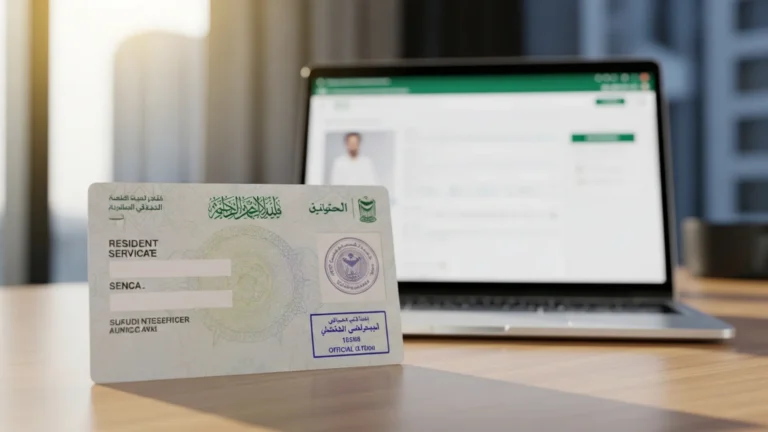
Open Commercial Registration Saudi: 2026 Guide

To open commercial registration Saudi Arabia requires, you apply through the Saudi Business Center at business.sa in roughly 6 online steps — reserve a trade name, file the articles of association, pay the commercial register fee of about SAR 1,200–2,000, and receive a unified CR number starting with “7”. Since the new Commercial Register Law took effect on 3 April 2026, the CR has no expiry date; you simply confirm the data annually. Most applicants complete the process in 1–5 working days once documents are ready.
What a commercial registration actually is
The commercial registration (Arabic: السجل التجاري, commonly written “CR”) is the legal record that says a business exists in the Kingdom of Saudi Arabia. It is issued and maintained by the Ministry of Commerce through the Saudi Business Center. Without it, a company cannot open a bank account, sign a commercial lease, issue tax invoices, register employees with the General Organization for Social Insurance (GOSI), or bid on a tender through Etimad.
The CR carries a unique national number. Under the Commercial Register Law that came into force on 3 April 2026, that number is unified nationally and begins with the digit 7. The old model — a head-office CR plus separate branch CRs in each city, each with its own expiry — has been replaced by a single national register with branch data recorded underneath it. Businesses holding registers under the previous system have a five-year grace period to migrate, and the Ministry of Commerce updates records progressively.
Two other changes matter in practice. First, the CR no longer expires. Instead of paying a renewal every year to avoid suspension, you file an annual confirmation that the register data is still accurate. Second, English trade names are now permitted alongside Arabic, which removes a long-standing friction point for international brands entering the market.
Who needs to open commercial registration Saudi requirements cover
The rule is simple: anyone carrying on commercial activity in the Kingdom on a continuing basis needs a CR. That includes:
- Saudi and GCC nationals setting up a sole establishment (مؤسسة فردية) or a limited liability company.
- Foreign investors — but only after obtaining an investment licence from the Ministry of Investment (MISA). The MISA licence comes first; the CR is issued against it.
- Branches of foreign companies operating in Saudi Arabia, again on the back of a MISA licence.
- Professional firms (engineering, consulting, accounting) which typically need an additional professional licence from the relevant supervisory body before the CR is finalised.
- E-commerce sellers above the casual-trading threshold, who also register the store on the Maroof platform.
Freelancers working under a Ministry of Human Resources and Social Development (MHRSD) freelance certificate do not need a CR for that certificate’s scope, but the moment the activity becomes a company with staff, invoices and a lease, the CR becomes mandatory. If you are a foreign investor mapping out the sequence, our guide to company formation in Saudi Arabia walks through how the MISA licence, CR, and municipality permit stack together.
What you need before you start
Applications stall far more often on missing prerequisites than on the online form itself. Have these ready:
For Saudi and GCC nationals
- National ID (or GCC ID) with an active Absher account — the National Single Sign-On used to authenticate on business.sa.
- A registered mobile number linked to Absher for OTP verification.
- A national address registered with Saudi Post (Wasel/SPL).
- Age 18 or above, or a court/guardian authorisation if younger.
For foreign investors
- A valid MISA investment licence (see our MISA licence guide for Saudi Arabia).
- Parent-company commercial register or certificate of incorporation, attested by the Saudi embassy in the country of origin and by the Ministry of Foreign Affairs (MOFA).
- Audited financial statements of the parent company for the most recent financial year (attested).
- Board resolution appointing the general manager and authorising the Saudi entity, attested.
- Passport copies of shareholders and the proposed general manager.
- Legal translation into Arabic by a licensed translator for every foreign-language document.
For everyone
- Three to five candidate trade names, ranked. Names must not conflict with an existing registration, must not use restricted words, and must fit the activity.
- The ISIC-4 activity codes you intend to register. Pick these carefully — some activities trigger extra approvals from bodies such as Balady (municipality), the Saudi Food and Drug Authority, or the Communications, Space and Technology Commission.
- Proposed capital figure and the shareholding split.
Step-by-step: how to open commercial registration Saudi Business Center style
The whole flow runs through the Saudi Business Center’s e-services portal at business.sa/ar/eservices. The interface is Arabic-first with an English toggle in the top bar. Here is the sequence as you will actually see it on screen.
- Sign in. Open business.sa, click تسجيل الدخول / Login, and choose the National Single Sign-On (النفاذ الوطني الموحد). Enter your Absher username and password, then the OTP sent to your registered mobile. Foreign investors without an Absher account sign in using the MISA-issued credentials for the investor account.
- Reserve the trade name. From the e-services list choose حجز اسم تجاري / Trade Name Reservation. Type your first-choice name; the system checks it live against the register and against the reserved-words list. Approved names are held for a limited period, so move to the next step promptly. Since April 2026 you can also submit an English version of the name in the same screen.
- Select the legal form and activities. Choose between sole establishment, limited liability company (LLC), single-shareholder LLC, joint-stock company, or foreign branch. Then search the ISIC activity tree and tick every activity you want on the register. The portal flags activities that require a prior licence and tells you which authority issues it.
- Draft and file the articles of association. For an LLC, the portal generates the memorandum from a standard template. You fill in shareholders, capital, share split, and manager powers. Electronic signature by each shareholder (or their attorney under a notarised power of attorney) replaces the old trip to a notary. Sole establishments skip this step.
- Pay the fees. The portal issues a SADAD invoice with a payment number. Pay through your bank’s app or online banking under “Government Payments → Ministry of Commerce”. Payment usually reflects within minutes.
- Download the CR. Once payment posts, the commercial register certificate is issued electronically and appears in your dashboard as a PDF with a QR verification code. The unified number beginning with 7 is on the face of the certificate. There is no paper original — the digital record is the legal one.
Straightforward cases — a Saudi national opening a single-activity sole establishment — often finish inside one working day. Foreign-owned LLCs with attested documents typically take longer, mainly because of attestation and translation lead times rather than the portal itself.
What happens immediately after the CR is issued
The CR is the beginning, not the end. Six registrations normally follow within the first two to four weeks, and several of them auto-trigger from the CR:
- Chamber of Commerce membership — mandatory, and required for attesting company documents and signatures.
- MHRSD / Qiwa file — open the establishment file at qiwa.sa to hire staff, manage contracts and see your Nitaqat (Saudization) band.
- GOSI registration at gosi.gov.sa — social insurance for employees. For a Saudi employee the total contribution is around 21.5% of the contribution wage, split between employer and employee.
- ZATCA registration at zatca.gov.sa — corporate tax/zakat file, plus VAT registration at 15% once you cross the mandatory turnover threshold. E-invoicing (Fatoora) obligations apply in phased waves by taxpayer size.
- Balady municipal licence at balady.gov.sa — the physical premises permit for shops, offices, clinics and warehouses.
- Muqeem and visa services — muqeem.sa for resident employee data, and the visa platform at visa.mofa.gov.sa (Enjaz) for work-visa issuance abroad.
Companies planning to litigate, register liens, or serve notices should also familiarise themselves with the Ministry of Justice portal najiz.sa, and small enterprises should look at the support programmes published by Monsha’at, the Small and Medium Enterprises General Authority.
Fees and timelines (indicative, 2026)
Government charges change from time to time. Treat the figures below as indicative planning numbers and confirm current figures on the official portal before you budget.
| Item | Authority / portal | Indicative fee (SAR) | Typical timeline |
|---|---|---|---|
| MISA investment licence (issue) | MISA | Issue & renewal fees suspended in 2026 (previously SAR 12,000 first year, SAR 62,000 renewal) | 3–10 business days |
| Trade name reservation | Saudi Business Center | Nominal / included | Minutes |
| Commercial registration issuance | Ministry of Commerce | ~1,200–2,000 | Same day to 3 days |
| Chamber of Commerce membership | Chamber of Commerce | ~2,000–3,000 per year | 1–2 days |
| Articles of association e-signature | Saudi Business Center | Included in CR flow | Same day |
| Municipal (Balady) licence | Balady | Varies by activity and premises | 3–15 days |
| GOSI employer registration | GOSI | No fee; contributions ~21.5% total for a Saudi employee | 1–2 days |
| VAT registration | ZATCA | No fee; VAT rate 15% | 1–3 days |
| Iqama issuance / renewal (per employee) | Absher / MOI | ~650 per year government fee, plus applicable levies | 1–5 days |
| Annual CR data confirmation | Ministry of Commerce | Nominal (replaces old renewal) | Minutes online |
A realistic all-in first-year budget for a small foreign-owned LLC — licence, CR, chamber, attestations, translations, municipal permit and one or two work visas — usually lands in a band rather than at a single number, because attestation costs vary sharply by country of origin. Noble Core’s fixed-scope KSA formation package starts from SAR 36,999, which lets founders plan against one figure instead of a moving target.
Annual confirmation: the change that replaced CR renewal
Under the previous framework, a business that forgot to renew its CR risked suspension of the register and knock-on freezes across Qiwa, GOSI and banking. The 2026 law removes the expiry date entirely. In its place is an annual confirmation obligation: once a year, the authorised person logs into business.sa and confirms that the registered particulars — address, activities, manager, capital, shareholders — remain accurate, updating anything that has changed.
Practical points to plan around:
- Set a calendar reminder tied to the CR issue date; the portal also sends notifications to the registered mobile and email.
- Confirmation is a data-accuracy exercise, not a payment event, though nominal service charges may apply.
- Changes such as adding an activity, changing the manager, or moving premises should be filed when they happen, not saved up for the annual confirmation.
- Keep the contact mobile number current. Because almost every government notification arrives by SMS to the number on file, an outdated number is the single most common reason businesses miss a deadline.
How to verify a commercial registration
Before signing with a Saudi supplier, landlord or partner, verify their CR — it takes under a minute and is free.
- Go to business.sa/ar/eservices and open the commercial register enquiry service (الاستعلام عن سجل تجاري).
- Enter the CR number (or the trade name) and submit.
- Read the returned record: legal form, status (active / suspended / cancelled), registered activities, capital, and the authorised manager.
- Cross-check that the activity you are contracting for actually appears on the register. A CR that lists “general trading” does not authorise regulated work such as construction contracting or medical services.
- Scan the QR code on any CR certificate you are handed. A genuine certificate resolves to the Ministry of Commerce record; a mismatch is a red flag.
The same verification habit applies in reverse: check how your register reads to the outside world before a bank or tender committee does.
Foreign ownership, capital and the MISA sequence
Saudi Arabia permits 100% foreign ownership in most economic activities, which means a foreign investor generally does not need a local partner to hold shares. A short negative list and a handful of sectors with sectoral conditions remain, and some activities carry minimum capital expectations tied to the licence type rather than to the CR itself.
The sequence that trips people up is this: the CR cannot be issued to a foreign shareholder before the MISA licence exists. Applicants who reserve a trade name first, then discover their activity needs a licence variant they did not apply for, end up restarting. The clean order is:
- Confirm the activity is open to foreign investment and identify the correct MISA licence category (service, industrial, trading, entrepreneur, professional).
- Assemble and attest parent-company documents.
- Obtain the MISA licence — typically 3–10 business days once the file is complete.
- Reserve the trade name and file the CR on business.sa.
- Complete chamber, Qiwa, GOSI, ZATCA and Balady registrations.
- Open the corporate bank account, then apply for the general manager’s visa and Iqama.
Note that MISA licence issue and renewal fees were suspended in 2026 — previously SAR 12,000 for the first year and SAR 62,000 for renewals — which materially lowers the entry cost for foreign entities. Because such reliefs are announced with defined scopes and periods, confirm the position that applies to your licence category on the official portal at the time you file.
Common mistakes to avoid
- Choosing activity codes casually. The ISIC codes on your CR determine what you may invoice for, which permits you need, and whether banks will accept your account application. Adding a code later is a filing, not a formality.
- Reserving a trade name before checking the activity. Some names are only permitted for certain activities or legal forms; a mismatch forces a fresh reservation.
- Skipping the Arabic legal translation. Foreign documents submitted without a licensed Arabic translation are returned, and the re-submission cycle usually costs more days than doing it correctly the first time.
- Attesting only at the embassy. Most foreign corporate documents need the full chain — notary, home-country foreign ministry, Saudi embassy, then MOFA in the Kingdom. A partial chain fails at the counter.
- Assuming the CR still expires. Under the 2026 law it does not, but the annual confirmation is a real obligation. Treating it as optional is how records drift out of date.
- Using a personal mobile number that later changes. Government notifications from the Ministry of Commerce, ZATCA and MHRSD all route to the number on file.
- Delaying GOSI and Qiwa registration. You cannot legally onboard staff or issue work visas until the establishment file exists, and hiring plans slip accordingly.
- Ignoring VAT and e-invoicing timing. VAT registration at the 15% rate becomes mandatory above the turnover threshold, and ZATCA’s Fatoora e-invoicing waves apply by taxpayer size — build compliant invoicing into your accounting system from day one rather than retrofitting it.
- Registering a virtual address for an activity that requires physical premises. Balady inspections check the actual location against the licence.
- Naming a general manager who is not available to travel. The manager on the articles must complete visa and Iqama formalities; an absent manager blocks bank account opening.
How Noble Core helps
Most of the work in opening a Saudi commercial register is not on the portal — it is upstream, in choosing the right licence category, getting the activity codes right, and sequencing attestations so nothing arrives out of order. That is where files gain or lose weeks.
Noble Core Ventures runs the full sequence as one managed track: activity and licence-category assessment, MISA application, trade name reservation, articles of association drafting and e-signature coordination, CR issuance on business.sa, Chamber of Commerce membership, Qiwa and GOSI establishment files, ZATCA registration, Balady permit support, corporate bank account introduction, and the general manager’s visa and Iqama. Our clients get a single point of contact, a fixed scope, and a document checklist that is specific to their country of origin rather than a generic list.
If you already have a MISA licence and only need the register issued, Noble Core’s commercial registration service handles the filing, the fee payments and the post-CR registrations as a standalone engagement. If you are starting from zero, the formation package covers the whole path from activity selection to a bank-ready entity, priced from SAR 36,999 so you can budget against one number.
Either way, the practical advice is the same: decide your activities first, verify the licence category before you touch the portal, and get your foreign documents into the attestation chain early. Everything else on business.sa is a form.
Need help setting up in Saudi Arabia? Noble Core handles your MISA licence, commercial registration, and visas end-to-end — done right the first time.
Frequently Asked Questions
How do I open commercial registration Saudi Arabia requires for a new company?
You apply online through the Saudi Business Center at business.sa in about six steps: sign in with Absher National Single Sign-On, reserve a trade name, choose the legal form and ISIC activity codes, file and e-sign the articles of association, pay the SADAD invoice of roughly SAR 1,200 to 2,000, then download the electronic CR certificate.
Does a Saudi commercial registration still expire in 2026?
No. Under the Commercial Register Law effective 3 April 2026, the commercial registration has no expiry date. Annual renewal has been replaced by an annual confirmation, where the authorised person logs into business.sa once a year and confirms the registered particulars are still accurate, updating address, activities, manager or capital if anything changed.
What is the unified commercial register number starting with 7?
The 2026 law introduced a single national commercial register number that begins with the digit 7, replacing the old system of separate head-office and branch registers with individual expiry dates. Branch details are now recorded under the one national number. Businesses registered under the previous system have a five-year grace period to migrate their records.
How much does it cost to open commercial registration Saudi businesses use?
The commercial register issuance fee is indicatively SAR 1,200 to 2,000, with Chamber of Commerce membership adding roughly SAR 2,000 to 3,000 per year. MISA investment licence issue and renewal fees were suspended in 2026, previously SAR 12,000 and SAR 62,000. Confirm current figures on the official portal before budgeting.
Can a foreigner open a commercial registration in Saudi Arabia without a local partner?
Yes in most activities. Saudi Arabia permits 100% foreign ownership across the majority of economic sectors, so no Saudi shareholder is required. However, the foreign investor must first obtain an investment licence from the Ministry of Investment (MISA), typically issued within 3 to 10 business days, before the commercial registration can be issued.
What documents do I need to open commercial registration Saudi authorities accept?
Saudi and GCC nationals need a national ID, an active Absher account and a registered national address. Foreign investors additionally need a MISA licence, attested parent-company incorporation documents, audited financial statements, a board resolution appointing the general manager, shareholder passports, and licensed Arabic legal translations of every foreign-language document.
How long does it take to get a commercial registration in Saudi Arabia?
A Saudi national opening a single-activity sole establishment can often finish within one working day on business.sa. Foreign-owned LLCs typically take longer, usually 1 to 4 weeks overall, because the MISA licence takes 3 to 10 business days and document attestation plus Arabic translation add lead time before filing begins.
What registrations follow after the commercial registration is issued?
Six normally follow within two to four weeks: Chamber of Commerce membership, the MHRSD establishment file on Qiwa, GOSI social insurance registration where the total contribution is about 21.5% for a Saudi employee, ZATCA tax and 15% VAT registration, the Balady municipal premises licence, and Muqeem plus visa platform access for staff.