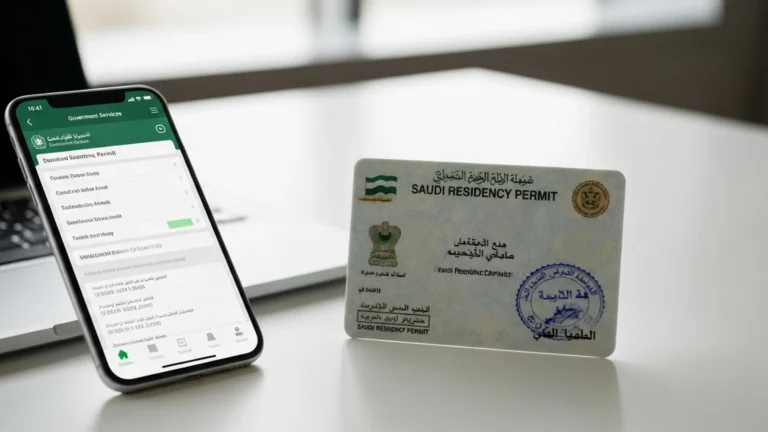
Iqama Fees Breakdown Saudi: Full 2026 Cost Guide

The iqama fees breakdown saudi employers pay in 2026 starts with the core residence permit government fee of about SAR 650 per year, added to a work permit fee commonly around SAR 9,700 per year and an expat levy of roughly SAR 800 per month per dependant. Add medical insurance, Absher service charges and Muqeem registration, and a realistic first-year iqama cost sits between SAR 15,000 and SAR 25,000 per employee. All figures are indicative — confirm current amounts on absher.sa before you budget.
What the iqama is and why the fee structure looks complicated
The iqama (residence permit, or hawiya muqeem) is the identity document issued to expatriate residents of the Kingdom of Saudi Arabia. It carries a 10-digit ID number beginning with “2”, ties the holder to a registered employer, and is the key that unlocks almost every other service: opening a bank account, registering a vehicle, obtaining a driving licence, enrolling children in school, signing a lease, and issuing dependant visas.
Newcomers are often surprised that there is no single “iqama fee”. What people call the iqama cost is actually a stack of separate government charges collected by different authorities through different portals. The Ministry of Interior collects the residence permit fee through Absher. The Ministry of Human Resources and Social Development (MHRSD) collects the work permit fee and the expatriate levy, largely through the Qiwa platform. The General Organization for Social Insurance (GOSI) collects occupational hazard contributions. Private insurers collect the mandatory medical cover premium, verified against the Council of Health Insurance database.
Understanding which authority owns which line item is the single most useful thing an employer can learn, because when a payment fails or a renewal is blocked, the fix always sits with the authority that owns that specific charge — not with Absher generally.
Full iqama fees breakdown saudi employers should budget for in 2026
The table below sets out the main recurring components. Treat every figure as indicative for planning: the Kingdom periodically revises levies and service fees, and some charges vary by company size, Saudisation (Nitaqat) band and the number of dependants. Always confirm the live amount on the relevant portal before transferring funds.
| Cost component | Collected via | Indicative amount (SAR) | Frequency |
|---|---|---|---|
| Iqama issue / renewal government fee | Absher (MOI) | 650 | Per year |
| Work permit fee (rukhsat amal) | Qiwa / MHRSD | 9,700 | Per year |
| Expatriate levy — dependants | Absher / MOI | 800 per dependant | Per month |
| Medical insurance (individual, basic cover) | Licensed insurer | 1,200 – 4,000 | Per year |
| GOSI occupational hazard (expat employee) | gosi.gov.sa | 2% of monthly wage | Monthly |
| Exit / re-entry visa (single, 2 months) | Absher | 200 | Per issue |
| Exit / re-entry extension (per month) | Absher | 100 | Per month |
| Final exit visa | Absher | No fee (dues must be clear) | Once |
| Employment visa issuance (Enjaz / MOFA) | visa.mofa.gov.sa | 2,000 – 2,300 | Per visa |
| Muqeem subscription (per company) | muqeem.sa | Tiered by headcount | Annual |
| Iqama transfer of sponsorship (first transfer) | Qiwa / Absher | 2,000 | Per transfer |
| Iqama replacement (lost card, first time) | Absher | 1,000 | Per incident |
Two figures dominate the total: the work permit fee and the dependant levy. A single employee with no dependants might cost roughly SAR 11,000–13,000 a year in direct government charges. The same employee with a spouse and two children adds around SAR 28,800 a year in dependant levy alone, which is why family status is the biggest variable in any iqama budget.
Who pays what: employer versus employee obligations
Under Saudi labour regulations the employer is responsible for the cost of recruiting the employee, issuing and renewing the iqama, the work permit fee, and the medical insurance for the employee. Employers are also expected to cover the cost of the employee’s final exit at the end of the contract.
The dependant levy is a different matter and is commonly borne by the employee, unless the employment contract expressly provides otherwise — many senior packages include it as a benefit. Because this is a contractual question rather than a fixed rule, both employers and candidates should confirm it in writing at offer stage. Setting it out clearly in the contract registered on Qiwa avoids disputes later.
Costs almost always missed in first-year budgets
- Medical examination and attestation of degree certificates in the home country before visa issuance.
- Enjaz service charges and courier fees at the visa stage, separate from the MOFA visa fee itself.
- Insurance upgrades where the employee’s family needs cover beyond the basic tier.
- The professional accreditation (verification of practising certificate) step required for certain job titles such as engineers and accountants.
- Bank transfer and portal payment charges when settling government fees via SADAD.
Step-by-step: how to check and pay iqama fees on Absher
Absher Business (Absher Aamal) is the employer-facing portal where iqama fees are actually settled. The flow below reflects the standard 2026 interface; screen labels are occasionally refreshed, so read the on-screen wording rather than clicking from memory.
- Sign in at absher.sa and choose Absher Business rather than Absher Individuals. Complete the two-factor OTP sent to the registered mobile number.
- From the dashboard open My Services, then Sponsorship Services.
- Select Iqama Services and then Renew Iqama or Issue Iqama depending on whether the employee is new or existing.
- Search for the employee by iqama number or border number. The system returns their record, current expiry date and insurance validity.
- Absher displays the payable amount and generates a SADAD invoice number. Note this reference — it is what you use in online banking.
- Pay the SADAD bill through your corporate bank portal under Government Payments > Ministry of Interior. The credit usually appears in Absher within minutes, occasionally up to 24 hours.
- Return to Absher, reopen the same service, and confirm the balance is applied. Click Renew to complete the transaction.
- Download the updated iqama print-out from Query Services > Print Iqama Details, and verify the new expiry on muqeem.sa.
Important sequencing note: the work permit must be valid before the iqama can be renewed. If Absher blocks the renewal, the usual cause is an expired work permit on Qiwa, not a problem with Absher itself.
Renewing the work permit on Qiwa before the iqama
The work permit (rukhsat amal) is issued by MHRSD and administered through Qiwa. The correct order is: work permit first, then iqama. Attempting it the other way round produces the most common error message employers report.
- Log in to qiwa.sa with the establishment account linked to your unified national number.
- Open Establishment Services and check that your Nitaqat (Saudisation) band is green or better — a red band restricts several transactions.
- Go to Work Permits, locate the employee, and select Renew Work Permit.
- Confirm the employment contract on file is active and digitally signed by both parties. An unsigned contract will halt the transaction.
- Generate the SADAD invoice for the work permit fee and settle it through your bank.
- Once the permit shows as renewed, move to Absher and complete the iqama renewal within the same window.
Employers building a workforce from scratch should map this cycle before the first hire arrives. Our team walks clients through it as part of company formation in Saudi Arabia, because the visa quota you receive at establishment stage determines how many of these permits you can issue at all.
Documents and IDs you need before you start
Nothing slows an iqama transaction more than missing paperwork discovered halfway through the portal flow. Assemble the following before you log in.
For a new iqama (first issuance)
- Employee passport valid for at least six months, with the entry visa page.
- Border number (issued on arrival) — required until the iqama number is generated.
- Completed medical examination at an approved Saudi facility, with results uploaded.
- Active medical insurance policy registered against the employee’s border or iqama number.
- Signed employment contract uploaded to Qiwa.
- Employer’s commercial registration and unified national number (the new CR ID beginning with “7” under the Commercial Register Law effective 3 April 2026).
- Biometric enrolment appointment at an Absher-designated centre.
For renewal
- Valid work permit on Qiwa.
- Medical insurance valid for at least the period of the requested renewal.
- Zero outstanding traffic violations against the employee record.
- All expatriate levy instalments settled.
- Establishment file active with no MHRSD or GOSI suspension.
Timelines: how long each iqama step actually takes
Processing times below reflect typical experience where documents are complete. Delays are almost always caused by document gaps, not by the authorities’ turnaround.
| Step | Portal / authority | Indicative timeline |
|---|---|---|
| Block visa approval (visa quota) | Qiwa / MHRSD | 3 – 10 business days |
| MISA investor licence (foreign entity) | MISA | 3 – 10 business days |
| Employment visa stamping | MOFA / Enjaz | 5 – 15 business days |
| Medical exam and insurance activation | Approved provider | 1 – 3 business days |
| First iqama issuance after arrival | Absher / Jawazat | 5 – 10 business days |
| Iqama renewal (fees pre-paid) | Absher | Same day – 48 hours |
| Sponsorship transfer | Qiwa | 2 – 7 business days |
| Exit / re-entry visa | Absher | Immediate once paid |
Plan renewals at least 30 days before expiry. Absher opens the renewal window well ahead of the expiry date, and using that buffer removes the risk of late fees or a lapse that complicates travel.
How iqama costs fit into total Saudi company setup budgeting
For a foreign-owned entity, iqama costs sit downstream of the licensing spend. The picture in 2026 is unusually favourable: MISA investor licence issuance and renewal fees remain suspended (previously SAR 12,000 for issuance and up to SAR 62,000 for renewal), and 100% foreign ownership is available across most activities. The commercial registration itself runs roughly SAR 1,200–2,000, with Chamber of Commerce membership at around SAR 2,000–3,000 per year.
Under the new Commercial Register Law effective 3 April 2026, the CR is a unified national record with an ID starting “7”, carries no expiry date (replaced by an annual confirmation), permits English trade names, and provides a five-year grace period for migration of existing records. That removes a recurring renewal cost from the setup ledger — but it does not change iqama economics, which remain per-employee and per-year.
A practical planning rule: model your first-year Saudi cost as licensing plus registration plus (headcount × iqama stack). For a five-person team with mixed family status, the iqama stack will typically exceed the licensing spend within the first twelve months. Companies entering under an MISA licence for Saudi Arabia should confirm their approved visa quota early, since it caps how quickly the team can scale.
Related government charges expatriate employers encounter
GOSI social insurance
Expatriate employees are registered with GOSI for occupational hazard cover only, at roughly 2% of monthly wage, paid by the employer. For Saudi national employees the combined employer and employee contribution is approximately 21.5% of wage. Register and pay through gosi.gov.sa; unpaid GOSI dues can freeze iqama transactions.
ZATCA obligations
Payroll itself is outside VAT, but the 15% VAT rate applies to most business purchases, and the Zakat, Tax and Customs Authority operates e-invoicing (Fatoora) in phased waves. Keep zatca.gov.sa compliance current — a suspended tax file can block establishment services elsewhere.
Municipality and commercial licensing
Premises-related licences run through balady.gov.sa, while the commercial registration and most Ministry of Commerce filings are handled on the Saudi Business Center. Government tenders sit on Etimad, and small-business support programmes are published by Monsha’at.
Using Muqeem to verify what you have actually paid
Muqeem is the residency information platform many employers use as their operational record. It is the fastest way to confirm that a payment posted correctly and that an iqama expiry has genuinely moved.
- Log in at muqeem.sa using the establishment credentials.
- Open Employees and search by iqama or passport number.
- Check the Iqama Expiry and Work Permit Expiry fields — these should now differ from what you saw before payment.
- Use Reports to export an expiry-calendar spreadsheet for the whole workforce, then set internal reminders 60 and 30 days out.
If Absher shows a completed transaction but Muqeem still displays the old expiry, wait one working day before raising a case — synchronisation between systems is normally quick but not instantaneous.
Reading your SADAD bill correctly
Every government fee in the Kingdom is settled through SADAD, and misreading the invoice is a frequent source of confusion. Each bill carries a biller code identifying the authority (Ministry of Interior, MHRSD, GOSI and so on) and a unique invoice number tied to a specific transaction and employee.
- Pay the exact amount displayed. Partial payments sit as unallocated credit and do not release the transaction.
- Do not reuse an old invoice number — each renewal generates a fresh one, and an expired reference will be rejected.
- Keep the bank confirmation reference against each employee file; it is the only proof if a payment needs to be traced.
- Confirm the biller code matches the authority you intend to pay. A work permit fee paid under the wrong code will not clear an Absher block.
Sponsorship transfer, exit/re-entry and final exit costs
Beyond the annual renewal cycle, three transactional events generate their own fees and are worth planning for in advance, because each one has a sequencing requirement that trips up first-time employers.
Sponsorship transfer
Transferring an employee from one establishment to another is handled on Qiwa under Employee Transfer. The first transfer typically costs around SAR 2,000, with higher amounts for subsequent transfers. Both establishments must have active files, the receiving employer needs available quota in the correct job classification, and the employee’s iqama must be valid at the moment of transfer. Plan a two to seven business day window and do not schedule the employee’s start date on the assumption of same-day completion.
Exit and re-entry visas
An employee travelling abroad and returning needs an exit/re-entry visa issued through Absher before departure. A single two-month visa runs about SAR 200, with roughly SAR 100 per additional month. Multiple exit/re-entry visas cost more but suit employees who travel frequently. Two practical rules: the iqama must remain valid for the entire period of the visa, and the visa must be issued before the employee leaves the Kingdom, never after.
Final exit
The final exit visa itself carries no government fee, but it will not issue while anything is outstanding — unpaid traffic violations, an active vehicle registration in the employee’s name, an unsettled mobile or utility account, or an open GOSI matter. Employers should run a clearance check through Absher and Muqeem four to six weeks before the intended departure date, since resolving a legacy item can take longer than the visa itself.
Building a renewal calendar that does not fail
The single highest-return administrative habit for any employer in the Kingdom is a disciplined expiry calendar. Government portals surface the data; the failure point is almost always internal tracking.
- Export the full workforce expiry report from Muqeem monthly and store it as the single source of truth.
- Track four dates per employee, not one: iqama expiry, work permit expiry, insurance expiry and passport expiry. The earliest of the four is your real deadline.
- Set alerts at 60 days (budget approval), 30 days (documents assembled) and 14 days (transaction executed).
- Hold a standing SADAD payment buffer in the corporate account so renewals are never delayed by a treasury approval cycle.
- Re-check the establishment file status at MHRSD, GOSI and ZATCA quarterly — company-level suspensions block every employee at once.
- Record each SADAD reference number against the employee file immediately after payment, not at month-end.
Companies running twenty or more residency files usually find that this calendar, maintained properly, eliminates almost every late-renewal cost they used to treat as unavoidable.
Common mistakes to avoid
- Renewing the iqama before the work permit. The order is always Qiwa first, then Absher. Reversing it produces a hard block.
- Letting medical insurance lapse by a single day. Absher validates insurance coverage in real time; an expired policy stops the renewal outright.
- Budgeting only the SAR 650 residence fee. This is the smallest component. The work permit fee and dependant levy carry most of the cost.
- Forgetting dependants renew separately. Each family member has an individual iqama with its own fee and levy schedule.
- Ignoring outstanding traffic fines. Unpaid violations against the employee’s record will block renewal until settled through Absher.
- Missing the 30-day buffer. Leaving renewal to the final week removes any margin for a failed payment or document issue.
- Assuming fees are static. Levy and service amounts are revised from time to time; verify on the portal each cycle rather than reusing last year’s spreadsheet.
- Treating the establishment file as an afterthought. A suspended GOSI, ZATCA or MHRSD file will freeze iqama services for the whole company, not just one employee.
- Not exporting an expiry calendar. Manual tracking across a growing team is where lapses originate; use Muqeem’s report function instead.
- Paying the wrong SADAD biller code. The money leaves your account but never reaches the transaction you were trying to complete.
How Noble Core helps with iqama fees and renewals
Most companies do not struggle with any single iqama step — they struggle with keeping thirty of them synchronised across a growing headcount, three portals and two authorities. That is the work we take off the desk.
Noble Core manages the full residency cycle for clients in the Kingdom: quota planning at licensing stage, block visa applications through Qiwa, Enjaz and MOFA visa processing, medical and insurance coordination, first iqama issuance, and a managed renewal calendar with escalation before anything approaches expiry. Our visa and iqama service also covers sponsorship transfers, exit/re-entry management and dependant processing, so families are handled alongside employees rather than as an afterthought.
For companies still at the entry stage, our setup packages start from SAR 36,999 and include the MISA licence application, commercial registration, Chamber membership and the initial GOSI, ZATCA and Qiwa registrations that make iqama issuance possible in the first place. Because the licensing and residency workstreams sit with one team, the visa quota is sized to the hiring plan from day one rather than renegotiated after the first three hires.
All fees quoted throughout this guide are indicative for planning purposes. Government charges are set by the relevant Saudi authorities and can be revised — always confirm current figures on Absher, Qiwa, Muqeem or the responsible portal before committing budget.
Need help setting up in Saudi Arabia? Noble Core handles your MISA licence, commercial registration, and visas end-to-end — done right the first time.
Frequently Asked Questions
What is the full iqama fees breakdown saudi employers face in 2026?
The stack has four main parts: the iqama residence permit fee of about SAR 650 per year through Absher, the work permit fee of roughly SAR 9,700 per year through Qiwa, the expatriate dependant levy of around SAR 800 per dependant per month, and medical insurance from SAR 1,200. All figures are indicative; confirm current amounts on the official portal.
How much does it cost to renew an iqama in Saudi Arabia?
A straightforward renewal for an employee with no dependants typically costs SAR 11,000 to 13,000 per year in direct government charges, combining the SAR 650 residence fee, the work permit fee near SAR 9,700 and medical insurance. Dependants add roughly SAR 800 each per month. Verify the exact payable amount on Absher before generating your SADAD invoice.
Who pays the iqama fees, the employer or the employee?
Saudi labour regulations place the iqama issuance and renewal fee, the work permit fee and the employee’s medical insurance on the employer, along with the final exit cost. The dependant levy is commonly borne by the employee unless the employment contract states otherwise. Agree this in writing at offer stage and record it in the Qiwa contract.
How do I pay iqama fees on Absher step by step?
Sign in to Absher Business, open My Services, then Sponsorship Services, then Iqama Services and select Renew Iqama. Search the employee by iqama or border number, generate the SADAD invoice, pay it through your bank under Government Payments, then return to Absher and confirm the renewal. Download the updated iqama details and verify the expiry on Muqeem.
Why is my iqama renewal blocked even after paying the fees?
The most common cause is an expired work permit. Absher will not renew an iqama while the Qiwa work permit is lapsed, so renew the permit first. Other blockers include expired medical insurance, unpaid traffic violations against the employee record, outstanding GOSI or ZATCA dues, and a suspended establishment file at MHRSD.
What is the expat dependant levy and how is it calculated?
The dependant levy is a monthly charge of approximately SAR 800 for each family member sponsored on an employee’s iqama, collected through Absher alongside the residence permit. A spouse plus two children adds around SAR 28,800 annually. It is usually settled as a lump sum covering the renewal period, so budget it ahead of the renewal window.
How long does an iqama renewal take in Saudi Arabia?
With the work permit valid, insurance active and fees pre-paid through SADAD, an Absher renewal usually completes the same day or within 48 hours. A first iqama issuance after arrival takes five to ten business days including biometrics and the medical exam. Start renewals at least 30 days before expiry to keep a safety buffer.
How do iqama costs fit into overall Saudi company setup budgeting?
Licensing is now comparatively light: MISA licence issue and renewal fees are suspended in 2026, commercial registration runs about SAR 1,200 to 2,000 and Chamber membership SAR 2,000 to 3,000 yearly. Iqama costs are per employee per year, so for teams above four or five people they typically exceed total licensing spend within the first twelve months.