Saudi Residence Permit (Iqama) 2026: Complete Guide
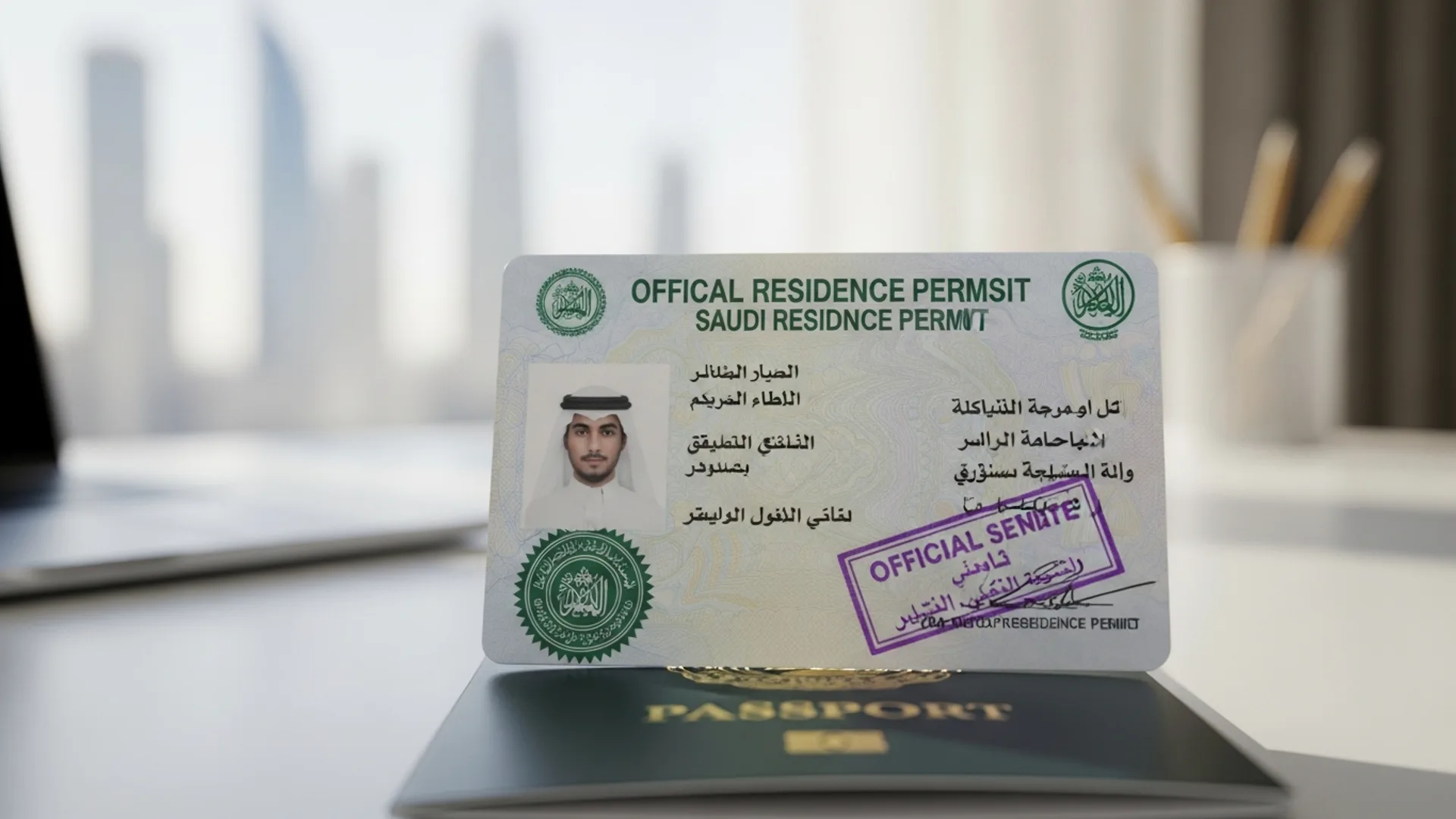
A residence permit in Saudi Arabia — the Iqama — is the official ID card that lets expatriates live and work in the Kingdom legally. The base government issuance/renewal fee is approximately SAR 650 per year, issuance typically takes 3–10 working days after your medical and biometrics, and the entire process runs through three portals: Muqeem, Absher, and Qiwa. This 2026 guide walks you through every step, fee, and document — whether you are an employee joining a Saudi company or an investor setting up your own business.
What is the Saudi residence permit (Iqama)?
The Iqama (إقامة) is the residence permit issued by the Saudi Ministry of Interior through the General Directorate of Passports (Jawazat). It is a smart ID card that records your name, nationality, profession, sponsor (employer or your own company), and permit validity. Every expatriate over a certain age who lives in Saudi Arabia — employees, investors, and their dependents — must hold a valid Iqama.
In practice, the Iqama is far more than a card. It is the key that unlocks daily life in the Kingdom: opening a bank account, signing a tenancy contract (Ejar), registering a SIM card, obtaining a driving licence, enrolling children in school, accessing government services on Absher, and sponsoring family members. Without a valid Iqama, none of these services are available.
Since the Premium Residency (often called the “Saudi Green Card”) launched, there are now two broad residence tracks: the standard sponsored Iqama covered in this guide, and the Premium Residency for high-net-worth individuals and investors, which removes the need for a sponsor entirely. Most expatriates — well over 90% of the Kingdom’s roughly 13 million foreign residents — hold the standard Iqama.
Who needs a residence permit in Saudi Arabia?
Anyone who intends to stay in the Kingdom beyond the validity of a visit visa needs a residence permit. The main categories are:
- Employees — sponsored by a Saudi-registered employer. The employer initiates the work visa, and the Iqama is issued after arrival.
- Investors and business owners — foreign entrepreneurs who hold a MISA (Ministry of Investment) licence can obtain an Investor Iqama under their own company, effectively becoming their own sponsor.
- Dependents — spouses, children, and in some cases parents, sponsored by a resident family head who meets the salary and profession requirements.
- Domestic workers — sponsored by Saudi citizens or eligible residents under a separate quota system.
- Premium Residency holders — a self-sponsored category with one-time or annual fee options, outside the standard Iqama system.
Visit visas, business visit visas, and tourist eVisas do not permit residence or employment. If you plan to run a business in the Kingdom, the correct route is a MISA investment licence followed by an Investor Iqama — a process Noble Core handles end-to-end as part of company formation in Saudi Arabia.
Physical card vs digital Iqama
Since the shift to digital government services under Vision 2030, the Iqama exists in two equally valid forms: the physical smart card printed by Jawazat, and the digital version displayed in the Absher and Tawakkalna apps the moment issuance completes on Muqeem. In day-to-day life — police checkpoints, hotel check-ins, courier deliveries — the digital Iqama on Tawakkalna is accepted everywhere. Banks and some notarised transactions may still ask to sight the physical card, so collect it from your employer or Jawazat when printed. If the card is lost or damaged, report it on Absher and request a replacement; a reissuance fee applies (indicatively around SAR 1,000 for a lost card — confirm the current figure on Absher before paying).
The three portals you will actually use: Absher, Muqeem, and Qiwa
Understanding which platform does what saves days of confusion:
- Absher — the Ministry of Interior’s individual services portal. Residents use Absher to check Iqama validity, view traffic fines, issue exit/re-entry visas for themselves and dependents, and update personal records. Registration requires your Iqama number and a Saudi mobile number.
- Muqeem — the residency-management platform used primarily by employers and PRO teams. Companies issue, renew, and transfer Iqamas, print Iqama data, and issue exit/re-entry visas for staff through Muqeem. Individuals can also use the free Muqeem “Resident Validity” check to verify Iqama and visa status with just a passport or Iqama number.
- Qiwa — the Ministry of Human Resources and Social Development (MHRSD) labour platform. Work permits (rukhsat al-amal), employment contract authentication, Saudization (Nitaqat) status, and sponsorship transfers are processed here. An Iqama cannot be issued or renewed unless the linked work permit and contract are in order on Qiwa.
Two supporting systems complete the picture: GOSI (social insurance registration — mandatory before a work permit is granted) and the MOFA visa platform with Enjaz for the initial entry visa stamping at the Saudi embassy in your home country.
Step-by-step: how to get your first Iqama in 2026 (employee route)
Here is the full sequence from job offer to card in hand. Your employer drives most of it, but knowing each screen keeps the process honest and fast:
- Employer obtains a visa quota (block visa). The company applies on the MHRSD/Qiwa system for a work-visa allocation in your nationality and profession. Approval depends on the firm’s Saudization (Nitaqat) band.
- Visa authorization issued via MOFA. Once the quota is approved, the employer creates the individual visa authorization on the Ministry of Foreign Affairs visa platform (visa.mofa.gov.sa) and sends you the visa authorization number.
- Attestation and Enjaz application in your home country. You (or an agency) submit the application through Enjaz, complete the pre-departure medical (GAMCA/Wafid-approved clinic), attest your degree certificate, and obtain the work-visa stamp from the Saudi embassy or consulate.
- Enter the Kingdom. The 90-day clock starts on arrival — your employer must issue your Iqama within 90 days of entry, or fines apply.
- In-Kingdom medical examination. Complete the medical test at an approved clinic; results upload electronically to the Ministry of Health’s Sehhaty/eFada system.
- Contract authentication and GOSI registration. The employer uploads and authenticates your employment contract on Qiwa and registers you with GOSI. Note: total GOSI contributions for Saudi employees run around 21.5% of wage (employer + employee); for expatriates the employer pays the occupational-hazards branch only (~2%).
- Work permit issuance on Qiwa. The employer pays the annual expatriate work-permit levy through Qiwa. This is the single largest recurring cost (see fee table below).
- Iqama issuance on Muqeem. With the medical passed, contract authenticated, and work permit paid, the employer’s PRO issues the Iqama on Muqeem (“Issue Resident Identity” service) and pays the ~SAR 650 government issuance fee. Biometrics are captured via the Absher/Jawazat appointment if not already on file.
- Card printing and delivery. The physical card is printed by Jawazat and typically delivered through the employer within days. Meanwhile, the digital Iqama appears immediately in the Absher and Tawakkalna apps and is legally valid.
- Register on Absher. Create your individual Absher account with your new Iqama number and Saudi SIM — this is your gateway to every subsequent government service.
End-to-end, an organised employer completes steps 5–9 in about 1–3 weeks after your arrival; the pre-arrival stages (quota, visa, attestation) commonly take 4–8 weeks depending on your country.
Step-by-step: the Investor Iqama route (business owners)
If you are establishing your own company, the sequence is different — your company becomes your sponsor:
- Obtain a MISA investment licence. The Ministry of Investment (MISA) licence is the legal foundation for 100% foreign-owned business in most activities. Processing typically takes 3–10 business days with complete documents, and MISA licence issuance/renewal fees are currently suspended in 2026 (they were previously SAR 12,000/62,000). See our full guide to the MISA licence in Saudi Arabia.
- Register the company. Under the new Commercial Register Law effective 3 April 2026, you receive a unified national Commercial Register (CR numbers now start with “7”) with no expiry date — replaced by an annual electronic confirmation. CR issuance costs roughly SAR 1,200–2,000 (indicative), plus Chamber of Commerce membership of about SAR 2,000–3,000 per year. Registration runs through the Saudi Business Center (mc.gov.sa).
- Open files with ZATCA, GOSI, Qiwa, and Muqeem. Tax registration with ZATCA (VAT is 15%; e-invoicing “Fatoora” integration is being rolled out in waves), a GOSI establishment file, and Qiwa/Mudad activation for payroll compliance.
- Issue the investor work visa. The new entity requests an investor/general-manager visa, which you stamp via Enjaz in your home country (or convert in-Kingdom in eligible cases).
- Complete medicals and issue the Investor Iqama on Muqeem — same in-Kingdom steps as an employee, but the sponsor is your own company. You can then sponsor your family as dependents.
The investor route gives you full control: no external sponsor, the ability to hire staff, and a path to Premium Residency later if desired. Noble Core’s formation packages (from SAR 36,999) bundle the MISA licence, CR, government registrations, and the general manager’s Iqama into one managed timeline.
Premium Residency: the self-sponsored alternative
For investors and high-earning professionals who prefer not to be tied to a sponsor at all, the Premium Residency Center offers several products — including limited-duration (annual fee) and unlimited (one-time fee) options, plus special categories for investors, entrepreneurs, and exceptional talent. Premium residents can own property, sponsor family, switch jobs freely, and exit and re-enter without visas. It is significantly more expensive than a standard Iqama, so most founders start with the Investor Iqama and upgrade once their Saudi operations mature. Check the official Premium Residency portal for current category fees before applying.
Documents required for a Saudi residence permit
Prepare these before you begin — missing attestations are the most common cause of delay:
- Passport valid for at least 6 months (12 months recommended for a full-year Iqama)
- Work visa stamp obtained via Enjaz/MOFA
- Attested degree or professional certificate matching the visa profession
- Pre-departure medical certificate (Wafid/GAMCA-approved clinic)
- In-Kingdom medical test results (uploaded to eFada)
- Authenticated employment contract on Qiwa (employees) or MISA licence + CR (investors)
- Passport-size photographs (white background) and biometrics (fingerprints captured at the border or Jawazat)
- For dependents: attested marriage certificate and children’s birth certificates, plus proof the sponsor’s profession/salary permits family sponsorship
Iqama fees and timelines in 2026
Government fees are set per service and can change; treat the figures below as indicative for 2026 and confirm current amounts on Absher, Muqeem, or Qiwa before paying.
| Item | Indicative cost (SAR) | Typical timeline |
|---|---|---|
| Iqama issuance / renewal (government fee) | ~650 per year | Same day to 5 working days once prerequisites are met |
| Expatriate work-permit levy (paid by employer via Qiwa) | ~9,600 per worker per year (varies by company mix) | Instant on payment |
| Dependent levy (per dependent, per month) | ~400/month (~4,800/year) | Charged at Iqama issuance/renewal |
| In-Kingdom medical examination | ~300–700 (clinic dependent) | Results in 1–3 working days |
| Exit/re-entry visa (single) | ~200 for first 2 months + ~100/extra month | Instant via Absher/Muqeem |
| MISA licence issuance/renewal (investor route) | Fee suspended in 2026 (was 12,000 / 62,000) | 3–10 business days |
| Commercial Register (unified, no expiry from Apr 2026) | ~1,200–2,000 | 1–3 business days |
| Chamber of Commerce membership | ~2,000–3,000 per year | Same day |
| Noble Core investor setup package (incl. Iqama support) | From 36,999 | Managed end-to-end |
Payment is made through SADAD (linked to any Saudi bank account or the employer’s corporate account). Fees must be settled before Muqeem will process issuance or renewal.
How to check your Iqama status and expiry
Three free, official ways — no third-party sites needed:
- Absher: log in at absher.sa → Dashboard → “Iqama service” shows validity and expiry date (note: dates display in the Hijri calendar; use the built-in converter for Gregorian).
- Muqeem Resident Validity check: on muqeem.sa, open the visitor “Resident Validity” service, enter the Iqama or passport number plus nationality, and view status instantly — useful before you have an Absher account.
- Tawakkalna app: your digital Iqama card with live validity appears automatically once issued.
Beyond validity checks, Absher is also where you monitor everything that can silently block a renewal: traffic violations (Absher → Dashboard → Traffic Violations), the status of your exit/re-entry visas, and your dependents’ Iqama records. Employers should mirror this on Muqeem, where the company dashboard flags every worker whose permit, medical, or insurance record needs attention — reviewing it monthly is the cheapest compliance habit a Saudi employer can build.
Set a reminder at least 30 days before expiry. Renewal itself is fast — the employer settles the work-permit levy on Qiwa, pays the ~SAR 650 fee, and renews on Muqeem, often within a day — but any unpaid traffic fine, expired vehicle registration, or GOSI arrears will block the renewal until cleared.
Renewing, transferring, and updating your Iqama
Renewal
Iqamas are renewable in one-year increments (some categories allow quarterly work-permit payments to spread cost). The renewal chain is strict: GOSI compliant → work permit paid on Qiwa → no outstanding government fines → renewal executed on Muqeem. The new expiry is written to the same physical card; no reprint is needed unless data changes.
Sponsorship (employer) transfer
Job changes are processed digitally on Qiwa as a “employee transfer” request. The new employer initiates the request, the notice period and contract conditions are validated electronically, and once approved the Iqama sponsor field updates automatically. There is a government transfer fee (tiered — indicatively SAR 2,000 for the first transfer, rising for subsequent ones; confirm on Qiwa).
Exit/re-entry and final exit
An Iqama alone does not let you leave and return — you also need an exit/re-entry visa, issued in seconds on Absher (individuals) or Muqeem (employers). Single-trip visas cost indicatively SAR 200 for the first two months plus about SAR 100 for each additional month; multiple-trip visas cost more. Two rules matter: the visa must remain valid for the entire period you are outside the Kingdom, and your Iqama must be valid on the date you return. When leaving permanently, the employer or company processes a final exit visa instead, which closes the residency file; make sure end-of-service dues, bank accounts, and vehicle ownership are settled first, because a final exit cannot be issued with open obligations.
Profession or data changes
Profession changes (to match a new role) go through Qiwa/MHRSD; passport renewals and personal-data updates are filed via Absher or Muqeem so the Iqama record matches your new passport. Always update the Iqama within the required window after renewing your passport.
Common mistakes to avoid
- Missing the 90-day issuance window after first entry — fines escalate and the file becomes harder to process. Chase your employer’s PRO early.
- Letting the Iqama expire — late-renewal penalties apply (indicatively SAR 500 for a first offence, doubling after), and an expired Iqama freezes bank access and Absher services.
- Reading the expiry date as Gregorian when Absher shows Hijri — a 10–11 day error per year that catches many residents out.
- Ignoring linked fines — a single unpaid traffic violation blocks renewal on Muqeem. Check Absher’s violations page a month before renewal.
- Travelling without a valid exit/re-entry visa — leaving without one (or overstaying it abroad) can invalidate the Iqama.
- Profession mismatch — working in a role different from the profession printed on the Iqama causes issues at inspections and with licence applications; align it via Qiwa.
- Using unofficial “Iqama check” websites — some harvest personal data. Only use absher.sa, muqeem.sa, or qiwa.sa.
- Investors skipping the compliance files — issuing a CR but delaying GOSI/Qiwa/ZATCA activation stalls the Investor Iqama and can trigger penalties.
How Noble Core helps
For employees, the Iqama is your employer’s job. For founders and investors, it is your project — and it sits on top of a full company-formation stack: MISA licence, unified Commercial Register, ZATCA, GOSI, Qiwa, Muqeem, and bank onboarding, each with its own portal, prerequisites, and sequence. Getting the order wrong costs weeks.
Noble Core manages the entire chain as one engagement: we secure your MISA investment licence (typically 3–10 business days), complete the Saudi company formation under the new 2026 Commercial Register framework, activate all government files, and process your Investor Iqama and family sponsorships — with packages starting from SAR 36,999. You land in Riyadh with a company, a residence permit pathway, and a compliance calendar already built. Talk to our Saudi setup team to map your fastest route to a 2026 Iqama.
Need help setting up in Saudi Arabia? Noble Core handles your MISA licence, commercial registration, and visas end-to-end — done right the first time.
Frequently Asked Questions
What is a residence permit in Saudi Arabia?
The Saudi residence permit, called the Iqama, is a smart ID card issued by the Ministry of Interior (Jawazat) that allows expatriates to live and work legally in the Kingdom. It records your sponsor, profession, and validity, and is required for banking, housing contracts, SIM cards, driving licences, and access to government services on Absher.
How much does the Saudi Iqama cost in 2026?
The government issuance or renewal fee is approximately SAR 650 per year. On top of that, employers pay the annual expatriate work-permit levy (indicatively around SAR 9,600 per worker), and residents sponsoring family pay a dependent levy of roughly SAR 400 per dependent per month. Confirm current figures on Absher or Qiwa, as fees can change.
How long does it take to get a residence permit in Saudi Arabia?
After you arrive in the Kingdom, an organised employer typically completes the medical test, contract authentication on Qiwa, work-permit payment, and Iqama issuance on Muqeem within one to three weeks. The law requires issuance within 90 days of entry. Pre-arrival stages — visa quota, MOFA authorization, and Enjaz embassy stamping — usually add four to eight weeks.
How do I check my Iqama status and expiry date?
Use official portals only. Log in to Absher (absher.sa) and open the Iqama service to see validity, or use the free Resident Validity check on Muqeem (muqeem.sa) with your Iqama or passport number. The Tawakkalna app also displays your digital Iqama. Remember Absher shows dates in the Hijri calendar, so convert to Gregorian carefully.
Can I get a residence permit in Saudi Arabia without an employer?
Yes, through two routes. Investors who obtain a MISA investment licence and register a company can hold an Investor Iqama sponsored by their own business — MISA licensing takes about 3–10 business days and its fees are suspended in 2026. Alternatively, the Premium Residency program offers self-sponsored residence for eligible investors and professionals without any sponsor.
How do I renew my Saudi residence permit?
Renewal runs through the employer or your own company: ensure GOSI compliance, pay the annual work-permit levy on Qiwa, clear any traffic fines or government dues, then pay the ~SAR 650 fee and renew on Muqeem. The process often completes within a day, but any unpaid fine blocks it, so check Absher at least 30 days before expiry.
What documents are required for an Iqama in Saudi Arabia?
You need a passport valid at least six months, the work visa stamped via Enjaz, an attested degree or professional certificate matching your visa profession, pre-departure and in-Kingdom medical test results, an authenticated employment contract on Qiwa (or a MISA licence and Commercial Register for investors), photographs, and biometrics. Dependents additionally need attested marriage and birth certificates.
Can I sponsor my family on a Saudi residence permit?
Yes. Residents whose profession and salary meet MHRSD requirements can sponsor a spouse, children, and in some cases parents as dependents. Each dependent requires attested civil documents, a dependent Iqama, and payment of the dependent levy — indicatively SAR 400 per month per dependent. Investor Iqama holders can sponsor family through their own company from day one.