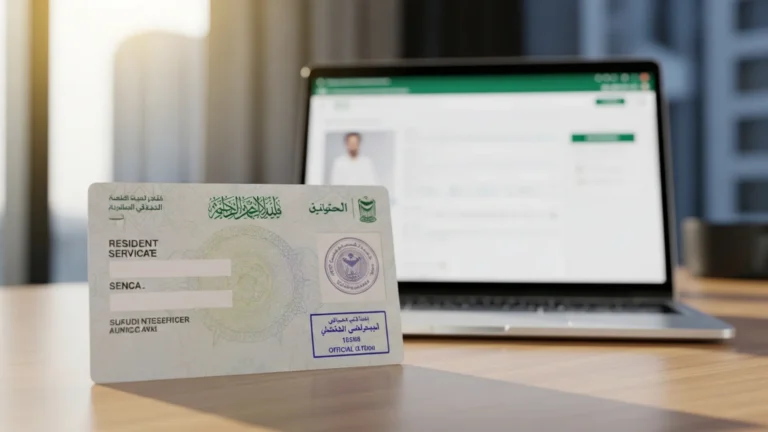
Renew Health Certificate Saudi: 2026 Balady Guide

To renew health certificate Saudi requirements in 2026, you apply through the Balady platform (balady.gov.sa), pass a municipal health examination at an approved centre, and pay an indicative SAR 100–200 fee per worker. The health certificate is valid for one year, renewal usually completes in 1–3 working days, and each food-handling employee needs their own card linked to the establishment’s commercial register.
What the Saudi health certificate actually is
The health certificate — commonly called the “health card” or Shahadat Sihiya — is a municipal document issued under the supervision of the Ministry of Municipal and Rural Affairs and Housing through the Balady platform. It confirms that a worker who handles food, drink, personal-care services or public-facing hygiene-sensitive work has passed a basic medical examination and a short health-awareness component.
It is not the same as a medical insurance card, not the same as the medical examination for an Iqama, and not the same as a professional practice licence. It is a workplace hygiene clearance tied to the establishment’s activity, and municipal inspectors check it during routine visits to restaurants, cafés, bakeries, groceries, salons, barber shops, gyms, laundries and catering kitchens.
Because the certificate is linked to both the individual worker and the establishment file, the renewal process touches three systems at once: Balady for the certificate itself, the commercial register held by the Ministry of Commerce, and the worker’s residency data verified through Absher and Muqeem. When any one of those three is out of date, the renewal stalls — which is why most rejected renewals are not medical at all, but administrative.
Who needs to renew health certificate Saudi rules cover
The requirement applies to workers whose job brings them into direct contact with food, beverages, or the human body. In practice, municipalities apply it to:
- Food and beverage staff — chefs, kitchen assistants, waiters, baristas, juice and shawarma preparers, bakery staff, butchers, and anyone plating or serving.
- Retail food handlers — grocery and supermarket staff working with fresh produce, dairy, meat or bakery counters.
- Personal-care workers — barbers, hairdressers, beauty-salon staff, spa and massage therapists, nail technicians.
- Hospitality and facilities staff — hotel housekeeping, laundry workers, swimming-pool and gym attendants.
- Catering and central kitchens — including staff serving schools, camps, hospitals and event caterers.
- Delivery riders handling food in several municipalities, depending on local rules.
Owners and partners who are physically present in the outlet are usually treated the same as employees. If you are a foreign investor opening a food or beauty concept, budget for a health card for every operational headcount, not just the manager. Our team covers this as part of company formation in Saudi Arabia, so the operating permits and staff cards land in the right order rather than being chased after the fit-out is finished.
When to renew: validity, grace and the inspection trigger
A Saudi health certificate is normally issued for one year from the examination date. Some municipalities issue shorter or longer terms for specific activities, so always read the expiry date printed on the card itself rather than assuming twelve months.
The practical rule most establishments follow is to start the renewal 30 days before expiry. That window gives room for a re-test if a lab result needs repeating, and it prevents the awkward situation where a municipal inspector visits while a card sits expired. An expired card can trigger a violation notice against the establishment — not the worker — and repeat findings escalate. Renewing early is by far the cheapest form of compliance.
Set a shared calendar for the whole team. Because staff join at different times, cards expire on scattered dates, and a single spreadsheet with name, Iqama number, card number and expiry date prevents almost every avoidable fine.
Step by step: how to renew health certificate Saudi workers hold
The renewal is completed through Balady. The screen names below reflect the current flow; Balady updates its interface periodically, so if a button is renamed, look for the equivalent wording in the same section.
- Sign in to Balady. Go to balady.gov.sa and choose Login. Authenticate with your National Single Sign-On (Nafath) credentials — the same identity you use for Absher. Establishment owners should log in with the account linked to the commercial register.
- Open the services menu. From the dashboard choose Services → Health Certificate Services (خدمات الشهادة الصحية). If you manage a business, switch the profile selector from “Individual” to your establishment before continuing.
- Select “Renew Health Certificate.” Choose the renewal option rather than “Issue New.” Renewal reuses the existing record and is faster; issuing new creates a duplicate that can confuse inspection records.
- Pick the worker. The system lists employees linked to your establishment file. If a worker does not appear, their labour record has not synced — check the employee list on Qiwa and their residency status on Muqeem before continuing.
- Confirm the activity and outlet. Select the branch and the licensed activity (restaurant, salon, bakery, etc.). The examination panel differs slightly by activity, so an incorrect selection means the wrong tests.
- Choose an approved examination centre. Balady shows accredited clinics and municipal health centres by city with available slots. Choose one near the outlet to reduce staff downtime.
- Pay the fee. The platform issues a SADAD invoice with a bill number. Pay through your bank app, online banking or an ATM. Payment usually reflects within minutes but can take a few hours.
- Attend the examination. The worker attends with their original Iqama or national ID and the appointment reference. The visit typically takes 20–40 minutes.
- Complete the health-awareness component. Many municipalities require a short food-safety or hygiene awareness module, delivered either at the centre or online, with a simple assessment at the end.
- Download the renewed certificate. Once results clear, the certificate appears under My Certificates in Balady as a downloadable PDF with a QR code. Print a copy for display and keep the digital copy in your HR file.
Documents and data you need before you start
Gather these before opening Balady — the form times out and losing a half-completed application is a common frustration.
- Iqama (residency ID) or Saudi national ID number for each worker, valid and not expiring within the renewal period.
- The existing health certificate number or a copy of the expiring card.
- Commercial register number of the establishment, active and confirmed with the Ministry of Commerce.
- Municipal licence number for the outlet (the Balady operating licence).
- Registered mobile number linked to Absher for OTP verification.
- Recent personal photograph in the format the platform requests, if the card image needs refreshing.
- Employee’s labour record visible on Qiwa and registered with GOSI — mismatched employer data is the single most common reason a worker fails to appear in the list.
If any worker’s Iqama expires before the health certificate would, renew the Iqama first. Iqama issue and renewal government fees run at roughly SAR 650 per year plus applicable levies (indicative — confirm current figures on the official portal), and the health certificate simply will not issue against an expired residency record.
Fees and timelines at a glance
The figures below are indicative and vary by municipality, activity and examination centre. Always confirm the exact amount on the SADAD invoice generated by Balady before paying.
| Item | Indicative cost (SAR) | Typical timeline | Portal / authority |
|---|---|---|---|
| Health certificate renewal (per worker) | 100 – 200 | 1 – 3 working days | Balady |
| Medical examination at approved centre | Often bundled in the fee; 50 – 150 if billed separately | Same-day visit, 20 – 40 minutes | Accredited centre |
| Health-awareness / food-safety module | 0 – 100 | 1 – 2 hours | Balady-approved provider |
| Municipal operating licence renewal | Varies by activity and area | 1 – 5 working days | Balady |
| Commercial register fee | 1,200 – 2,000 | Same day to 2 days | Ministry of Commerce / Saudi Business Center |
| Chamber of Commerce membership | 2,000 – 3,000 per year | 1 – 3 working days | Chamber of Commerce |
| Iqama issue / renewal (government fee) | ~650 per year + levies | Same day online | Absher / MHRSD |
| MISA investment licence issue / renewal | Fees suspended in 2026 (previously 12,000 / 62,000) | 3 – 10 business days | MISA |
| VAT on private-sector service invoices | 15% | Charged at invoice | ZATCA |
Two notes worth flagging. First, MISA licence issue and renewal fees are suspended in 2026, which meaningfully lowers the entry cost for foreign-owned food and retail concepts — details in our guide to the MISA licence in Saudi Arabia. Second, VAT is 15% and ZATCA’s Fatoora e-invoicing programme is rolling out in waves, so any clinic or service provider invoicing you should be issuing a compliant electronic invoice.
How the 2026 commercial register changes affect health-card renewals
The new Commercial Register Law took effect on 3 April 2026 and changed the paperwork layer underneath every municipal service, including health certificates. The headline changes:
- A unified national commercial register replaces the old head-office-plus-branch register structure — one CR covers the business nationwide.
- New CR identifiers begin with the digit “7.”
- The commercial register no longer carries an expiry date; instead businesses submit an annual confirmation of their data.
- A five-year grace period applies for transitioning existing registers.
- English trade names are now permitted.
Practically, this means the old failure mode — “my CR expired so Balady blocked everything” — is replaced by a new one: “I missed the annual confirmation.” Diarise the confirmation date the same way you diarise health-card expiries. You can check and confirm register data through the Ministry of Commerce and the Saudi Business Center.
If your CR still shows the legacy number and you are opening new branches, migrating to the unified register early tends to smooth municipal and labour transactions rather than waiting out the grace period.
Renewing for a whole team: the bulk approach
Single-outlet owners renew one card at a time. Groups with 20+ food handlers should treat it as a scheduled operational task.
Build a rolling register
Keep one sheet per branch with: employee name, Iqama number, Qiwa job title, health-card number, issue date, expiry date, examination centre, and a status column. Sort by expiry and review it on the first working day of every month.
Batch appointments
Book several workers into the same examination centre on the same morning. Split the team across two days so the outlet keeps trading — most municipalities do not require the whole shift to attend together.
Keep labour data clean upstream
Most bulk-renewal failures trace back to labour records, not medicine. Before a renewal cycle, reconcile three lists: the employee roster on Qiwa, the residency list on Muqeem, and the contribution list on GOSI. GOSI contributions for a Saudi employee total roughly 21.5% across employer and employee shares (indicative — confirm current rates on the GOSI portal), and a worker missing from GOSI often signals a wider registration gap that will surface in Balady too.
Assign one owner
Give one person — usually the branch manager or HR coordinator — named responsibility for the register. Distributed responsibility is how expiry dates get missed.
What happens if the certificate has already expired
If the card has lapsed, the fix is the same process, done immediately: log in to Balady, select renewal, pay, and attend the examination. There is no separate “late” pathway to find. Where an expiry has run long, some municipalities require issuing a fresh certificate rather than renewing the old record — the platform will indicate which option is available.
Practical steps while the renewal is in progress:
- Move the affected worker to a non-food-contact task until the new certificate issues, if the rota allows.
- Keep the SADAD payment receipt and the appointment confirmation on file — they evidence that renewal is under way.
- Complete the examination at the earliest available slot rather than the most convenient one.
- Download and display the new certificate as soon as it appears in Balady.
Municipal fines for compliance findings are set locally and vary by activity and severity, so any figure quoted online should be treated as indicative only; confirm the current schedule on the official portal or with the municipality directly.
Checking and verifying a health certificate
Verification matters in two directions: you verify your own team’s cards, and inspectors or franchise partners verify yours.
- In Balady — the My Certificates or establishment services section lists every active certificate linked to the register, with status and expiry.
- By QR code — issued certificates carry a scannable code that resolves to the official record. This is the fastest check during an inspection.
- Through the Balady app — the mobile app mirrors the portal and is convenient for branch managers who need to pull a card quickly.
- Cross-check the worker’s status on Muqeem for residency validity and Absher for identity data, so you catch an expiring Iqama before it blocks the next renewal.
Print and display cards where the municipality expects them — typically visible in the food-preparation area. A valid certificate that nobody can produce during an inspection creates the same friction as a missing one.
Common mistakes to avoid
- Choosing “Issue New” instead of “Renew” — creates a duplicate record and slows verification later.
- Starting the renewal with days to spare — leaves no room for a repeat test or a payment that has not yet reflected. Start 30 days out.
- Ignoring the Iqama expiry — a health certificate cannot be issued against an expired or near-expired residency record. Renew the Iqama first.
- Missing the annual commercial-register confirmation under the 2026 unified-CR rules — the register no longer expires, but an unconfirmed record still blocks municipal services.
- Selecting the wrong activity in the Balady form — a salon selected as a restaurant produces the wrong examination panel and a wasted appointment.
- Paying the SADAD invoice and stopping there — payment is not completion; the examination and the awareness module still have to happen.
- Leaving workers off Qiwa or GOSI — if the employee is not properly linked to the establishment, they will not appear in the Balady selection list at all.
- Keeping only a paper copy — cards get damaged or lost; always keep the PDF from Balady in a shared HR folder.
- Assuming one card covers several branches — confirm branch linkage in the platform, especially after migrating to the unified register.
- Renewing without checking the municipal operating licence — an outlet licence lapsing quietly is a common companion problem discovered only at inspection.
How the health certificate fits your wider Saudi compliance calendar
For an operating business, the health card is one line in a broader annual rhythm. A simple compliance calendar for a food or personal-care establishment usually contains:
- Monthly — GOSI contributions, payroll through the wage protection process on Qiwa, VAT or quarterly VAT filing with ZATCA depending on turnover.
- Rolling — health certificates by worker expiry date; Iqama renewals via Absher; work-permit renewals via Qiwa and MHRSD.
- Annual — commercial-register confirmation with the Ministry of Commerce, Chamber of Commerce membership, municipal operating licence, Saudisation (Nitaqat) band review on Qiwa, and the MISA investment licence for foreign-owned entities.
- As needed — trademark and activity additions through the Saudi Business Center, government tenders via Etimad, SME support programmes via Monsha’at, and any commercial documentation through Najiz.
Vision 2030’s digital-government programme has pulled most of these services into unified online platforms, which is genuinely good news for operators: what once meant several counter visits is now a handful of logins. The trade-off is that each platform expects the others’ data to be current, so one stale record can ripple across several services.
How Noble Core helps
Noble Core Ventures works with foreign and local investors setting up and running businesses in the Kingdom. On the health-certificate side, we handle it as part of the wider operating-compliance package rather than as a standalone errand:
- Compliance calendar build — we map every expiry across CR, municipal licence, health cards, Iqamas and work permits into one tracker your branch managers can actually use.
- Balady and municipal filings — new issuance and renewal of health certificates, operating-licence applications, and activity corrections.
- Labour-file hygiene — reconciling Qiwa, Muqeem and GOSI so employees appear correctly in every government system before you need them to.
- Entity work — MISA licensing, commercial registration, Chamber membership and bank-account opening, delivered end to end via Noble Core’s commercial registration service.
- Tax and payroll setup — ZATCA registration, e-invoicing readiness under Fatoora, and GOSI enrolment.
Full company-formation packages start from SAR 36,999, and with MISA licence issue and renewal fees suspended in 2026, the arithmetic for entering the Saudi market has rarely been more favourable. If you are opening a restaurant, café, bakery, salon or retail food concept, tell us the headcount and the city and we will map the health-certificate load alongside the licensing timeline so nothing surfaces as a surprise on inspection day.
Need help setting up in Saudi Arabia? Noble Core handles your MISA licence, commercial registration, and visas end-to-end — done right the first time.
Frequently Asked Questions
How do I renew health certificate Saudi workers hold?
Log in to the Balady platform at balady.gov.sa using Nafath, open Health Certificate Services, choose Renew Health Certificate, select the worker and branch, pick an approved examination centre, pay the SADAD invoice, then attend the medical examination. The renewed certificate appears as a downloadable PDF under My Certificates, typically within one to three working days.
How much does it cost to renew a health certificate in Saudi Arabia?
The indicative cost is around SAR 100 to 200 per worker, with the medical examination often bundled into that fee. Where the examination centre bills separately, expect roughly SAR 50 to 150 more. Amounts vary by municipality, activity and centre, so confirm the exact figure on the SADAD invoice generated by Balady before paying.
How long is a Saudi health certificate valid?
A Saudi health certificate is normally valid for one year from the examination date, though some municipalities issue different terms for specific activities. Always check the expiry date printed on the card itself rather than assuming twelve months. Best practice is to begin the renewal about 30 days before expiry to allow for repeat tests or payment delays.
What documents do I need to renew health certificate Saudi requirements ask for?
You need the worker’s valid Iqama or national ID number, the existing health certificate number, the establishment’s commercial register number, the Balady municipal licence number, a mobile number registered on Absher for OTP verification, and a recent photograph if the card image needs updating. The employee must also appear correctly on Qiwa and GOSI.
Who needs a health certificate in Saudi Arabia?
Anyone whose work involves direct contact with food, beverages or the human body needs one. That covers chefs, kitchen staff, waiters, baristas, bakery and butchery workers, grocery food handlers, barbers, hairdressers, beauty and spa staff, hotel housekeeping, laundry workers, gym and pool attendants, and catering teams. Owners physically working in the outlet are usually treated the same as employees.
What happens if my Saudi health certificate expires?
An expired card can trigger a municipal violation notice against the establishment during an inspection. The remedy is to renew immediately through Balady using the same process; where the lapse has run long, the platform may require issuing a fresh certificate instead. Keep the SADAD receipt and appointment confirmation on file as evidence the renewal is under way.
Can I renew a health certificate in Saudi Arabia online?
Yes. The application, worker selection, centre booking and payment are all completed online through balady.gov.sa or the Balady mobile app, and the finished certificate is downloaded as a PDF with a QR code. The only in-person element is the short medical examination at the approved centre, which usually takes 20 to 40 minutes.
Does the 2026 commercial register law affect health certificate renewal?
Indirectly, yes. From 3 April 2026 a unified national commercial register applies, new CR numbers begin with 7, and the register no longer expires but requires an annual data confirmation, with a five-year grace period and English trade names now permitted. Municipal services including health certificates expect a current, confirmed register record.