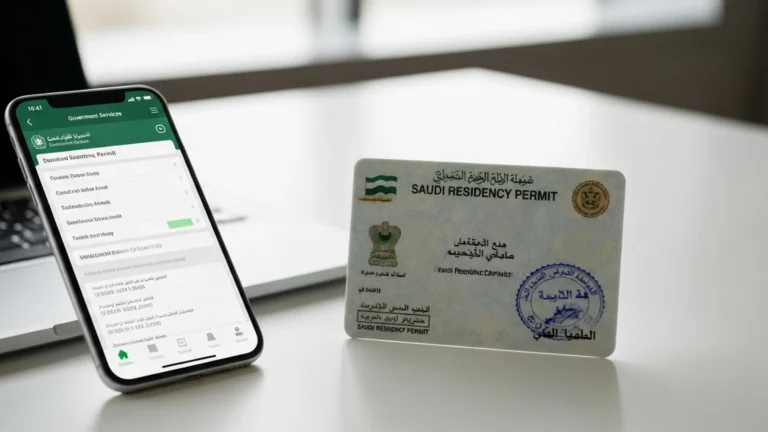
Enjaz for Organizations Saudi: 2026 Visa Guide

Enjaz for organizations Saudi is the corporate visa platform run under the Ministry of Foreign Affairs at visa.mofa.gov.sa, where licensed companies apply for and pay for work and business visit visas. A typical block work-visa authorisation is processed in roughly 2–5 business days after payment, government visa fees are commonly in the SAR 2,000–7,000 range per visa depending on category, and organisations complete each request across about 6 on-screen steps before printing the visa authorisation.
What “Enjaz for organizations Saudi” actually means
“Enjaz” is the government e-visa service delivered through the Ministry of Foreign Affairs (MOFA) at visa.mofa.gov.sa. There are two audiences on the platform. Individuals use Enjaz to lodge visit and business visa applications, usually through an approved travel agency. Organisations — companies, factories, contractors and consultancies registered in the Kingdom — use the corporate side of the platform to issue work visas, business visit visas and to manage the visa quota (block visas) approved for their establishment.
When people search for “enjaz for organizations Saudi” they usually mean the corporate login and workflow that lets a registered employer request an entry visa for a worker or business visitor, pay the government fee online, and print the visa authorisation that is then stamped by the Saudi embassy abroad. It sits alongside other government platforms — the labour side runs through Qiwa and MHRSD, residency runs through Muqeem and Absher — but the visa issuance and payment layer is Enjaz/MOFA.
It helps to think of the Kingdom’s business systems as a relay rather than a single window. The Ministry of Commerce and the Saudi Business Center establish that your company legally exists. The Ministry of Investment (MISA) confirms that foreign shareholders may own and operate it. The labour system decides how many foreign workers you may bring in. And only then does Enjaz turn an approved allocation into a concrete, printable visa for a named person. Understanding where Enjaz sits in that relay is what stops organisations from opening the visa platform too early and hitting a wall of greyed-out buttons.
Enjaz has been the public face of Saudi visa issuance for well over a decade, and while the branding and screens have been modernised in line with Vision 2030’s digital-government drive, the core corporate function has stayed consistent: a registered establishment, acting as sponsor, requests and funds an entry visa for a foreign national it intends to employ or host. Every visa issued this way is tied back to your establishment record, which is why the accuracy of that underlying record matters so much.
Who needs the Enjaz organisation account
You need corporate access to Enjaz if your establishment intends to bring foreign nationals into Saudi Arabia for employment or business. In practice that includes:
- Companies with a MISA (Ministry of Investment) licence hiring foreign staff for the first time.
- Established employers issuing new block (work) visas against an approved quota.
- Businesses inviting overseas partners, engineers or auditors on a commercial business visit visa.
- Contractors and factories staffing large projects who manage visas in volume.
If you are still forming the entity, the visa layer comes later in the journey. Foreign investors typically secure the investment licence first — our guide to the MISA licence in Saudi Arabia explains that stage — then the Commercial Register, then labour and visa quotas, and only then do you use Enjaz to issue individual visas.
There is also an important distinction between the two Enjaz experiences. An individual traveller applying for a tourist or personal visit visa usually goes through an approved travel agency that holds its own Enjaz agency access. A company issuing work visas for its own staff uses establishment access tied directly to its Commercial Register. These are genuinely separate accounts with separate permissions, and confusing them is one of the most common early stumbling blocks — an agency login will never show you your corporate quota, and your establishment login is not designed for one-off tourist applications.
Volume matters too. A consultancy hiring one specialist engineer a year has very different needs from a contracting firm mobilising two hundred workers for a Vision 2030 infrastructure project. Both use the same Enjaz platform, but the larger employer will lean heavily on well-maintained quota records, a healthy Nitaqat band and disciplined document control, because at scale even a small error rate translates into dozens of stalled visas.
Before you log in: the prerequisites
The Enjaz corporate workflow assumes several things are already in place. Missing any one of them is the single most common reason an application stalls.
- A valid Commercial Register (CR). Under the new Commercial Register Law effective 3 April 2026, establishments hold a unified national CR whose identifier begins with “7”, carries no expiry date, and is maintained through an annual confirmation rather than a renewal. Register and manage the CR through the Saudi Business Center and the Ministry of Commerce.
- An approved visa quota. Work-visa allocations are approved via the labour system (MHRSD/Qiwa) at qiwa.sa before Enjaz will let you issue against them.
- Saudization (Nitaqat) compliance. Your establishment’s Nitaqat band affects what and how many visas you can issue.
- GOSI registration. Employers register with the General Organization for Social Insurance at gosi.gov.sa; total contributions run at roughly 21.5% for a Saudi employee (employer and employee shares combined).
- A funded payment method for the online government fees.
Step-by-step: how to use Enjaz for organizations Saudi
The exact labels shift as MOFA updates the interface, but the corporate flow to issue a work or business visa follows this sequence. Always confirm the live screens on the official portal.
- Open the visa platform. Go to visa.mofa.gov.sa and choose the corporate / establishment login rather than the individual applicant path.
- Authenticate the establishment. Sign in with your establishment credentials linked to your CR and unified national number. Many actions are cross-verified with the labour and Muqeem systems.
- Select “Issue Visa” and the visa type. Pick the correct category — block work visa, business visit, or family visit for an employee’s dependents. Choosing the wrong category is a frequent, costly mistake.
- Enter the beneficiary details. Add the applicant’s full name (exactly as printed in the passport), nationality, passport number, profession/occupation, and the border/embassy where the visa will be collected. The profession must match the job title approved in your labour quota.
- Confirm quota and generate the request. The system deducts the visa from your approved allocation and produces a visa request reference number.
- Pay the government fee online. Settle the visa fee and any applicable charges through the portal’s payment gateway. Keep the payment receipt.
- Print the visa authorisation. Download and print the Enjaz visa slip, then forward it to the beneficiary so they can complete embassy stamping abroad.
For a business visit visa the flow is similar but shorter — there is no quota deduction; you enter the invitee, the purpose, and the sponsoring establishment, pay, and print the invitation/visa authorisation.
A few practical habits make this sequence far smoother. Keep a scanned, high-resolution copy of every beneficiary’s passport data page on hand so you can transcribe details without guessing. Decide the correct profession title in advance by checking exactly how it is worded in your labour quota, because Enjaz will not accept a free-text job description that drifts from the approved list. And where the platform offers a save-and-resume option, use it — a half-completed request that times out mid-session is easy to lose track of, and starting again risks entering conflicting data. For high-volume employers, appointing one trained coordinator to own the Enjaz workflow, rather than spreading it across several people, dramatically reduces mismatched entries.
After the visa is issued
Once the worker enters the Kingdom, the residency clock starts. Within the statutory window you must convert the entry into an Iqama (residency permit) and register the worker on Muqeem and Absher Business. Iqama issue and renewal government fees run at roughly SAR 650 per year plus applicable levies — indicative figures; confirm current amounts on the official portal.
Required documents and IDs
Have the following ready before you start a request on Enjaz for organizations Saudi. Exact requirements vary by visa category and nationality.
- Establishment Commercial Register number (the new “7”-prefixed unified national CR).
- Unified national number and MISA licence number (for foreign-owned entities).
- Approved labour visa quota reference from Qiwa/MHRSD.
- Beneficiary’s passport (valid at least six months) with a clear machine-readable page.
- Applicant’s profession/occupation matching the labour authorisation.
- Chamber of Commerce membership details where the category requires attestation.
- A recent passport photograph meeting embassy specifications.
- For business visits, an invitation letter and, where required, a Chamber-attested letter.
Enjaz fees and timelines table (2026, indicative)
The figures below are indicative planning numbers drawn from the wider setup process. Government visa fees vary by category, nationality and duration, and levies change periodically, so treat these as a guide and confirm the exact charge on the official portal at checkout.
| Item | Indicative fee (SAR) | Typical timeline |
|---|---|---|
| MISA investment licence (issue/renew) | Fees suspended in 2026 (previously 12,000 / 62,000) | ~3–10 business days |
| Commercial Register (Saudi Business Center) | ~1,200–2,000 | 1–3 business days |
| Chamber of Commerce membership (annual) | ~2,000–3,000 | Same/next day |
| Block work visa — government fee (per visa) | ~2,000–7,000 (category-dependent) | 2–5 business days after payment |
| Business visit visa (per visa) | ~300–2,000 (indicative) | 1–3 business days |
| Iqama issue/renewal (per year) | ~650 + applicable levies | Same day online |
| GOSI contribution (Saudi employee) | ~21.5% of wage (employer + employee) | Monthly |
VAT of 15% applies to relevant professional and service charges, and ZATCA e-invoicing (Fatoora) is rolled out in waves — see zatca.gov.sa. All figures above are indicative; confirm current figures on the official portal.
How Enjaz connects to the other government platforms
Enjaz does not work in isolation. A single foreign hire touches several Saudi authorities, and understanding the map prevents duplicated effort:
- MOFA / Enjaz — issues and prices the entry visa (visa.mofa.gov.sa).
- MHRSD & Qiwa — approve the labour visa quota and manage work permits and contracts.
- Muqeem & Absher Business — handle Iqama, exit/re-entry and residency once the worker arrives.
- Ministry of Commerce & the Saudi Business Center — hold the Commercial Register that authenticates the establishment.
- MISA — licenses the foreign investment that permits up to 100% foreign ownership in most activities.
- GOSI — registers the worker for social insurance; ZATCA handles VAT and e-invoicing; Monsha’at supports SMEs.
Because these systems cross-check one another, an error in the CR profession list or an unpaid GOSI balance can quietly block a visa on Enjaz even when the visa screen itself looks fine.
This integration is a strength once you understand it. A single, accurate establishment record propagates cleanly across MOFA, Qiwa, Muqeem and GOSI, so a well-prepared employer can move from quota approval to a printed visa authorisation in days. The flip side is that fragmented or outdated data anywhere in the chain surfaces as an unexplained block somewhere else. When an Enjaz request refuses to proceed and the visa screen gives no obvious reason, the fault is almost always upstream — a Commercial Register that has not completed its 2026 annual confirmation, a profession that was never added to the labour file, or a Nitaqat band that slipped after a Saudi employee left. Diagnosing these means checking the source system, not retrying the visa screen.
Keeping the establishment file healthy
Ongoing compliance keeps Enjaz working predictably. Under the 2026 Commercial Register framework, establishments confirm their CR annually rather than renewing it, and there is a five-year grace period built into the transition, but skipping the annual confirmation can still flag your record. English trade names are now permitted alongside Arabic, which simplifies matters for foreign groups. Chamber of Commerce membership, typically around SAR 2,000–3,000 per year, needs to stay current where your visa categories require attestation, and GOSI contributions must be settled monthly. Treating these as routine housekeeping, rather than emergencies to fix when a visa fails, is the single biggest predictor of a frictionless Enjaz experience.
Common errors and how to fix them
Most rejected or stuck Enjaz requests trace back to a small set of avoidable issues:
- Name mismatch. The beneficiary name must match the passport character-for-character. Any deviation triggers rejection at the embassy stage.
- Wrong profession. The occupation on the visa must match the approved labour quota; a mismatch fails the cross-check with Qiwa.
- Exhausted quota. If the “issue visa” button is greyed out, your approved allocation is used up — request more capacity via the labour system first.
- Nitaqat band restriction. A lower Saudization band limits new visa issuance until the band improves.
- Payment not settled. The authorisation will not print until the fee clears; keep the receipt reference.
- Passport validity. Passports with under six months’ validity are commonly refused.
Common mistakes to avoid
- Starting the visa step before the Commercial Register and labour quota are fully active.
- Assuming individual Enjaz (agency) access is the same as corporate establishment access — they are separate logins.
- Selecting the wrong visa category and paying a non-refundable fee.
- Letting the entry visa lapse before converting it to an Iqama on Muqeem/Absher.
- Overlooking GOSI registration and 15% VAT obligations that surface later.
- Treating indicative fees as final — always confirm the live amount on visa.mofa.gov.sa before paying.
- Ignoring the 2026 Commercial Register changes (unified “7”-prefixed CR, annual confirmation) that affect how your establishment data is validated.
How Noble Core helps with Enjaz and Saudi visas
Navigating Enjaz for organizations Saudi is straightforward once the underlying establishment file — CR, MISA licence, labour quota, GOSI and Chamber membership — is correctly built and synchronised across platforms. That upstream work is where most delays originate, and it is exactly what we handle end to end.
Noble Core supports foreign investors and Saudi employers from entity formation through to issuing the first visa. Our company formation service in Saudi Arabia stands up the licence, Commercial Register and government portal access, while Noble Core’s visa and Iqama service manages quota approvals, Enjaz issuance, and Iqama conversion so your team arrives without avoidable hold-ups. Packages start from SAR 36,999, and every fee we quote is reconciled against the current official figures before you commit.
Whether you are issuing a single business visit visa or staffing a project across dozens of workers, aligning the paperwork before you open the visa platform is the difference between a 2–5 day turnaround and weeks of back-and-forth.
We also keep clients current on the moving parts. The 2026 Commercial Register reforms, the suspension of MISA licence issue and renewal fees, the phased rollout of ZATCA e-invoicing and periodic changes to visa levies all affect the real cost and timing of bringing a worker into the Kingdom. Rather than relying on a figure that was accurate last year, we reconcile each quote against the live official portals — visa.mofa.gov.sa for the visa fee, the Saudi Business Center for the Commercial Register, and GOSI for social-insurance contributions — before it reaches you. That means fewer surprises at the payment screen and a plan you can actually budget against.
In short, Enjaz for organizations Saudi is not complicated once the foundations are right; it is the foundations that reward attention. Get the Commercial Register, MISA licence, labour quota, GOSI and Chamber records accurate and synchronised, and the visa platform becomes the quick final step it is meant to be. If you would like that groundwork handled for you — and the visa issued without avoidable delay — Noble Core can take it from first licence to first arrival.
Need help setting up in Saudi Arabia? Noble Core handles your MISA licence, commercial registration, and visas end-to-end — done right the first time.
Frequently Asked Questions
What is Enjaz for organizations Saudi?
Enjaz for organizations Saudi is the corporate side of the Ministry of Foreign Affairs visa platform at visa.mofa.gov.sa. Registered establishments use it to issue and pay for work (block) visas and business visit visas for foreign nationals, deducting them from an approved labour quota and printing the visa authorisation for embassy stamping abroad.
How do I log in to Enjaz as a company?
Go to visa.mofa.gov.sa and choose the corporate or establishment login rather than the individual applicant path. Sign in with credentials linked to your Commercial Register and unified national number. The system cross-checks your labour and residency records, so your CR, Qiwa quota and GOSI registration must be active before login unlocks visa issuance.
How much does an Enjaz work visa cost in 2026?
Government block work-visa fees are indicative at roughly SAR 2,000–7,000 per visa, varying by category, nationality and duration, with levies changing periodically. Business visit visas are lower, around SAR 300–2,000. These are planning figures only; always confirm the exact charge on the official portal at checkout before you pay, as fees are non-refundable.
How long does an Enjaz visa take to process?
A block work-visa authorisation is typically processed in about 2–5 business days after the government fee is paid, while a business visit visa often clears in 1–3 business days. Delays usually come from upstream issues such as an inactive Commercial Register, an exhausted quota, or a profession mismatch rather than the Enjaz visa screen itself.
What documents do I need for Enjaz for organizations Saudi?
You need your unified national Commercial Register number, MISA licence number for foreign-owned entities, an approved Qiwa labour quota reference, the beneficiary’s passport valid at least six months, the applicant’s profession matching the labour authorisation, a compliant passport photograph, and for business visits an invitation letter. Chamber of Commerce attestation applies to some categories.
Is Enjaz the same as Absher, Muqeem and Qiwa?
No. Enjaz (MOFA) issues and prices the entry visa. Qiwa and MHRSD approve the labour quota and work permits. Muqeem and Absher Business handle the Iqama, residency and exit or re-entry once the worker arrives. They cross-check each other, so an unpaid GOSI balance or wrong CR profession can block a visa on Enjaz even when the visa screen looks fine.
Do I need a Commercial Register before using Enjaz?
Yes. A valid Commercial Register is a prerequisite. Under the new Commercial Register Law effective 3 April 2026, establishments hold a unified national CR whose identifier starts with 7, has no expiry, and is maintained through an annual confirmation. Register and manage it through the Saudi Business Center and Ministry of Commerce before issuing any visa on Enjaz.
How can Noble Core help with Enjaz visas?
Noble Core builds and synchronises the establishment file that Enjaz relies on — CR, MISA licence, labour quota, GOSI and Chamber membership — then manages quota approvals, Enjaz visa issuance and Iqama conversion end to end. Packages start from SAR 36,999, and every fee is reconciled against current official figures before you commit, avoiding the delays that stall most applications.